An excellent photographer and teach, David duChemin, recently wrote piece on on optical sharpness. This prompted me to write a comment to his post. What I wrote got me to thinking that I had just written a weblog post of my own, with some editing and expansion, of course. So, I will post my comment here and then expand a little, maybe.
It is OK, OM (abbreviation for /Old Man/ that radio amateurs use as a term of endearment), for you to be salty and rant a bit. In fact, I think you you and I would have a good time together sitting around the campfire with a beer. We are at the top of our game although in different fields. And I am often sufficiently salty for both of us, enough so that my closest colleagues call me Doc Salty. 😉
I might go a step further and say that our current crop of lenses are *too sharp*, to the point fo being clinically sharp. It is a reason I gravitate toward those lenses that are less so, such as the older Fujinon 35mm f/1.4 or the 18mm f/2. They might be a little softer or less perfect optically. Heck, I even shoot legacy glass on an A7iii using adapters. The old designs, like the planar, sonnar, any of the double Gauss formulae, etc produce some interesting results of common subjects when shot wide open. The current parlance is to say they have /character/ (same as this old man).
After reading probably hundreds of lens reviews over my lifetime, the poster is probably correct. Most optical formulae are at their sharpest, optically, a couple stops down from wide open. If optical sharpness is the only goal, then by all means shoot at the aperture that provides that result. I don’t follow that advice and never have because, as you say, the scene will demand an aperture (likely) that captures the mood. Furthermore, back in the old days, one would have a choice of only a few apertures (unless on a tripod) because the film speed impacted the combinations of shutter speed and aperture that was available for a particular subject.
The only real optical limitation that I can think of that *might* impact a capture is diffraction. I rarely shoot at apertures smaller than f/16, but even at f/11 the airy disc is getting big enough on small sensors that pixel peepers will notice (or a larger print) will make the result softer than I might like (unless that is the goal). There is an argument for using larger media. (I need me a large format field camera! 😉
Sharpness is fine and useful but is never the goal. I’m on board with you, OM, and consistently looking for an image that makes me want to come back again and again because it grabs me somehow.
I don’t make many of them. But, I am only shooting for me because the process of seeing and then applying the camera feeds my soul. I don’t care if anyone likes my images because they aren’t for them, they are for me. If I happen to share an image that makes someone else take a breath, God bless them for He has blessed me with the process.
Here’s to the campfire, OM, and 73 (which is /best regards or wishes/ in ham speak).
Yes, that is a long comment to a weblog post! However, I often write here about cameras and lenses and am one that bemoans the emphasis on clinical sharpness of image quality. There are reasons, beyond status, why Leica still sells cameras and lenses. Of course, there is something about owning a legendary marque. (Remember that I used to drive and ride BMWs. There were reasons beyond the marque that kept me coming back to those vehicles.) But beyond that there are practical reasons why those who run Leicas run them.
Lenses from the major manufacturers are almost all sharp. Some produce sharper images than others in their lineup. The major third-party manufacturers also offer high performance optics (thinking Sigma at the moment). In many ways, I think that optics are developed to a point that, with some exceptions, just about any lens from the major manufacturers that one might use is plenty sharp.
So, although I agree with the post that triggered duChemin is generally correct — camera lenses are generally sharpest about two stops down from maximum aperture — the fact is irrelevant to producing beautiful or moving images.
I am technically inclined and have spent time fussing over MTF charts looking for the best glass. I think I am done with chasing that particular unicorn. I also think I might not be replacing equipment that I have, for the most part. I have some lovely cameras, both analog and digital. I have more lenses that I can ever use. I think that my focus should be on going out and finding interesting things to photograph. Then bring the captures home, review them, and make the adjustments needed to bring out the best of what I saw.
I do not care much anymore about chasing perfection (in my equipment). Everything that I have is good enough. There will remain (of course) that element of my personality that likes to try new things. But, I can satisfy that itch by playing with vintage glass with the Sony A7iii. Most of those lenses are not expensive.
I also think duChemin is right and his rant was rather fun.
I remain grateful. Life is good.
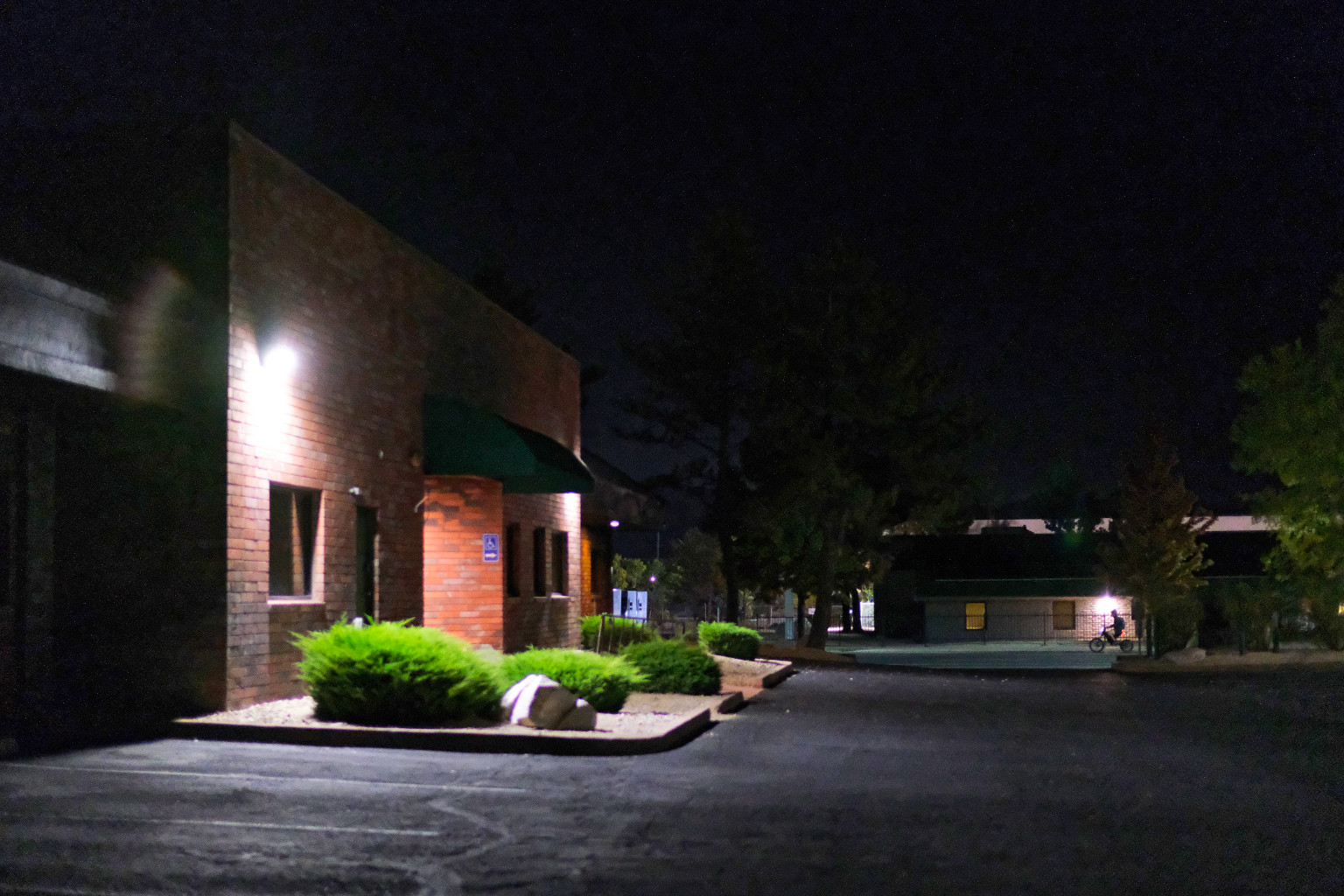
N.B. The header image is a capture I made while walking The Girl a little late one evening. I had a late supper with a best friend and so we walked after dark. I mounted the Voigtlander 35mm f/0.9 Nokton lens on the X-Pro3 (it is a beastly lens and also special purpose) and carried that for some night photography. I need to turn down the electronic viewfinder brightness for night work as my right eye was quite dazzled. But, I made a few captures that demonstrates something of the quality of the lens. It is not super sharp (Ha!) wide open, but does have plenty of character. It will be fun working this lens a bit more.