Parks on the Air: Washoe Lake SP, 16-17 February 2025 AAR

The Yaesu FT-897D transceiver used for the day’s activation of Washoe Lake State Park. Although a legacy radio, it is still capable.

Sunday morning came gray, threatening rain and wind. I woke late for me, about 0700h, but I felt better than I have in a while. I think I slept better for a couple of nights. That does make a difference.

I had talked to friends about possible activating Prison Hill, a low-point Summit (on the Air) hill that would be my first SOTA activation of 2025. But it was raining at 0800h so I thought maybe not.

I was engrossed in my coffee and in working on my Winlink/Digirig/VARA install on my station computer. After months of no attention, nothing worked anymore. Thank you, Microsoft. It is likely that there were more than one updates that resulted in a reset of the sound settings.

Why do I say this? Well, the settings I remember establishing for the Digirig were gone. I did not change them. No one else has access to the computer. Induct.

But with the help from another ham, who wrote an excellent how-to, the process was relatively straightforward and I had Winlink, the Digirig, and VARA FM talking once again. I was able to exchange email with the local Winlink gateway. It was not long before I had VARA HF talking to the Elecraft K3 and then WSJT-X and JS8Call followed.

So, I made another mug of coffee and some hot cereal for breakfast. That left me at about 0930h and the rain was gone and the Sun was shining. I decided to get out for an outing and maybe play some radio.

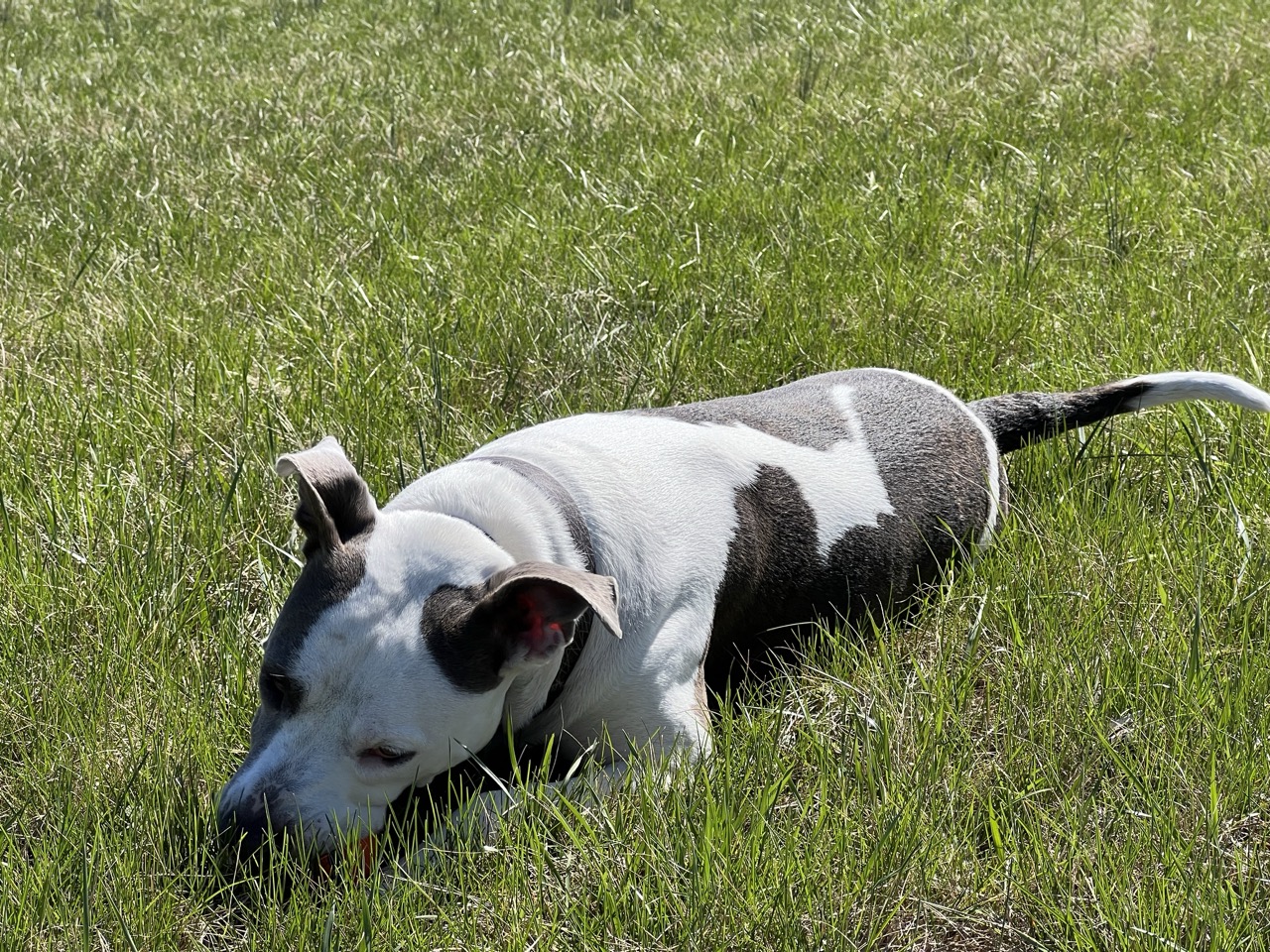
The Girl has not been out of the house but for the backyard to eliminate and to the vet for checks since her knee surgery about a month ago. She has asked to go with several times of late. I decided to take her with because she could be with me in the rig while I operated the radio and I could get her out for a little walk without endangering her knee.

Spooner Lake SP was full of tourists and we had enough snow that there was no good place to operate. So, grumpily, we headed back down the hill. I decided to go to Washoe Lake SP and play there.

What I did not know is that the wind was howling through Washoe Valley. The warning signs prohibiting high-profile vehicles were flashing. When we got the our operating point off Bellevue Road, I could barely stand to deploy the antenna.

I elected to use the Chameleon MPAS 2.0 in the vertical mode. I drove the spike well into the wet ground, affixed the counterpoise and matching transformer, then deployed the mil-extension and whip. The antenna leaned about 30-degrees under wind pressure.

I retrieved the Yaesu FT-897D from its case and the support equipment for it. This legacy radio is old, but I have 300Hz and 2.3KHz filters in it and it works very well. Plus there is not a lot of fiddling with cables and such. I also know how to run the rig.

Everything took longer than usual — a factor of the wind and the length of time since I last setup the portable station. But, after about 20 minutes, I had the station assembled and was ready to operate.

So, I said goodbye to Older Son and started hunting other activators. I used HAMRS on my iPhone for logging as well as reading spots from the POTA website. I made a couple of contacts and then started looking for an open frequency on the 20-meter band.

I landed on 14.290MHz in the phone portion of the band and called a couple of times to see if the frequency was in use. In between calls, I started a spot for myself on the POTA website. Hearing nothing, I pressed the spot button and started calling.

It took only a few minutes before the first few calls started coming in. For the first few minutes it was a steady stream, but no pile-up. Then ka-blooey! the frequency blew up and I spent nearly the next three hours working a huge pile-up. Sometimes there were so many calls I could not get even a fragment of a call sign.

I did not move from the frequency or change modes for about three hours. At the end of that time I had 206 contacts in the log. At the end, the calls trailed off. A last call brought a few more. Then the frequency went quiet. I offered my thanks and indicated I was ending my occupation of the frequency (QRT).

I shut down the radio, made a photograph, and then got out and began recovering the station. The wind had abated some so it was not as bad as when I deployed the station. But it was also cooler and the Sun had fallen behind the Sierra.

Once the station was put away, I got The Girl out and we walked around the site. She sniffed, peed, and pooped and had a good time. It is good for her to exercise her leg. She lost a lot of muscle mass from the starboard hip. It will take time for her to recover that.

With that out of the way, I picked her up and put her in the rig. Then I clambered in myself, started it up, and called my buddy in Montana. We both marveled at the run.

As usual, I learned a few things.

  • Deploying a portable station is a skill. I had no problem with the setup. I had everything needed in the rig with me. But, I was not as efficient as normal. That is a lack of practice.
  • When my deployment skills are fresh, I can deploy that station (FT-897 and Chameleon MPAS) in about ten minutes. This deployment took between 20 and 30 minutes.
  • My code skills might be a little slower than they were when I last ran a frequency. But I was still able to copy the callsigns and exchanges at 18wpm.
  • The mental game was pretty challenging. I had so many callers, sometimes five or more at the same time. During some of the busiest periods I could not even get a fragment of a call sign. Fortunately, if I just waited someone would put out their call sign in the clear.
  • That gave me an opportunity to pull one caller off the pile, work him (or her), and then let everyone know I was ready to take another call. (I called QRZ.)
  • The 20m band was hot and had legs. It was unusually busy and I was hearing callers from Southern California and Oregon. Normally those are harder areas to work. Arizona, Washington, Utah, Colorado, and New Mexico were LOUD.
  • My noise floor was between S4 and S5, which is quite high for the location. There was some noise on the band. There was also some fading at times.
  • Recovery of the station took a little longer than I wanted. But, I was mentally tired after all that work. It was a good kind of tired.
  • I am well on my way to a second Kilo at Washoe Lake SP. That surprised me.
  • It was a good day, despite the wind. I was shocked at how busy I was.

It was a very good day. I am grateful. Life is good.

Most of the contact map for my activation of Washoe Lake State Park, US-2640.

A Little Radio

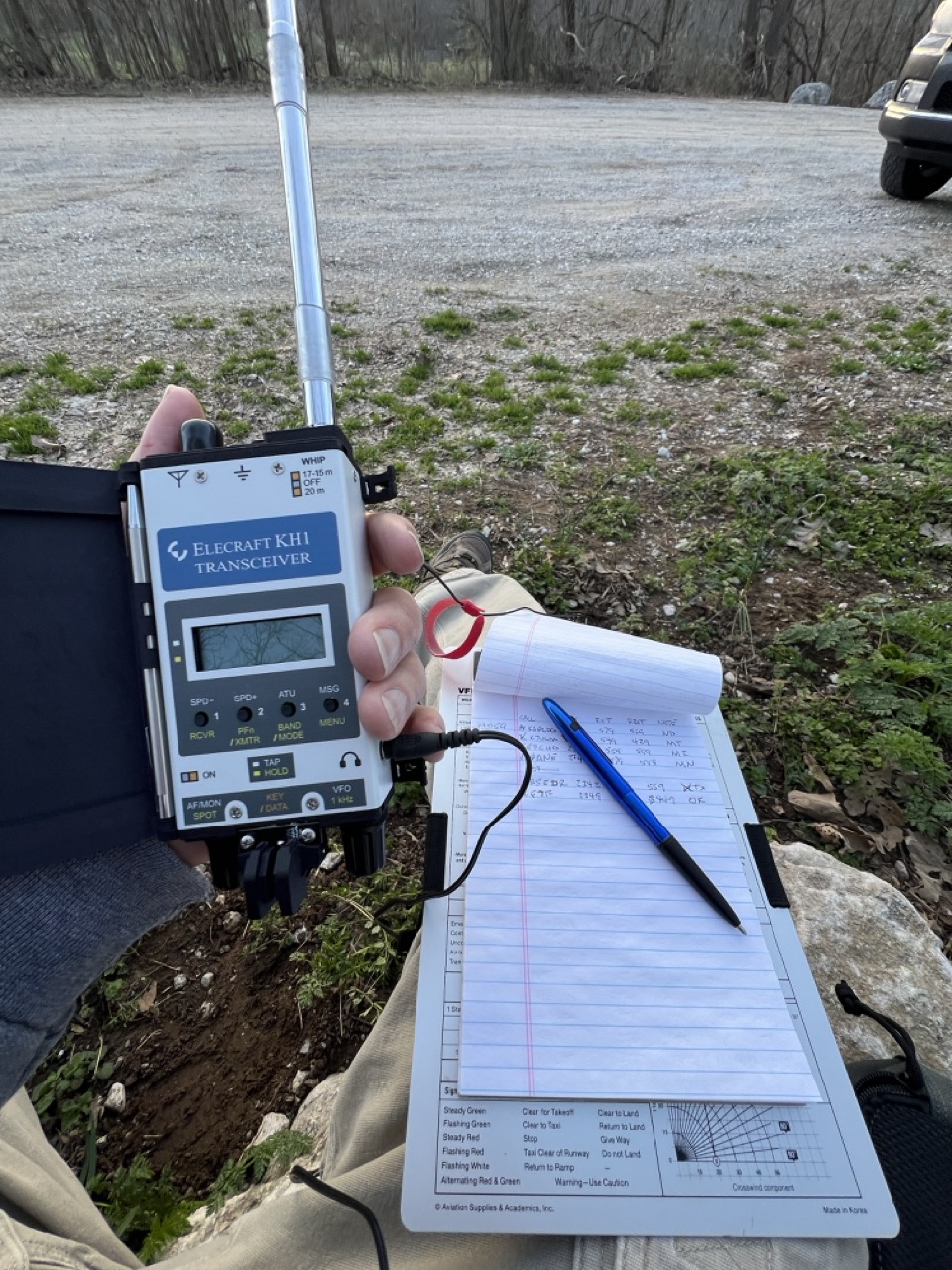
A KH1 stump shot, photographed with my iPhone 13 Pro Max and no post processing.

A few days ago (before the new year), I had The Girl out for a walk. The Sun shone and made it feel warm even if the air was cool.

It was a day that had no afternoon duties scheduled, so after walkies I got out my Elecraft KH1 to play just a little radio. I sat on this old cottonwood block, facing the Sun. The Girl hung out in the rig, only a few feet away. I think she liked the warm of the rig.

I heard a few stations calling CQ POTA and answered their calls. However, none heard me and answered. The few watts the KH1 makes was not making the trip this afternoon. After about 15 minutes, I decided to pack it in and head home. I paused for the photograph, then reloaded the KH1’s box and put it away.

There will be another day for radio, God willing. It was still a good day — we had a good walk and I sat in the Sun for a few minutes, listening to the radio waves.

Life is good.

Edit: Yes, the title is a pun. The KH1 is a little radio.

AAR: Field Day 2024

Local site for Field Day operations.

Setup

The American Radio Relay League (ARRL) hosts an annual radio event called Field Day. The objective is to get away from the home station, setup a station somewhere portable, and practice a field activation. There are lots of things to learn by operating portable and the lessons learned are valuable when the time comes to serve during events that need radio support or during emergencies. Although Field Day is not a contest per se, it is contest-like in that points are offered for contacts and bonus activities.

My friend Greg planned our expedition for weeks. We made a scouting run of the dry lake (above) a few weeks ago and it looked like a pretty good spot. It is relatively flat, far enough but not too far from the highway, and there is room for several stations.

My plan was to use my Elecraft KX3 with its panadapter and amplifier as my primary station. Given that Greg wanted me to run the VHF/UHF net (that we always do for Field Day), I also decided to take my Yaesu FT-857D because it is all band and all mode.

But, work kept delaying my preparations for camping. I also needed to replace the camper’s battery box because the lid of the original was lost during my trip home in early May. So, although I planned to leave Thursday afternoon, it was Friday morning before I finished the loadout and headed out.

Travel to Site

The north end of a southbound semi-truck. We were waiting to pass construction on southbound US395 on the way to Field Day 2024 camp.
Travel to the dry lake was relatively uneventful. I got away from the house around 1000h local and drove south on US395. I bypassed the bulk of the construction in Gardnerville by taking a small detour. The US395 construction near Holcomb Junction could not be circumvented, however. But, I was lucky and the delay was only a few minutes.

The access road from the state highway to the dry lake was slow. The road is rough from OHVs running hard on it. There are lots of loose rocks that are kicked out by those vehicles. There is also some rutting of the road from storm and snow runoff. I was often running a couple miles an hour and some stretches allowed a little more speed without beating up the camper or the rig. I think travel from the highway to the site required about 45 minutes or so.

When I arrived on site, both Greg/Subrina and Tim had their camps and stations set up.

Camp

I had no trouble getting camp setup and ready to support Sera and me. I have setup my camper so many times that it is nearly routine. The playa bed was relatively level although I did drop the tongue a half a foot to level the camper forward to aft. It was level enough laterally. However, I found myself stressed and in a hurry because of my late arrival. I really wanted to be setting up my station on Friday and not setting up camp.

Greg came over when he saw me putting up the EZ-Up. It is possible to set one up solo, but it is much easier with two people. I staked out the tie-downs carefully as well. The wind does blow on Nevada afternoons and has been known to fold up shelters (and tents… and awnings).

By the time I had camp setup, I was pretty much done, physically and mentally. So I elected to deploy my station Saturday morning and sat in my chair in the shade to collect my thoughts and relax.

Greg and Subrina graciously asked us to supper. Because I was not completely prepared for this outing, I had nothing to contribute — not even dessert.

This was 2024 FD camp at Desert Creek Dry Lake.

Station

Greg was working his station, an Icom 7000, in his radio trailer.
My plan was to deploy the Chameleon MPAS 2.0 in the vertical configuration for my primary station antenna. I would use the Yaesu FT-857D for my Saturday operation and the KX3/PX3/KXPA100 for Saturday night and Sunday morning operations.

I got out the MPAS pack and started laying out the components on my work table. Unfortunately, the spike was missing. Tim, who had wandered over to watch my deployment said “I have a piece of 3/8-inch all-thread. I also have a three-foot 3/8-inch by 24 extension if you want to get the feed point off the ground.”

We drove over to his camp, retrieved the parts, and returned to my camp to complete the antenna deployment. We found the all-thread to be too flimsy to support the MPAS. Greg suggested he had a light fence post that might provide stability, so he and Tim walked over the Greg’s camp.

Tim returned with three posts, which was an excellent idea because we fabricated a tripod using the three light-duty posts and a heavy zip tie. This provided excellent stability of the antenna system and the feedpoint was about five feet above ground level.

I also had a speaker-wire doublet that I built that I considered deploying for a second antenna. However, after working so hard to deploy the MPAS antenna, I elected to use just one antenna.

The sun was bright when I made this capture of Tim at his camp.
I was also going to deploy a roll-up J-Pole for VHF/UHF operation, but Tim suggested I just use the mobile antenna of my 4Runner. I took that suggestion. After working so hard on the MPAS, simplicity was the expedient.

I setup the Yaesu FT-857D and the LDG YT-100 matching unit on my worktable. I elected to use my 30Ah Bioenno LFP battery for power into a West Mountain Radio distribution block. I was unsure how much energy I might need so I added a PowerFilm 60w foldable solar panel to the mix into a Genasun GV-10 Lithium charge controller. I did not meter the power.

I chose the FT-857D for my Saturday outdoor operation because it includes the 2m and 70cm bands. Greg tasked me with net control duty for the local net we run at the beginning of Field Day. This affords the local operators a chance to get started with a set of contacts without the hassle of trying to break the initial pile-ups that occur on the bands.

A Microsoft Surface Go 2 has been my radio computer (and travel work computer) for a couple of years. It is a relatively low power computer, but it also does not use a lot of energy. This attribute, plus the fact that it has adequate power to run radio software, makes it an excellent computer for field work.

I ran an extension cable from the antenna in my 4Runner to the VHF/UHF output of my FT-857D.

This was followed by a little testing. I had an operational station for the start of Field Day 2024.

Operations

I started operation at 1100h local by calling on the designated frequency (VHF). Two of four known operators responded. This resulted in a trip by Greg to Fred’s camp to help him get his station sorted. After a few minutes, we had three of four planned operators all on the same frequency. The remainder had elected to camp outside the dry lake basin and could not be heard.

I ran the net on the designated frequencies with one flub — I forgot to pass control to the next operator on my list to make their contacts. Fortunately, I had my smarter brother Greg to remind me of my error. The net ran smoothly after that.

After the net closed, I puttered for a few hours playing search-and-pounce on running stations. Outside of our little group, I made only one or two contacts on phone; the remainder were all CW mode (Morse Code).

I had to move the shade tarp from the east side of my shelter to the west. The direct sun was too hot. The temperature was fine with the shade from the shelter (and tarp).

By sundown I had a few dozen contacts. I was not working that hard, but really enjoying being away from the house, the cooler weather (at altitude), and the sound of the radio. When we met for the evening break, we all had about the same number of contacts by straw poll.

I returned to camp, moved the antenna connection indoors, and connected it to the Elecraft KXPA100 amplifier for my KX3/PX3 station. I had a little setup to do before I was ready to run indoors, but that did not take long.

After getting The Girl out for a break (and feeding her), I sat down at the radio and worked stations I could hear. I probably worked until about 2200h local before retiring for the night.

As is usual for me, I woke about 0500h when night turned into twilight. I turned on the radio and made a coffee while listening to the background noise of the HF bands. I also stepped outside to look around and enjoy the cool morning air before returning to the station and working more operators.

I shut down about 1100h, satisfied with my 140 contacts.

Fred, KG7VNG, setting up his station Saturday morning.

Conclusion

I spent the remainder of Sunday with my friends and relaxing in the shade at my camp. Fred tore his station down, packed up, and headed home. He had work Monday. I offered help to Greg and Tim with tearing down their stations, but both had the chores handled. We are all experienced field operators.

I put away the FT-857D station and stowed it in the 4Runner. As I write, I cannot remember if I put away the Elecraft KX3 station or not. I think that I did, knowing that I would be up and wanting to break camp Monday morning.

Monday morning I rose, made a coffee, and stepped outside the camper to enjoy the morning air. I was treated to a beautiful alpenglow on a nearby mountain, this caused me to make a photograph. I decided to get out the DJI Mini and see if the batteries had any charge. Once again, I brought the tool but had not prepared it before leaving home.

Of course, none of the batteries carried a full charge. But I was able to fly a circuit around the dry lake and make a few aerial images.

I finished my coffee and made another. Sera and I walked to the other camps to see if anyone needed help. All were good.

Alpenglow on the mountain south of the ARRL Field Day campsite. The moon is also in the frame. Shot with my iPhone 13 Pro Max.

Things Learned

  • Sometimes stuff happens. In this case, the stuff was me being busy with other things than preparing for the 2024 Field Day expedition. This resulted in a delay of my planned departure and then the compression that comes from being late. It added unnecessary stress to my life and my setup.
  • Always check your equipment before leaving home. I had alternatives, but it is better to have a complete antenna system from the start.
  • Always have a backup plan. I had several other antennas I could deploy in the back of the 4Runner. I always carry spares.
  • Always carry spare parts and supplies. You might not need them, but another operator in your group could have a failure or be missing a critical piece of equipment for operations. Be prepared to help out other operators in your group.
  • Be prepared to offer physical assistance to other operators in your group. Some equipment is much, much easier to deploy with a second set of hands. Sometimes an additional brain is of use as well as all of us can get locked in a loop when trying to solve a problem.
  • The addition of a tarp to extend the shade of the EZ-Up was necessary. The sun was too bright to readily read the SG2 screen and direct sun provided a lot of unwanted heat. A second tarp would be a good addition so that one could be setup on west and east sides of the EZ-Up. However, I would leave the north and south facings open for air flow on summer outings.
  • From an operational standpoint, I had fun. I did not burn up the ether trying to make a lot of contacts. I am not sure that I want to do that, as I operate a radio for fun and for practice should I need to run a radio. I operate portable (a lot) because I want to get out of the house and because there is so much noise at my house. But, I think maybe I should be a little more serious during one of these outings and keep my butt in the chair and run frequencies. It would be good practice to push the operation a little harder.

It was a good Field Day outing. I had fun playing radio. I learned a few things, as I generally do on a field deployment. I enjoyed my friends. My dog and I had a blast. Everyone was safe and seemed happy to be in the field together.

I am grateful. Life is good.

This is an aerial view of our Dry Lake camp. I captured this early Monday morning with the DJI Mini 4 drone.

Daily Image: Dry Lake Sunrise 25 June 2024

Alpenglow on the mountain south of the ARRL Field Day campsite. The moon is also in the frame. Shot with my iPhone 13 Pro Max.

I am back from ARRL Field Day camping and radio play. I will write a complete AAR when I return from field work this week. But, here is a hint at what the site looked like. I made this capture early Monday morning as the sun rose over camp.

The trip home was uneventful. It was a good weekend and a good day.

I am grateful.

Daily Image: Molle II Patrol Pack 12 June 2024

This is my Molle II Patrol Pack (MARPAT) in the wild with the Elecraft KH1 transceiver shack in a box. Shot with the Fujifilm X100V and post-processed on my iPhone 13 Pro Max with Snapseed.

I bought a milsurp Molle II Patrol Pack a couple-three months ago. It is part of my (apparently) never-ending search for the perfect pack. These are long out of service, relatively rare, and in demand. They are also nearly the perfect size for a daypack.

My seller scrounged up a stiffener and pad for my pack and I have them installed. The stiffener helps keep the shape of the bag. It works well enough, although I might have to trim it up just a bit as it seems to be about a half-inch too tall.

It is big enough to hold my necessaries for hiking with The Girl. I have enough water for us both for a morning or afternoon hike, and even room for a small radio. I have been carrying a camera and small water bottle in a small Domke bag slung cross-body and over the pack. That does not put too much pressure on my neck (a personal peeve).

I like it so far. I am still setting it up and would like to carry a water bottle on the outside, but the Maxpedition bottle bag I have does not hang well from the PALS webbing. So, I need another solution.

I paused to make this image on a small summit just off our regular path near Spooner Summit. I had paused to breathe a minute, take some water, and water The Girl. She also posed for me while we were on break.

It was a good day. I am grateful. Life is good.

US-4838 — Busiek SF POTA Activation 19 March 2024

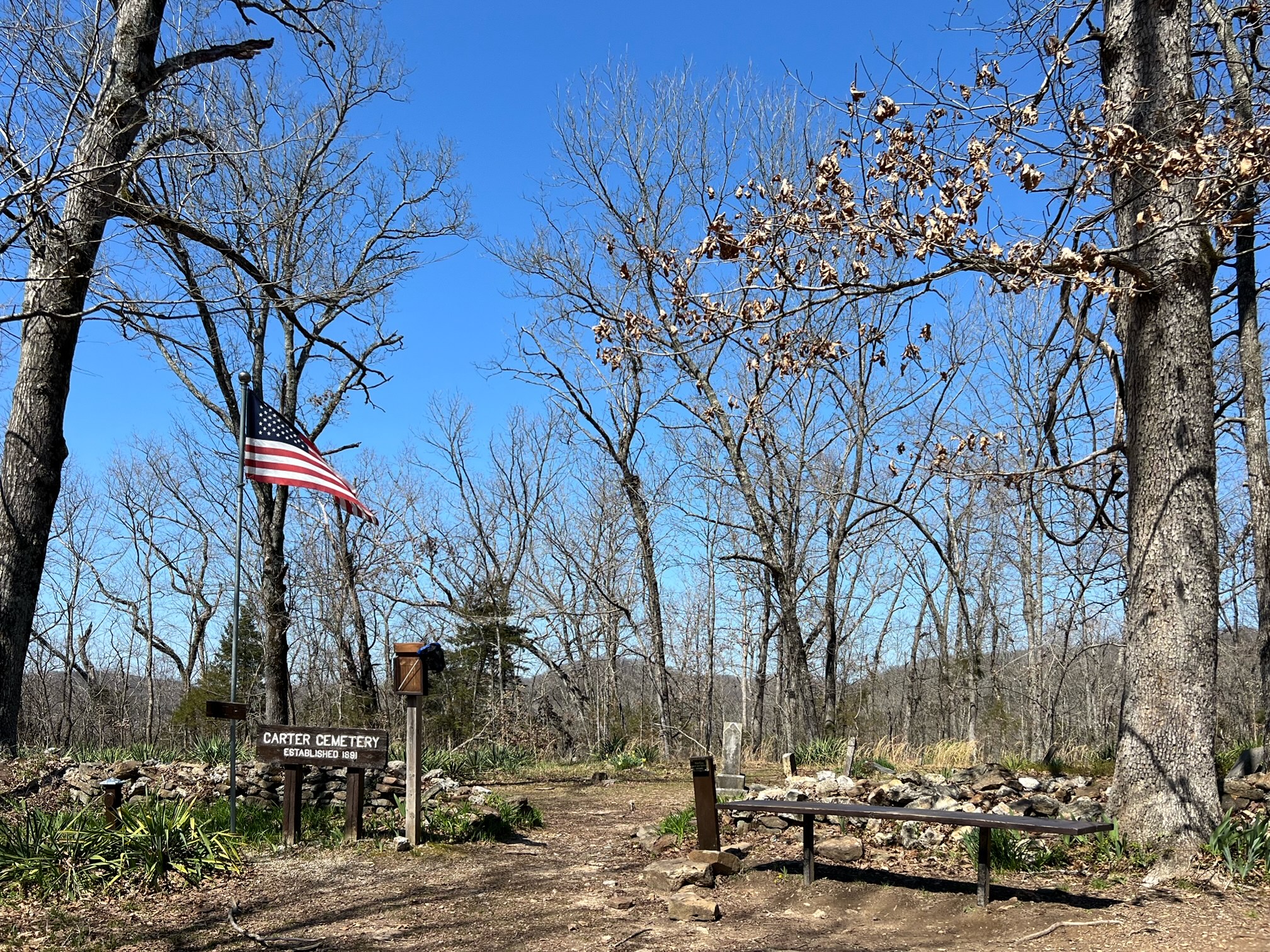
Carter Cemetery, established 1891, in Busiek State Forest, POTA US-4838 in Christian County, MO. It is south of Ozark about ten miles. Shot with iPhone 13 Pro Max.

Busiek State Forest, POTA US-4838, has been on my to activate list for a long time. I hiked the Yellow Trail with the kids a couple of years ago. Along the way, we came on the Carter Cemetery, an old family plot that was established late in the 19th Century. It looked like a perfect place to activate the park.

But, I never got back to do the activation. So, last week I had a day off and it was a pretty nice day. So I took The girl and we drove out there. There were not a lot of people, it being a weekday. So there was not much traffic to deal with.

We had a nice hike up to the cemetery. I decided to set up on a bench there, although I had to face away from the trail to get my leg high enough for my kneeboard. I did not care for that facing, but it was necessary.

I decided to use the Elecraft KH1 for the activation. I am still learning that radio and have a little trouble with the paddles. But I can make it work and it is an excellent little rig.

I was just starting to work calling stations when Sera broke away from me and approached another dog. The other do said No! emphatically, but there was not really a fight. I had to drop everything and retrieve my dog.

There was no damage other than a pissed-off handler. But it really affected me emotionally and in one way really ruined the day. I just cannot take my attention from Sera when we are out in the field and might encounter another.

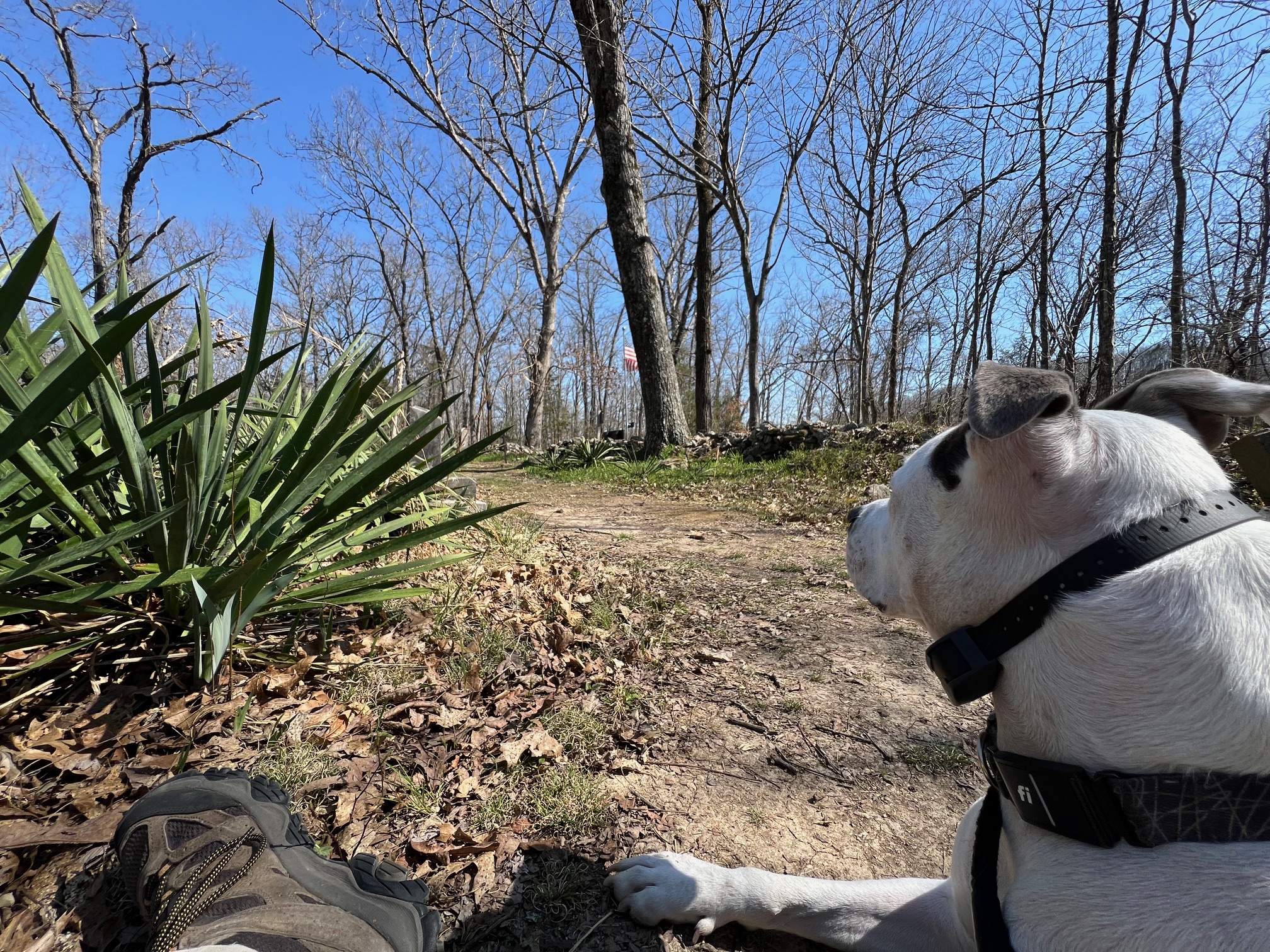
I moved us about 50 feet away from the trail, behind a low rock wall. She could not see the trail and I could. I put her in a down-stay and sat on my sweatshirt and started over.

I could pay attention to my operations and stay aware of the situation around me. It was a much better location from which to activate the park.

I made 14 contacts on three bands — 20m, 17m, and 15m. It was more than enough to make the activation and there was still time to get in a bit more walk before returning home for the day. I packed up the kit, donned my pack, and we walked on up the trail another quarter of a mile to a split. Both ways would require fording the stream. I was not geared for a fording, so we reversed and walked back down the trail and to the rig.

The Girl got a nice big drink from the stream. (I love the rocky-bottomed Missouri streams in the Ozarks.) We crossed the bridge and stowed gear in the rig, then drove home.

I had a lot of maintenance scheduled for the 4Runner starting the next day. All of the 200,000-mile scheduled maintenance was done, plus I replaced the tires and had the alignment checked and adjusted. It was a lot of money, but I think the rig might have another 100,000 miles left in it and I might as well get them.

In the end a learned a few things:

  • I absolutely have to station myself so I can remain aware of what is going on around me.
  • I cannot ever allow my attention to be completely subsumed by another activity when I have The Girl out with me.
  • The little Elecraft KH1 is an excellent radio. But I doubt I will ever operate pedestrian mobile when I have The Girl with me. There is just too much that can go wrong in a hurry if I do not have hands free to wrangle her.
  • I think the paddles need a little more adjustment to be right. I still fumble my sending more than I should (and normally do).
  • I really like POTA activations. I want to do more, but I have to choose my OP carefully so I can remain aware of what is going on around me. Yes, I repeated myself. It is that important.

Despite the uncomfortable feelings associated with Sera’s behavior and the engagement with another dog, it was a good day to be out. It was a good day to be with her. And it was a good day to play a little radio.

I am grateful. Life is good.

At our second operating position in Carver Cemetery. Shot with iPhone 13 Pro Max.

The Elecraft KH1 Handheld Transceiver

My Elecraft KH1 5-band handheld transceiver. Shot with iPhone 13 Pro Max.

This is not a formal review. There are plenty of those out there in the wild. This article is a bit of my experience in using this little rig in the field. Perhaps someone will find something useful from my experience.

The KH1 was designed by one of my favorite radio engineers, Wayne Burdick of Elecraft. I do not know how long the little rig was in development, but it was released late in 2023. I ordered mine on 20 October 2023, an hour after I learned of its existence. It was delivered in February 2024.

  • It is a five-band CW mode (Morse Code) ham radio transceiver that is small enough to fit in my hand.
  • It has an internal battery pack that will run it for hours.
  • It has a small set of paddles that will store in their socket on the bottom of the radio.
  • Two knobs on the bottom provide access to volume and VFO and protect the paddles.
  • There are four small buttons on the front panel that provide access to many regularly used functions.
  • There is an internal speaker, but the little rig sounds much better with phones.
  • The rig has an internal log feature.
  • It will run with a short telescoping whip antenna and a counterpoise affixed to the radio.

There are a lot more features to the KH1 than listed above. But you can induct from that list.

There is a menu system for features/settings not directly settable from the front panel and bottom controls. The menu requires some learning and reading the manual is suggested. (I need to read it again a couple of times.) The manual is well written and complete to the best of my knowledge.

The display is bright and readable in daylight. It is backlit so is readable in low light. The bottom line can display decoded Morse Code if desired.

Deployment of the radio is very quick. The steps are:

  1. Retrieve the radio from its bag (or other storage).
  2. Affix the telescoping whip to its stud and extend it.
  3. Attach the counterpoise and throw it out on the ground. (Or let it droop from the drivers side window of your rig if waiting for your SO to finish shopping.)
  4. Unplug, turn over, and reinsert the paddles into their socket.
  5. Turn on the radio and start operating.

I can have mine running in less than five minutes. It will match 15m, 17m, and 20m easily with the internal loading coil. It will kinda-sorta match 30m with same internal loading coil. The 40m will not match without help. The best I can tell, one can still operate the KH1 on 40 meters as the finals are resilient, but power is reduced.

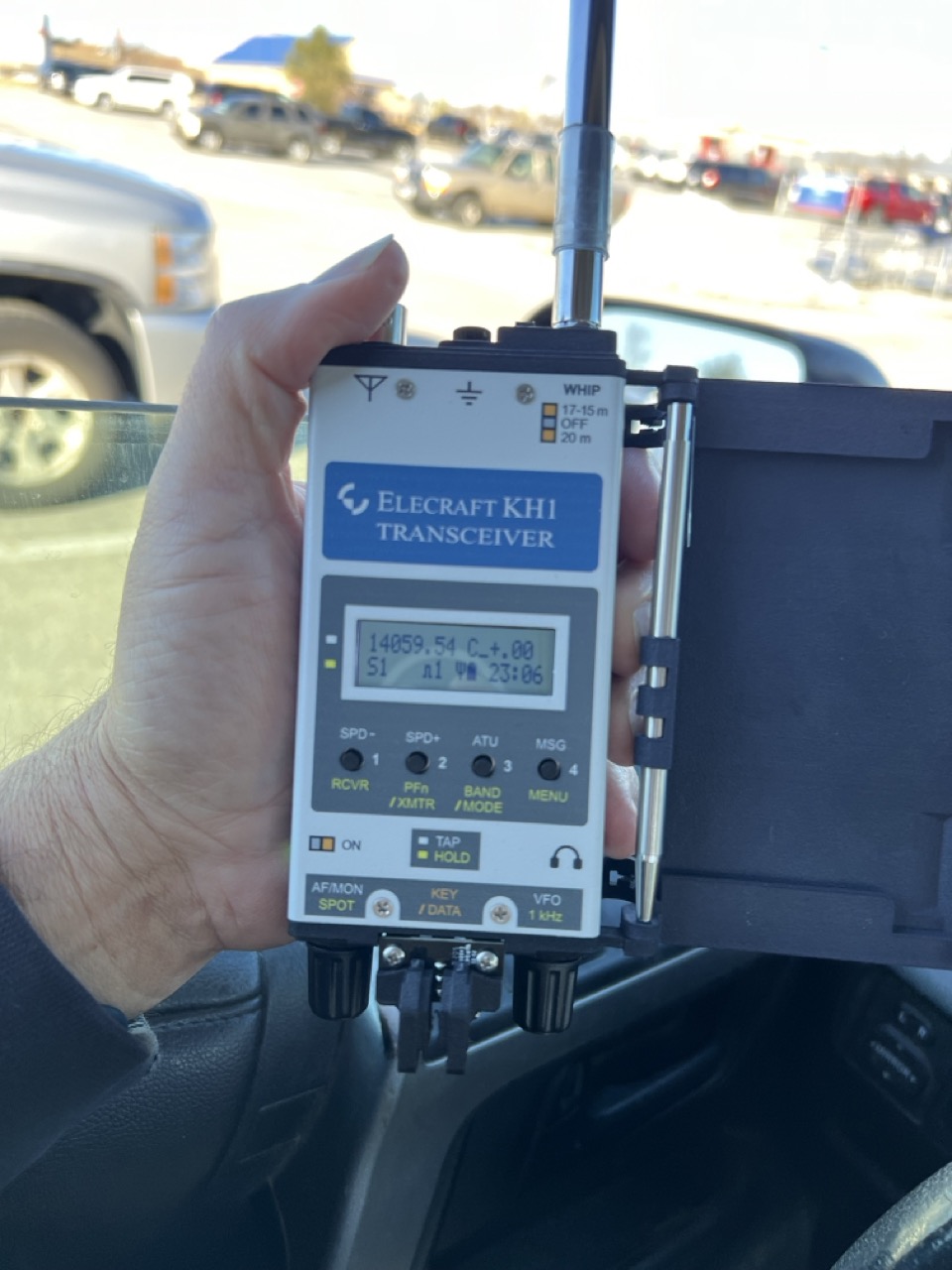
Right after I received mine, I carried it with me one afternoon when I drove over to Lowe’s to pick up my son from work. While waiting, I deployed the counterpoise, affixed the whip, and was operating the KH1 with the antenna sticking out my slightly open drivers side window. (It was cold.) I chased three POTA activators while waiting the few minutes for my son. Recovery did not take much longer than deployment and we were off for home.

The receiver is very good. I do not have its specs and I do not care. I find that I hear plenty of signals and the three filter levels work well for my style of operating. When chasing activators, I can use a little XIT (transmitter incremental tuning) to move my sidetone away from the pack so the operator can hear me a little better than the others.

Rejection of strong adjacent signals is solid. I expect this from Elecraft radios.

I have used the KH1 to activate several parks for the Parks on the Air program. I am still getting used to the little paddles, but they function well and are adjustable. I use a pilot’s kneeboard to log on paper. I might be able to position my iPhone on the kneeboard and use it for logging as well. But, for now, I am logging on paper.

I also have the Elecraft AX1 and AXE compromise antenna systems. Given that the KH1 already has a loading coil and switch for the 15m, 17m, and 20m bands, the AX1 seems superfluous. However, I mounted the AXE on the antenna stud and affixed the 33ft counterpoise that accompanies the AXE to the KH1 and pressed the ATU button for 7.060MHz. The KH1 buzzed and fidgeted a moment before returning a 1.2 or 1.3 SWR match. This is plenty good enough to operate on 40m.

My KH1 puts out about four watts (indicated) on the 40m band. That is enough.

With the AXE and long counterpoise attached, the KH1 will find a match on the 30m band as well. I flipped the switch to the 15m/17m side and hit the ATU button. I got a 1.1 SWR match.

I removed the AXE but left the long counterpoise attached to my KH1 and the rig will match frequencies on the 15m, 17m, and 20m bands easily with the longer counterpoise. That means all I have to do is remove the AXE from the rig and replace the whip and I can operate on the higher bands. That makes changing bands very fast.

After several POTA activations and a SOTA activation, I really like this little radio. It does everything my KX1 does but adds the 15m and 17m bands, which I find more useful for my field operations. I have other rigs that will do the other bands if I want them.

I have not done much with wire antennas and the KH1 yet. That is an area I need to explore and I will.

I have an unbuilt MTR5b in my inventory that I bought to get 15m in a pack-friendly radio. Now it seems I will not need the 5b.

I really like the Elecraft KH1. I plan to use it a lot this summer. I will also know a lot more about using the rig in a few more months.

AAR — Shelvin Rock Access SCA POTA, K-10221, 10 March 2024

I really despise the change to/from Daylight Saving Time. It interrupts my circadian rhythm for no good (to me) reason. Yesterday morning was the date to change to DST. So, my routine was AFU from the beginning.

Nonetheless, I had a couple of things on my list and got to them after I was sufficiently caffeinated, which required substantial caffeine. Older Son was busy with other things, so I went outside and retrieved some materials from the camper. I began rebuilding my end-fed random wire antenna.

I have a substantial amount of the copper-clad steel antenna wire that is quite small (maybe 26ga). It never releases its memory and will twist itself up readily. Witness the number of times I mentioned that in my travels when attempting to deploy that antenna.

I made new elements from the DX10 wire that Callum McCormick uses to build the DX Commander antennas. I bought and took delivery of 200m of the stuff late last week. So, I cut three 34ft pieces of wire and used one to make a sloping EFRW, the second to be the counterpoise (wire on the ground), and the third to be an extension to make the antenna work on the 80m band.

I setup a test antenna using the SOTAbeams Carbon 6 mast and the Elecraft KX2 would match it connected to a cobrahead adapter (direct connection to the radio) on all of the bands but the 12m band. I put a 9:1 Unun (matching transformer) between the wire and the radio and it matched all of the bands from 10m to 40m.

I then added the extension to make an inverted vee shape and then the radio with the 9:1 Unun would match all the bands from 10m to 80m. So, I have a working EFRW.

Then Older Son and I blew out the sunroof drains that were stopped up. I know they were blocked because I had water in the floormats of the 4Runner after a rainy night last week. Indeed, water was blown out of the passenger side drain when compressed air was applied.

I put away all the tools and went indoors to have a bite and take a break. Older Son and I decided to get The Girl out for a walk and a play and so we did.

She loves her ball. We have a lot of good plays with her ball and the thrower.

After walkies, Older Son decided to get in a workout so I elected to take The Girl and go activate a park. I wanted to play with the Elecraft KH1 a bit more as I am still learning the radio.

We drove out to Shelvin Rock Access SCA (K-10221) and I found a place to park. I got out the little radio, the small antenna bag (houses the Elecraft AX1 and AXE antenna plus some support materials), and a pilot’s kneeboard on which to keep my log. I sat on a rock, affixed the AXE to the antenna port and added the 4ft whip. I threw out the 33ft counterpoise and turned on the radio.

I set the rig to the 40m band and listened around 7.060MHz. There were stations either side of the frequency, but none heard there. I called a couple of times for usage but heard nothing. So I started the little radio calling CQ CQ POTA DE AG7TX K (calling any station for a Parks on the Air activation) while I spotted myself on the POTA website.

The little radio had tuned the AXE/whip combination to a very usable SWR (Standing Wave Ratio, a measure of the match of the radio to the antenna with 1:1 being perfect) of 1.2 or 1.3. It was putting out about four watts of power. In only a couple of minutes I started taking calls.

I worked several stations before no more callers appeared, so I changed to 10.111MHz on the 30m band and started calling, again letting the radio work while I respotted myself. I worked more stations.

I then rinsed and repeated the process at 14.059MHz on the 20m band. I finally called QRT (I am done and off the frequency) a few minutes before 0000Z (when the day changes), closed out my log, and put away the radio. I made 19 contacts in about 45 minutes — not a bad day.

I have a few notes from the outing.

  • I still have a bit of trouble with the paddles. They are small and need a bit more adjustment after my initial setup.
  • The AXE works perfectly with the KH1 and its whip antenna. The 40m and 30m bands are quite usable with the AXE screwed to the antenna port and the long counterpoise (33ft).
  • The Elecraft reflector correspondent who told me that the AXE would not work that way did not know what he was talking about. That is what I thought when I read his response and now I have proved it (again).
  • There is a bit of art to manual logging and managing this radio. I will need a few more repetitions, I think.
  • I am thinking that I really like this little radio. It is very handy, quick to deploy and recover, light in a pocket or pack, and has a very good receiver and very good audio (with headphones or earbuds). It is very easy to get it out and have a little radio fun without a big ordeal.
  • Wayne Burdick and Elecraft have once again outdone themselves with this little rig. It is a field operators friend and will be a lot of fun for POTA, SOTA, or quick operations.
  • I have activated a couple of parks by sticking the radiator out the window of my 4Runner with the counterpoise thrown on the ground/pavement.
  • A better application is to use Pro Audio Engineering’s (Howie Hoyt’s) bracket clamp to affix the AX1/AXE to something outside and run a short length of coaxial cable through the vehicle’s door seal if the weather is bad. That keeps rain out of the rig.

I had a good day and a fun, short POTA activation to boot. It was a good day. Life is good. I am grateful.

AAR: Blue Slip Tower Site POTA, K-11225, 08 March 2024

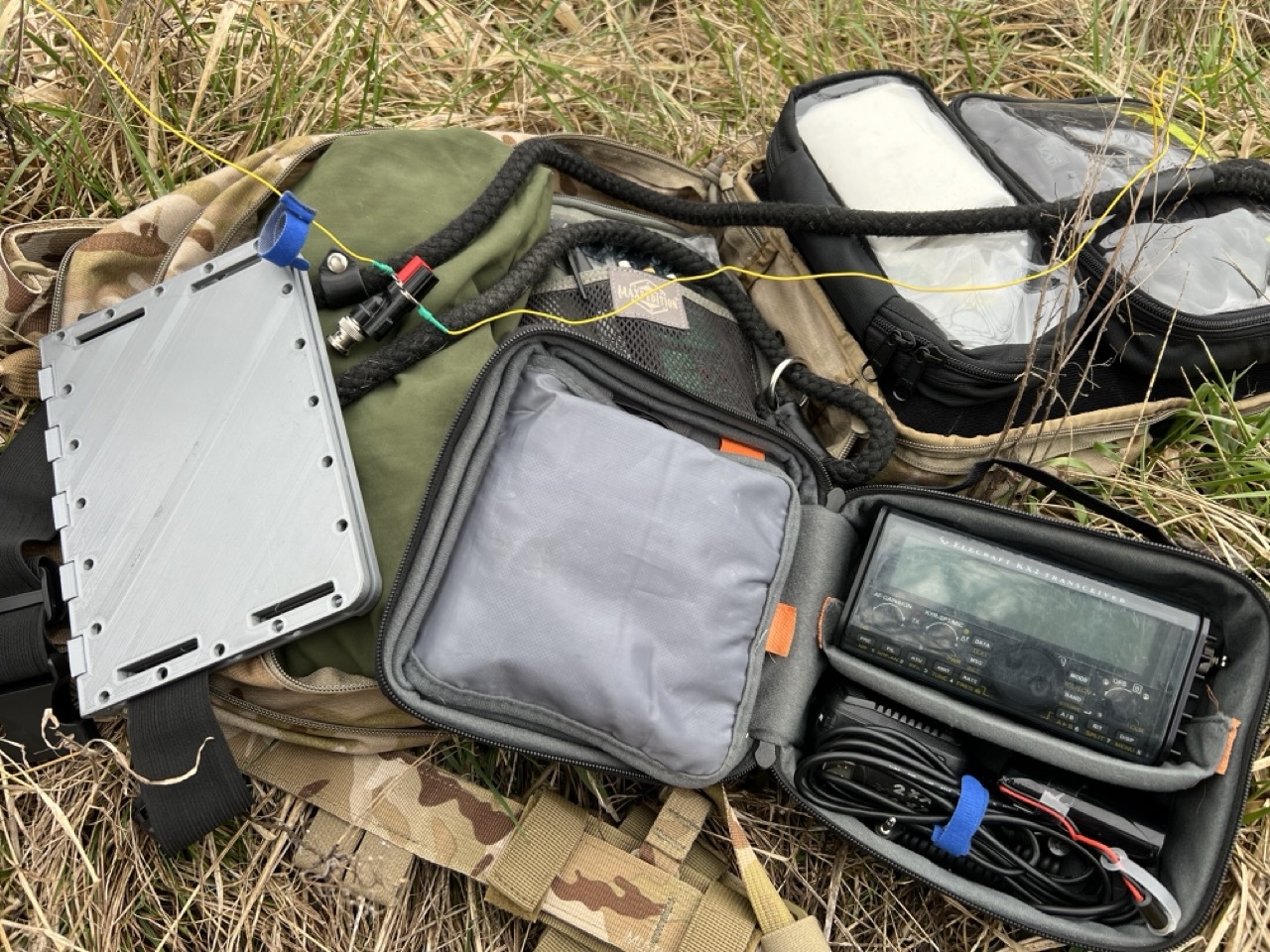
My pack and radio kit for the K-11225 Blue Slip Tower Site activation. Shot with iPhone 13 Pro Max.

When I went to bed Thursday night, I was pretty sure that I wanted to get out and activate a park. I had my eye on Blue Slip Tower Site State Conservation Area for a week or so. It was unactivated and I did not have any first activations to my credit.

After dealing with my morning duties and getting some food at Rosie Jo’s Diner, I fed The Girl, gathered up my radio bag and KX2 shack-in-a-bag, and headed out to the rig. I put the location of the park into my iPhone and we headed out. Too late I realized that I had not brought a camera with me. But, there is always the camera in my iPhone.

The drive out took about an hour. I had posted my activation so hunters would know I would be there. I was not sure if I would have mobile phone service, but should not have been. There are two cell towers on the hilltop as well as the fire watch tower.

When I arrived at the site, the gate was closed but not locked. It was posted, though, that unauthorized vehicles were not allowed on the access road. There was not a no trespassing sign, however. There should not be — it is public land and a conservation area open to hunting.

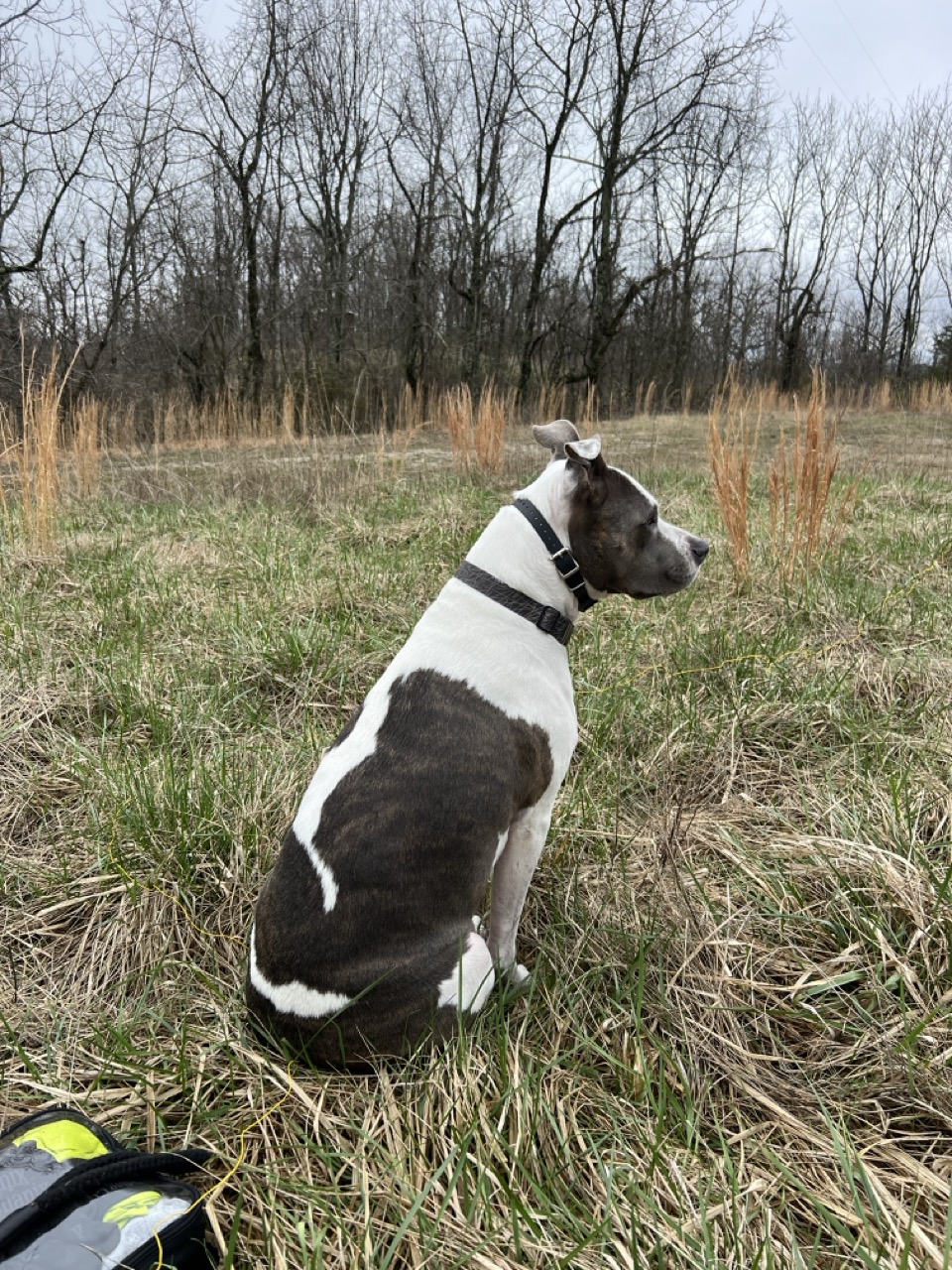
The Girl on Overwatch. Shot with iPhone 13 Pro Max.
I got The Girl out the rig, put my radio and antenna bags into my pack, and grabbed the SOTAbeams 10m Travel Mast from the back of the rig. It was a bit of a struggle to keep her out of the mud, but she complied.

The hump up the access road to the top of the hill was neither long nor too taxing. It was a nice climb through the woodlot with a lot of birds calling just ahead of us. The Girl kept an eye open for the dreaded bushytail, not wanting to let one sneak up on us. She also kept an eye on me, I noticed. I had to call her back in a couple of times because she tends to range out a 75 meters if I do not keep her reeled in.

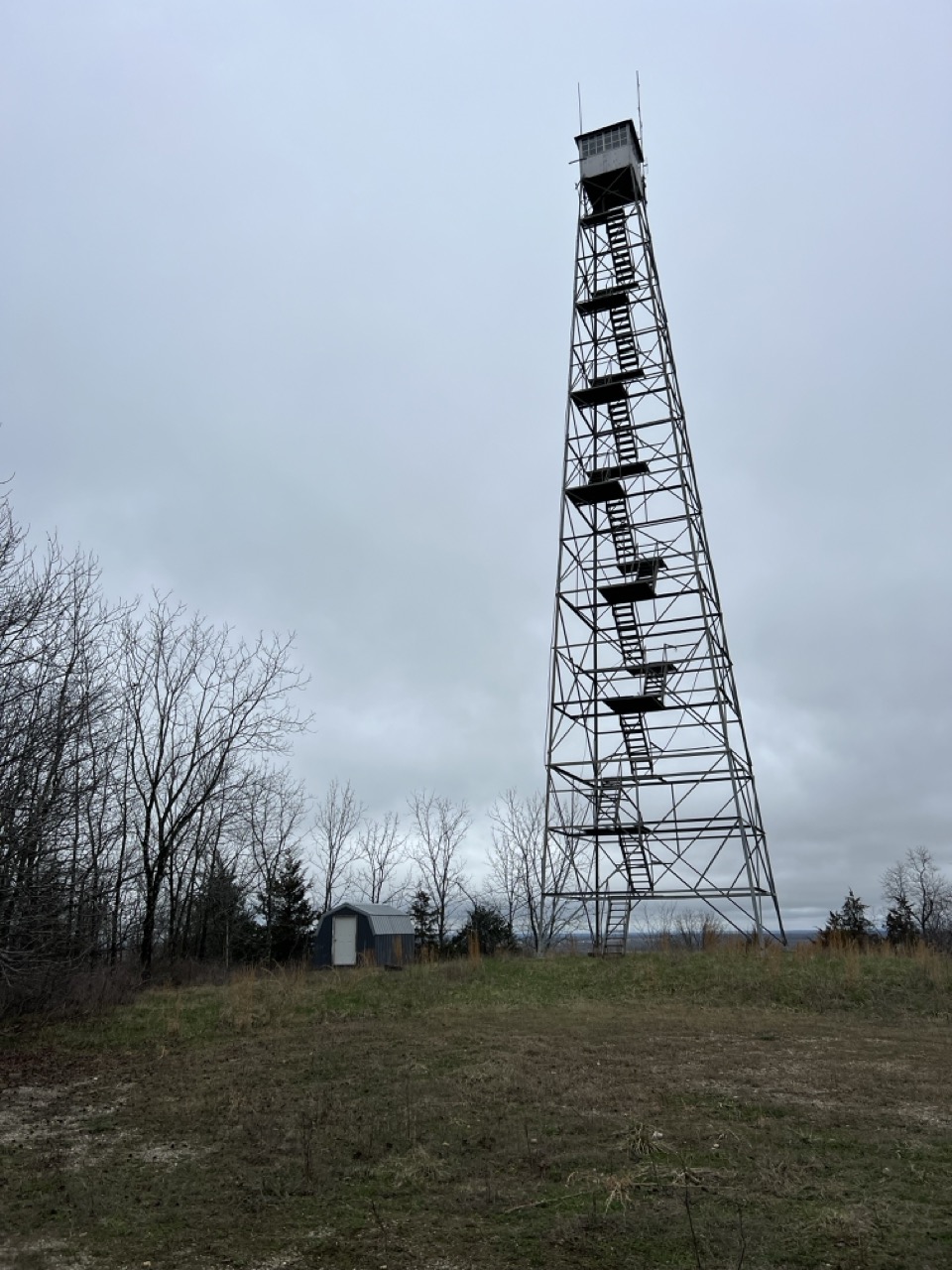
The fire watch tower at Blue Slip Tower Site. Shot with iPhone 13 Pro Max.
As mentioned above, I needed not worry about mobile phone signal because there are two cell towers on top of the hill. I had a good signal. I was tempted to climb the fire watch tower and operate near the top, but I worried that Sera might not pay attention and fall. So, I elected to sit on one of the footings and use the structure to support my antenna.

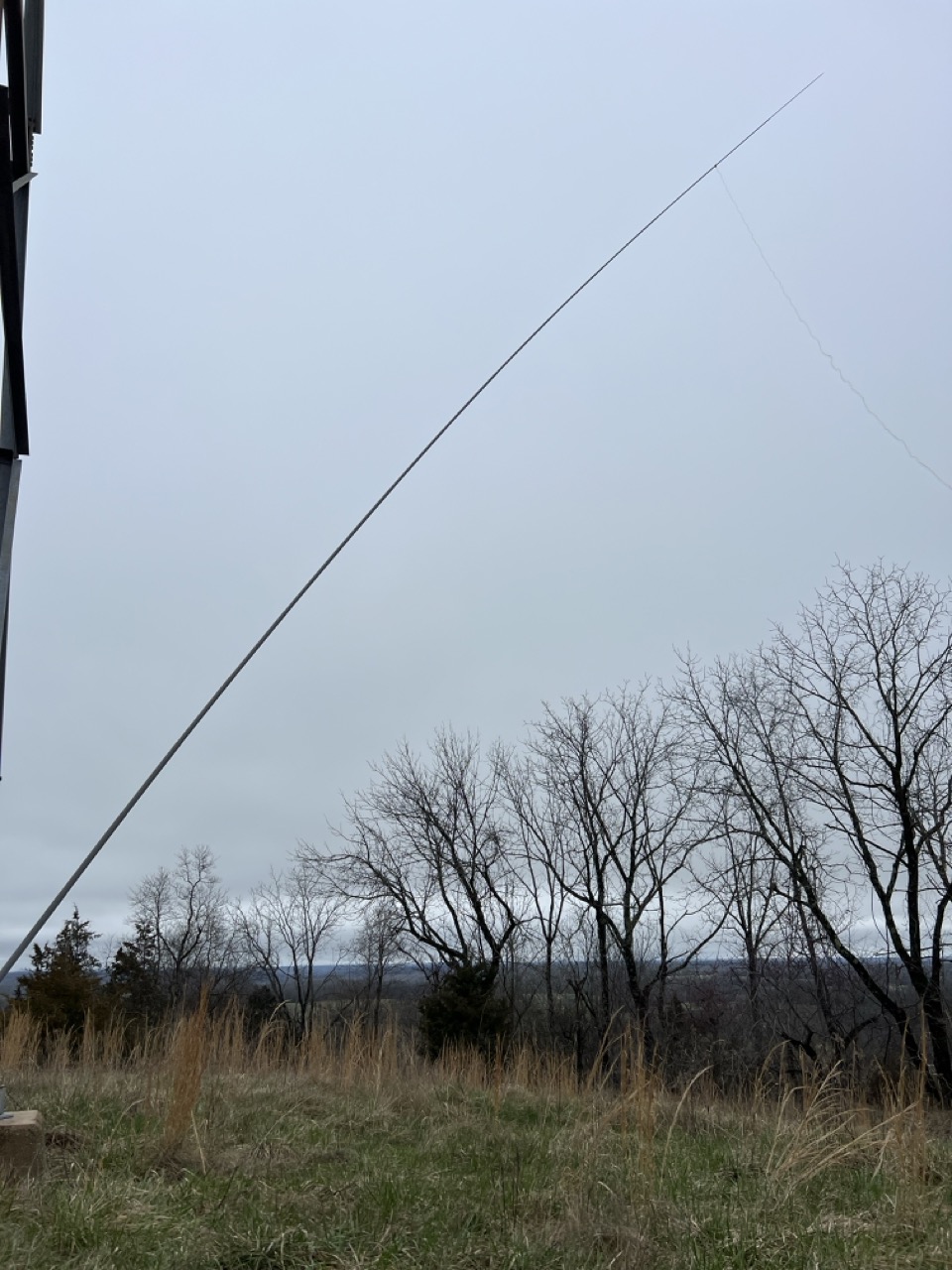
Although the wire is not visible, the SOTAbeams 10m Travel Mast that supports it certainly is. I affixed the mast to the tower leg. The antenna is an end-fed random wire about 28ft long. Shot with iPhone 13 Pro Max.
It did not take long to deploy the antenna. I considered using the end-fed half-wave for this activation, but decided that the slightly shorter end-fed random wire fit the setting better. I used a cobrahead (binding post adapter) affixed directly to the Electaft KX2 and threw the counterpoise wire out in the grass.

I fastened my kneeboard to my leg and set the rig on it. I grabbed a spare battery (lesson learned) and set it behind the little rig. The Girl settled into a spot in the grass to keep overwatch. I tuned the radio to the 30m band and selected 10.111MHz as my operating frequency. After listening a couple of minutes, I sent QRL? (is the frequency in use) and listened. I sent it again and listened again.

Nothing heard, so I set the radio to call CQ POTA DE AG7TX K and repeat while I opened the web browser on my iPhone and posted my spot. After a few cycles I checked the Reverse Beacon Network (again on my iPhone) and noticed that one of the spotting stations heard me. I knew I was getting out.

About that time the first call came in and I began working stations. The 30m band actually produced quite a few contacts, especially given I was running QRP (5 watts; low power). I worked stations to the east, mostly.

In the middle of my operation, a rancher drove up in his truck. “Did you see a cow come up here?” he called.

“Nope, nothing here.” I pointed out he had something hung under the passenger side of his rig so he got out to clear it. I sent AS AS (stand by) and chatted for just a few seconds before wishing him luck finding his missing cow. I then returned my attention to the radio as he drove off down the hill.

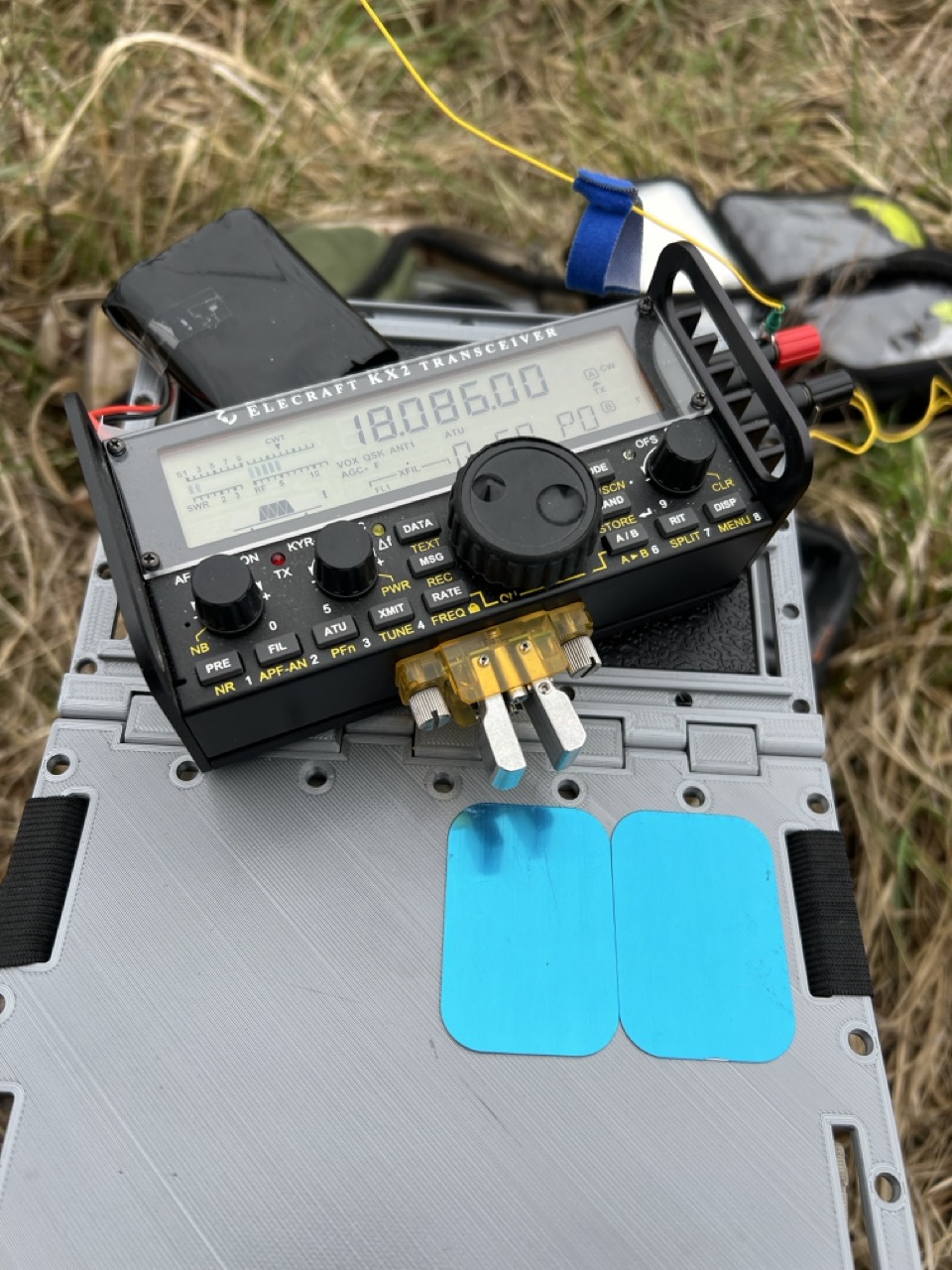
My Elecraft KX2 deployed on my kneeboard and ready to rock and roll. Shot with iPhone 13 Pro Max.
When that fishing hole was fished out, I moved to the 20m band and repeated the process. Twenty meters provided a lot more action and I worked a pretty good pileup until the calls thinned out. By that time I had about 30 calls in my log, so my activation was made. The skies were quite gray and I had missed some rain by only a few minutes. I really thought it might rain again.

I elected to move up to the 17m band, found an open frequency, and called a few times. Seventeen meters was quite a bit more noisy that the previous two bands. I figured I might take a call or two and then call it a day. I was starting to get cold and was ready for some food. I worked a couple of stations and then called QRT and shut off the radio.

In the end, I collected about 30 contacts and one DX station in Italy. It was a good day.

It did not take long to recover the station. The Girl and I enjoyed the walk back down the hill. The gate was open, so I left it. I was taught to leave gates in the condition I found them.

As I loaded The Girl and my kit into my rig, the rancher drove up.

“Did you find your cow?”

“Yes! She was stuck between two trees and calving! I managed to get the calf out, but now I need to get a chainsaw to free the cow.”

“Good luck!” I called and watched him hurry off to his place to get the tools needed to free his cow. It reminded me of the so many times I worked around the farm when I was a young man. Those are good memories. It was good work.

On the way home I stopped a Hucklebuck BBQ for a bite. The place is billed as the best BBQ around. They were not kidding — the brisket is the best I have had since I left Texas. I left warm and full and even brought the dog tax to The Girl.

I do not have a long list of lessons learned from this expedition. There were things I might have done differently, but they were not big changes. This one was pretty routine.

Life is good.

Parks on the Air AAR — Niangua State Recreation Area (K-10214)

The contact map from my activation of K-10214, Niangua SCA.

Wednesday morning I knew that I would have a hydraulic model running for several hours later in the day. After a couple of test runs, I started the first full run and sat at the computer for a few minutes, watching for an error/warning and listening to the fans run.

That was not going to do. So I looked at the POTA.app map to see what nearby parks I have not yet activated. I found a small conservation area (Niangua State Conservation Area, K-10214) about 45-minutes out and decided that would do. The sun had come out and I wanted to be outdoors.

I got The Girl ready and we walked out normal loop. I stuffed her into the rig while I went upstairs to retrieve my radio bag. Then we were off.

I called my buddy Dick on the way and we chatted about radio stuff until I got near where I thought I should exit the Interstate (dead reckoning). I pulled off the highway and looked at the map on my iPhone. My intuition was correct — I had exited on my turn instinctively.

So we drove the few short miles to the parking area, where I parked the rig and got out to survey. I decided to pull the rig forward a few feet and deploy the drive-on mast mount. I then retrieved the antenna bag from the back of the rig and the SOTAbeams 10m travel mast. I selected my end-fed half-wave antenna from the kit and the matching transformer.

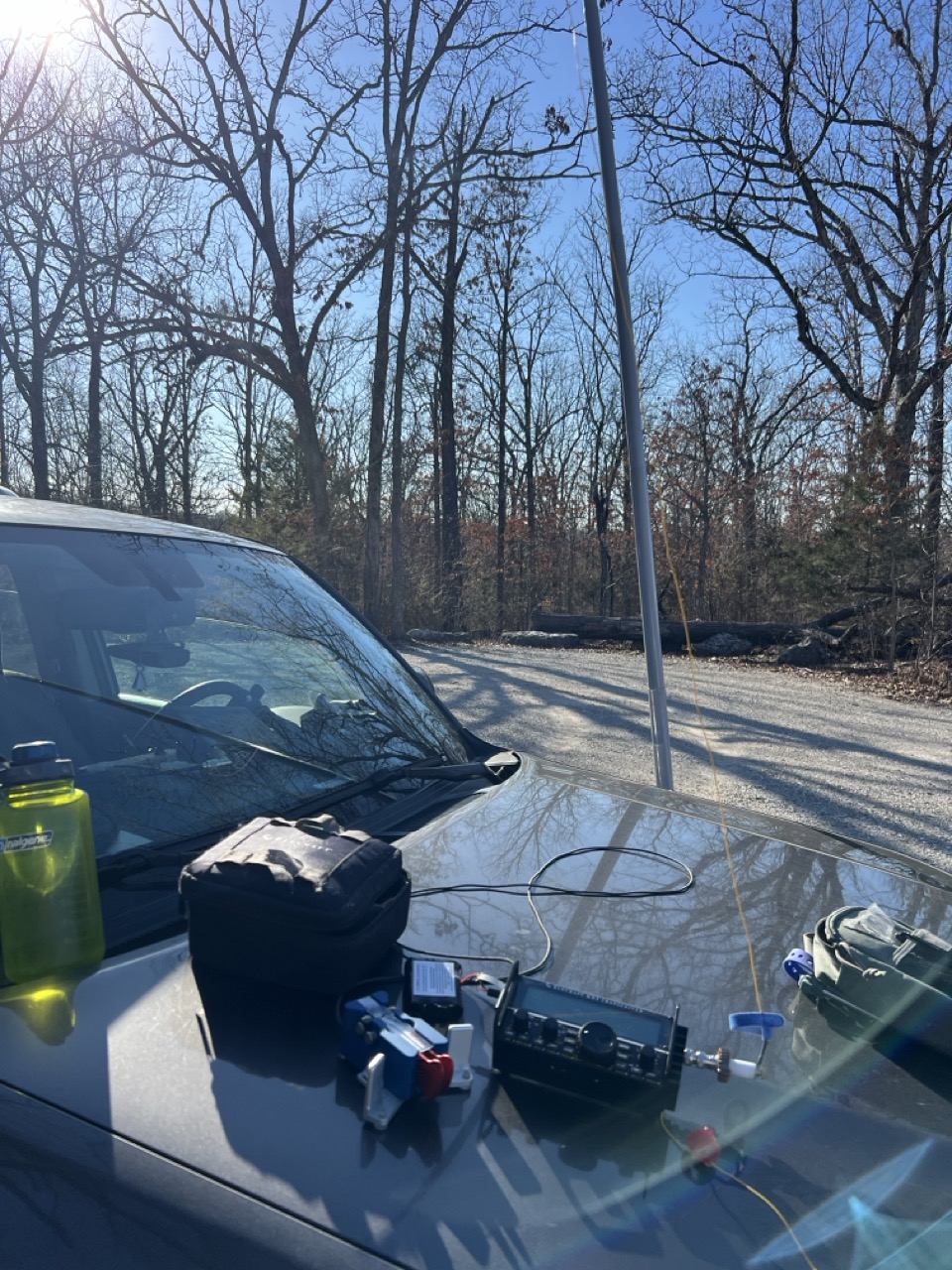
This was my operating position and station for the K-10214 activation. The KX2 is a great radio and the Begali Traveller key outstanding.
The radio was the Elecraft KX2 barefoot and I affixed the matching unit directly to the radio. I draped a short counterpoise wire off the front of the rig and connected it to the radio. I thought about using the factory paddles, but decided that I wanted the better feel of the Begali Traveller set.

Setup time was about 20-minutes, with some of that spent hunting the antenna bag in the back of the rig. Hmmmph…

I listened on the 10m band for a few minutes and checked the spots. One other activator was working 10m. So I decided to try. I picked a frequency, called QRL (is the frequency in use?), and listened. Nothing heard, so I punched the memory button and started calling while I spotted myself on the Internet.

After calling a few minutes there was no response. The 10m band was not open (for me). I listened for a couple of minutes on the 12m band and heard other stations operating, but every time I picked a frequency someone started calling.

“?#%@$# that” I thought, “I’ll just move to 15m.” So, I did.

I setup near the 21.060 QRP (low power) watering hole, listened, called QRL? again, and started calling while I respotted myself on the Internet.

In just a couple of minutes the callers started trickling in. What followed was about 1.75 hours of working stations. The 15m band provided a few contacts, then the 17m band filled out my quota. I worked both until I fished each hole dry.

Then I switched to the 20m band. I then spent the next hour working an almost steady pile-up of callers. About five minutes into the 20m band, my KX2 suddenly turned itself off. It would not restart.

“Battery died!” I thought. I dashed to the drivers side of my rig and grabbed the spare KX2 battery. I dashed back to the radio and plugged in the spare. I turned the radio back on and finished working my buddy Dick (he was the contact I was working when the battery died).

K7ULM? BAT DIED” I sent. He repeated his exchange and I logged the contact.

I had noticed that the KX2 was only putting out about 5-6 watts although I had it set for 10 watts. The battery was running low and I did not realize it. Fortunately I had a ready spare and it took only a few seconds to grab it and be running again.

I was logging on my iPhone (HAMRS), which works for me when I am in the field. I saw a text message banner pass at the top of the screen. It was my buddy Dick who said “20m is not working very well today…”

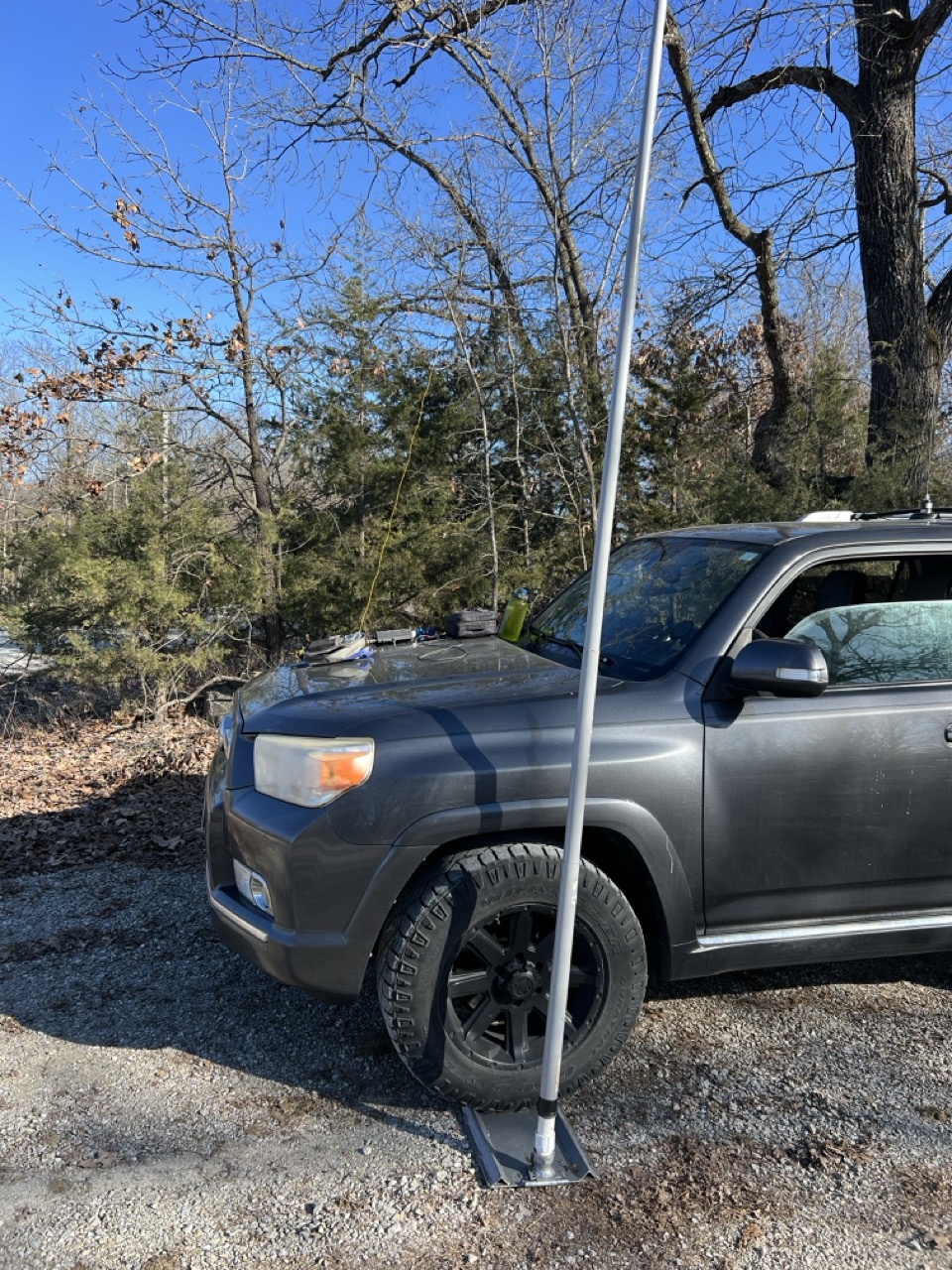
The drive-on mast mount was made by a maker friend, Tim W7ASY. I used the 10m SOTAbeams Travel Mast to deploy my 40m end-fed half-wave antenna for this activation.
“Ha!” I thought, funny guy.

The contact counter on my logging software said I had more than 65 contacts. I had worked through the pile-up, catching a fragment of a call or getting lucky when an operator called in the clear (between jumbles). My brain was pretty fried after working on the hydraulic model and then a number of big pile-ups.

I decided i had enough. The frequency was quiet — no callers. I sent DE AG7TX QRT SK (my call sign and I am signing off). Another caller appeared, so I worked that operator. (He was loud; it was an easy exchange.) I sent QRT again and turned off the radio.

I finished with 68 contacts in the log. I was the sixth activator of the park and the first code activator. Of course, there were lessons learned:

  • The end-fed half-wave is a much better antenna than the AX1/AXE. Of course I knew that, but fast deployments have been a thing for me lately. I had the room for this activation and took advantage of a superior antenna.
  • I thought the battery in the KX2 was in better shape. I thought that it was charging or at least not being used because I had used an external battery for the previous activations. I was wrong.
  • The lesson is to always check battery state of charge before going to the field.
  • Always have a spare battery handy. Things go bad.
  • Working a big pile-up is part of the fun of radio. Park activations provide that opportunity. But it is hard brain work and requires focus.
  • Expect to be tired after a park or summit activation. I was.

It was a good day. I chatted with Dick on my way home. I had 68 contacts in the log over an hour and three quarters. When I arrived home, Older Son was going through his workout. We went to supper after he finished and cleaned up.

I then showered and readied myself for bed. As I wrote, it was a good day. I am grateful. Life is good.