I read about the Khaki using the reference number for the unit and found that the case is 44mm in diameter. That is more like a wall clock on my 6.5-inch wrist. At least, I thought it might be. I responded to his email with this fact and he laughed about not even checking that.
The Hamilton came with a bracelet, but I rarely wear watches on bracelets. I can never get a bracelet to fit well — either too loose or too tight. I have a projecting wrist bone that a loose watch will bang against, making me uncomfortable. For that reason, I prefer a strap or I wear the head of the watch on the inside of my wrist, military style.
I ordered a few 22mm NATO and Zulu straps to try with the Hamilton. I could not get the bracelet off the watch. One spring bar just would not release for me. I handed it off to my buddy and he used his jeweler’s tools to cut it and remove the bracelet. When we regrouped for a weekly breaking of bread, I put a strap on the Hamilton and put it on my wrist.
It really does look like a wall clock on my small wrist. He offered to let me wear it for a week and I really like the look of the watch, so I accepted. But, in the end, it just does not fit me. I need a 38mm or a 40mm case to look proper on my wrist.
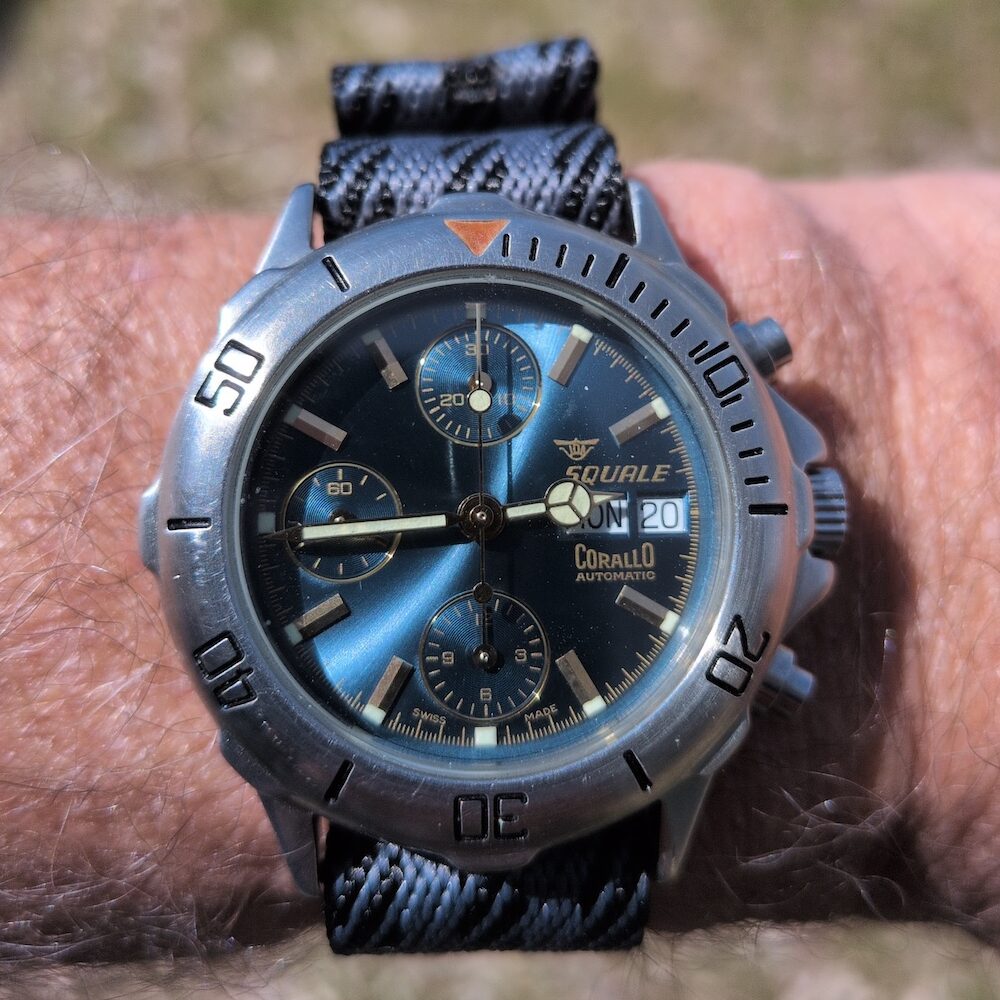
He also left me with a Squale Corallo chronograph-diver and a lovely vintage Wyler Incaflex. The former is a watch I am unfamiliar with, having not heard of a chronograph-diver before. They are difficult to design and build because of the start/stop and reset actuators. Those are points of entry for water. A watch on my wrist is unlikely to be subjected to any significant water pressure because I am not a diver. But, a watch on my wrist could get wet, so some water resistance is appropriate.
The Corallo is built on a Valjoux/ETA 7750-based caliber, which is a legendary watch movement. The time is set by pulling the crown out to Position 3 and making the adjustment. Position 2 is used for setting the Day/Date, but only when the hands are outside the range from about 2000h to 0200h/0300h. Avoiding that range is necessary to avoid damaging the movement, which is under stress during that period as it prepares to advance the Day/Date wheels. That said, and knowing that, I was at first unable to put the watch in time-set mode. The crown/stem seemed to require too much force and I did not want to force it.
After an email to my buddy, I finessed the stem/crown a bit with a thumbnail and it clicked into Position 3 yesterday afternoon. I set the watch using my phone’s NTP time connection and removed the bracelet.
It fits my wrist well, not with a bracelet, but with a 20mm NATO or Zulu strap. I had this subtle NATO in my inventory from a previous purchase, so I pulled it out and put it on the watch. It is fine, but I might want just a bit more color so will likely try a couple others straps from my inventory.
I have not made an image of the Wyler, yet. My buddy was disappointed when he received it, with the seller claiming the unit to be “mint.” The case has been more than polished, but the sharp edges ground down, likely because of bad nicks. So, it is not suitable for a collector in its current condition. I am not a collector, but a user. Therefore, I do not particularly care whether the unit is collectible or not — the dial is a true stunner and the Wyler brand was built on a solid caliber that resists shock better than most.
It will go for service and will be part of the trade we made. I decided to let my Speedmaster Triple-Date go because I prefer the Speedmaster ’57. The Triple-Date is also a bit difficult for me to read (old eyes), so this is a good trade for me.
It remains to be seen what I keep from my small collection of watches. A couple of them are on bracelets and should be. Neither would look good on a NATO strop. They might be OK on a leather strap. But bracelets do not work well for me, so if neither of them make the transition to a strap, then I will probably sell them. I no longer want to keep things just because. I want to keep them because they serve some purpose other than just “having” them.