Field Day 2022 AAR

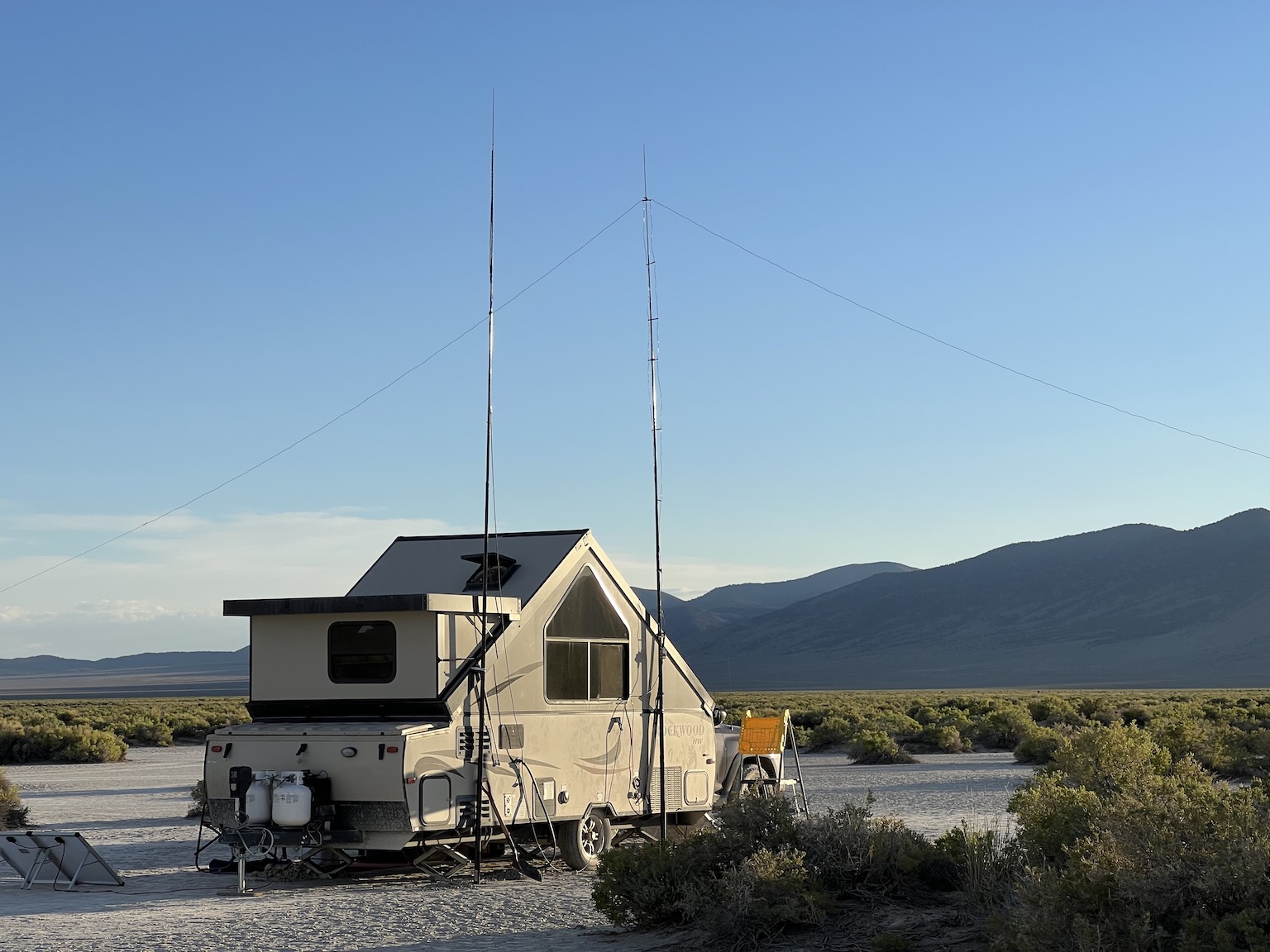
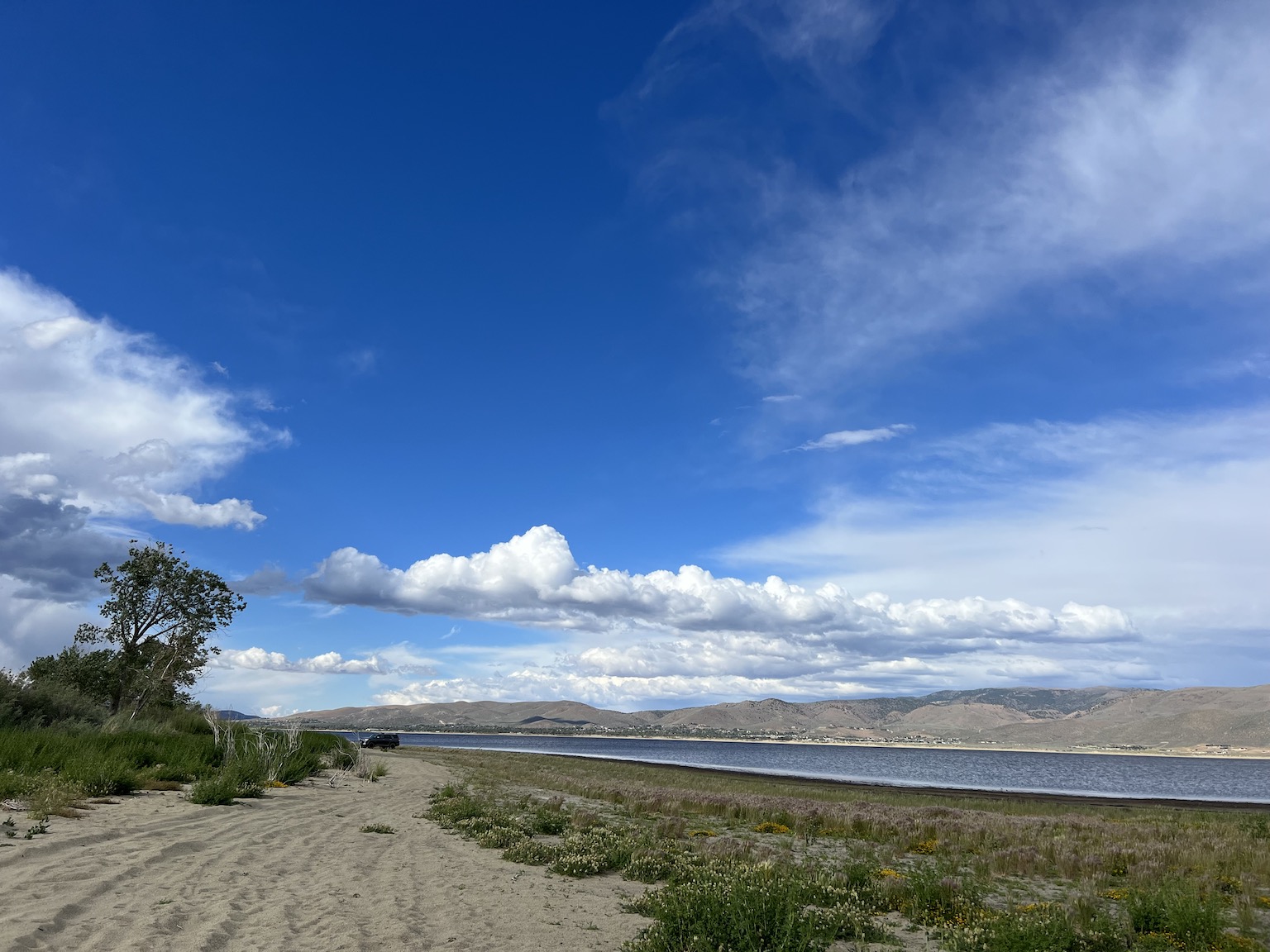
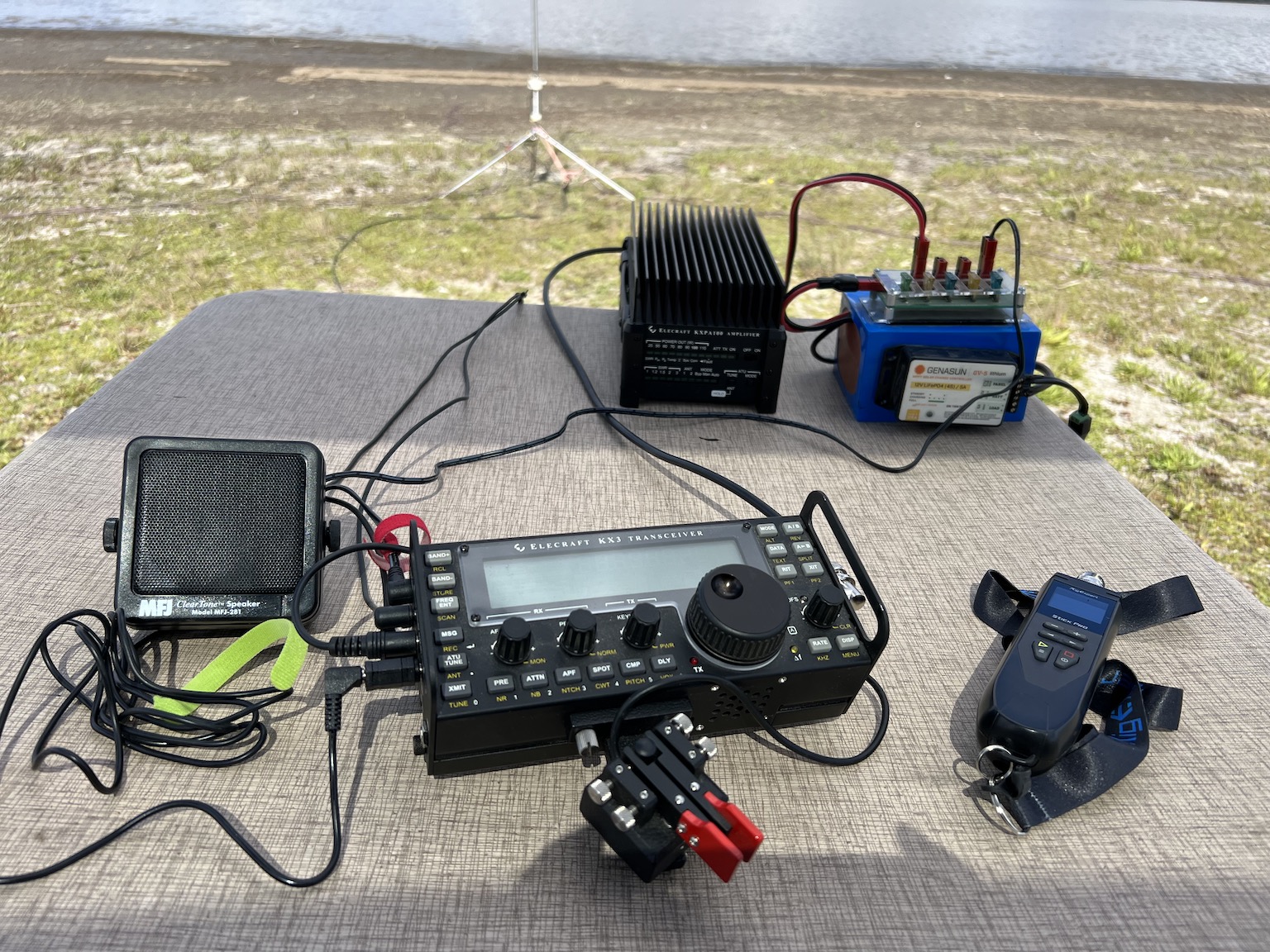
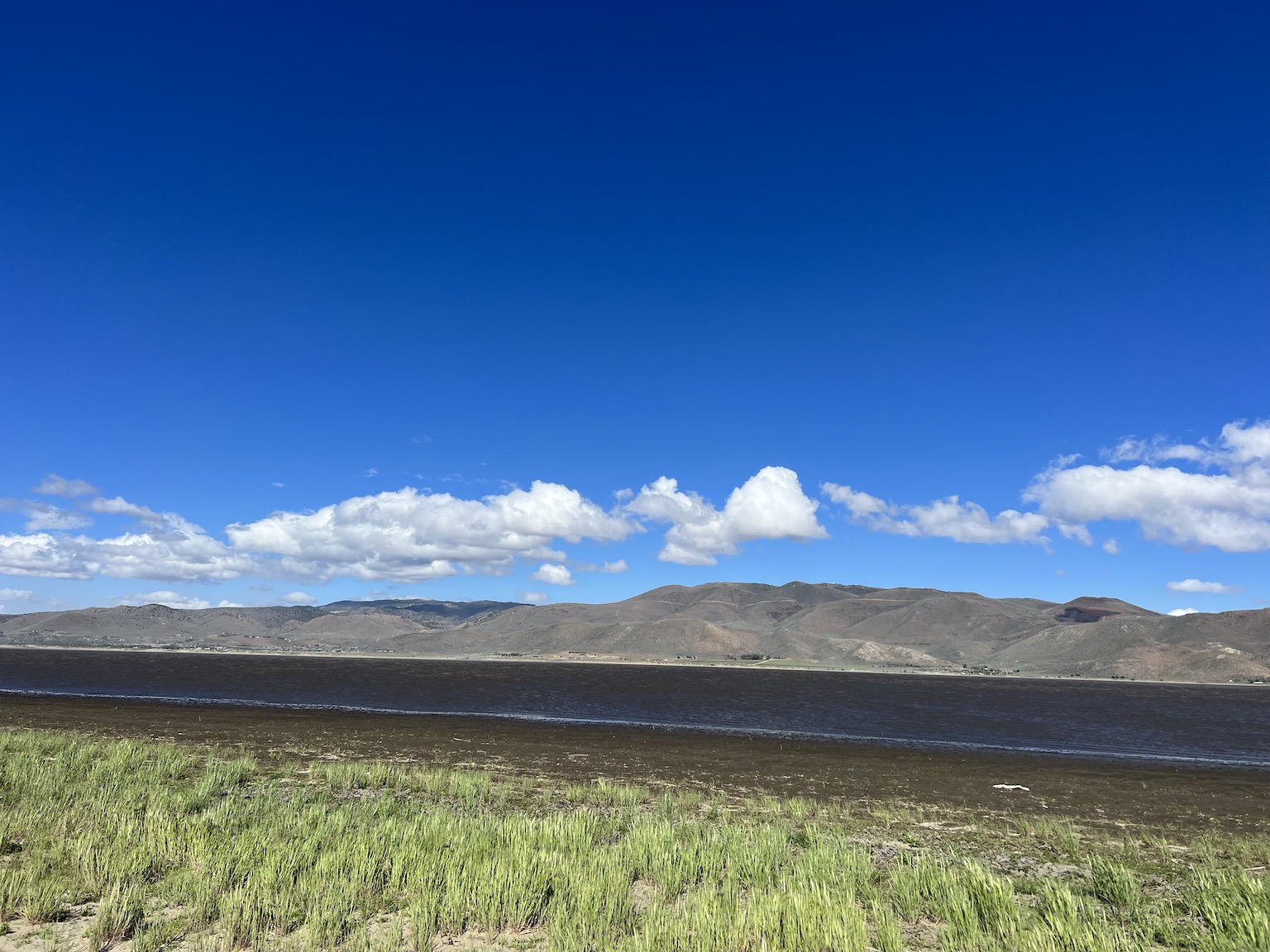
Early morning view of my camp at Smith Creek Dry Lake

Field Day 2022 is a long story, as these expeditions tend to have both a lot of moving parts and a lot of events. I would like to at least hit the high points of the story and describe some of the things that I learned. Perhaps one day there will be no more lessons… but I doubt it.

My intent was to leave Carson City on Thursday morning, have a leisurely drive for a couple of hours east to Dry Lake, and then set up camp and enjoy some solitude. However, the life of a consultant (consulting engineer) does not always lend itself to such plans. In any event, for this instance work interjected itself into the equation (it is a chaotic-dynamic system after all) and I was unable to prepare and leave as planned.

So, with Thursday not possible, Friday morning I threw some food, clothes, and gear into the camper and got out of town around noon. I did take time to make a grocery run the evening before, so I had a couple of sandwiches and some drinks in addition to breakfast and supper makings. I stopped at the Maverick on the east side of Carson City, refueled the 4Runner (gulp, gulp), did my final walk-around, and we (Sera and I) headed east.

On the way I chatted with a couple of operators through the SNARS (Sierra Nevada Amateur Radio Society — the Reno club) repeater network. I had a pretty good signal into the Mt. Rose repeater that is located southwest from Reno. It has a big footprint and I can hear it far to the east, especially when crossing the ridges in the basin and range territory.

I exited U.S. 50 onto NV 722 and drove through Eastgate, where I then started up the hill to cross the range into Smith Creek Valley, or whatever it is called. The grade is not bad and the air cooled with elevation. I put down the windows to enjoy the air and The Girl sniffed and whuffled as she smelled the things only she can smell.

I caught up with a one-ton truck dragging a trailer full of cattle. The 4Runner pulling the camper does not have the torque to pass on the uphill grade. But, I did not have to follow long because he pulled off the road before the summit. On the other side of the summit, I caught up with a heavy truck pulling a trailer and wagon full of cattle and moving very s-l-o-w-l-y. But I was not in a big hurry and followed a ways behind (you know why) until the driver turned off onto a ranch road and left me with an open highway.

Except… there were cattle on the highway. So I kept my speed down, not trusting them to stay out of my path and threaded my way through the herd.

Past the cattle-jam, it was only a few more miles to my turn off for Dry Lake. I took the first turn off, which is a good gravel road more than half way to the lake before it turns into a trail. The trail was quite passable if a little slow and dusty.

I called my friends two-meter simplex for directions to the camp site. I had a pin dropped in the GPSr I take with me, but they might have had to relocate camp. They confirmed their location and guided me through the collection of land sailors to our camp area. On site, I stopped by to see Greg and Subrina, who were finishing camp setup. I could see where Tom was setup and where Joe’s group was set up, so I took off to the northwest and chose a spot about 1,000ft from Greg’s Place.

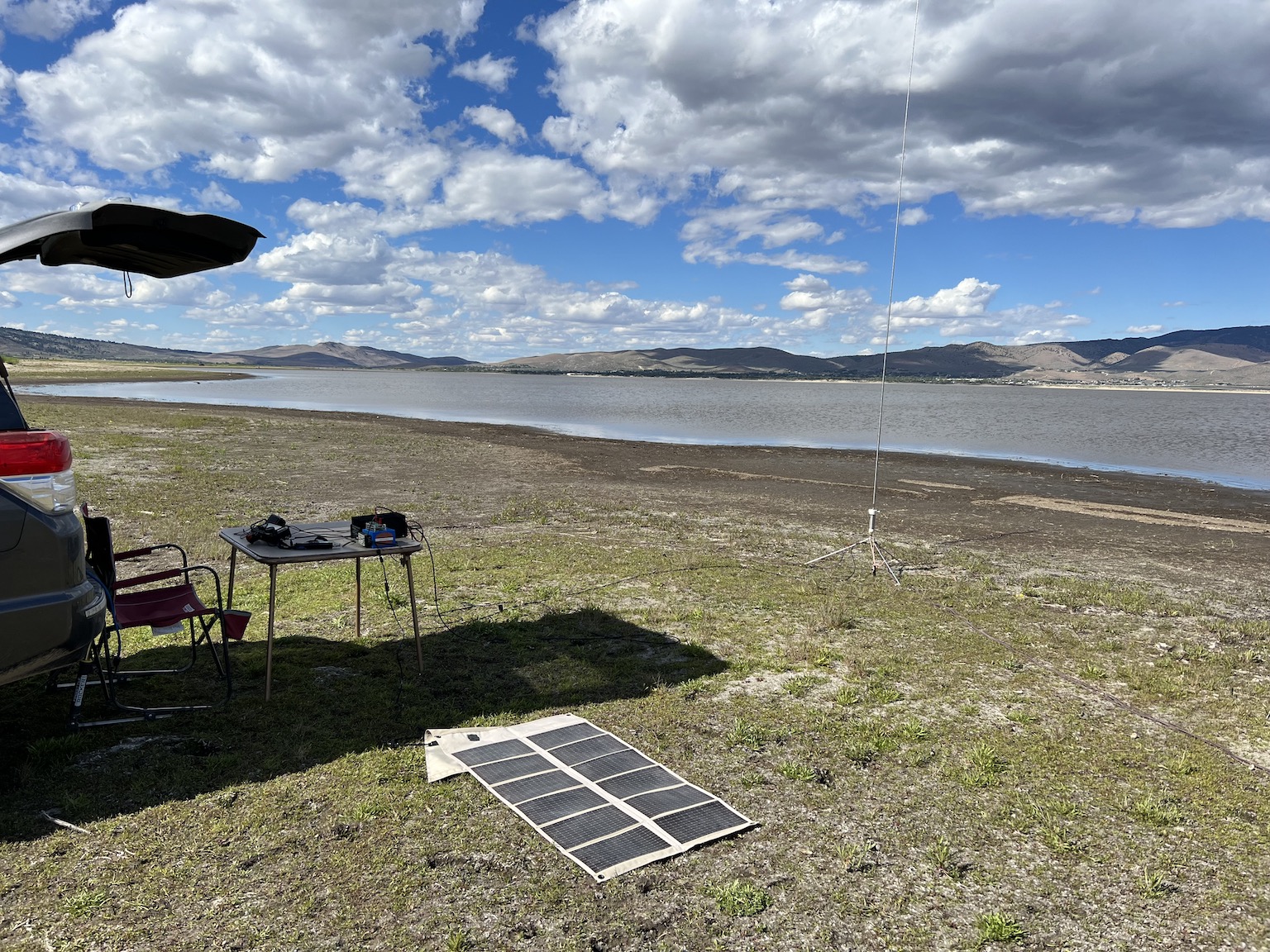
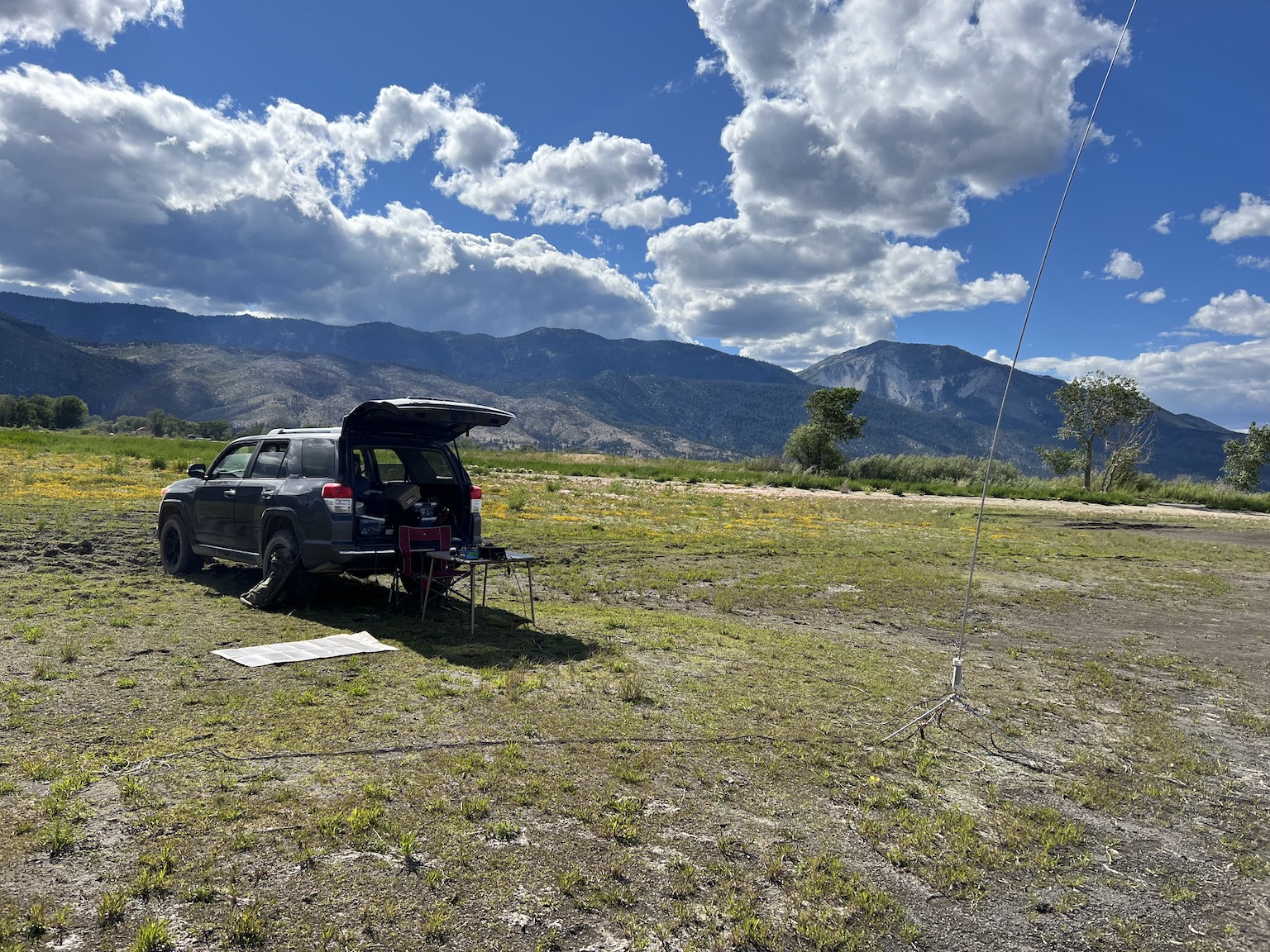
I then dropped the camper and began deployment of my camp and antennas. It does not take long to set up the camper, maybe 15 minutes or so. Once the roof is up and the sides are in place, it is only a few more minutes to drop the stabilizers and deploy the solar panels that keep the camper batteries charged. The sun was so good that my panels were generating about 110 watts. They are rated for 120 watts. The sun was good out at Dry Lake.

I decided to use the home built doublet my son and I made a couple of years ago. Each leg is 22 feet long and we built open wire feed line. The open wire terminates at about the window level of the camper, where I place a 4:1 balun to a short coaxial cable run for the last few feet to the radio.

I also deployed a twinlead J-Pole for local two-meter simplex operation. With our group so far apart and the fact that my camper is a Faraday cage (as far as HT use is concerned), I wanted an external two-meter antenna. I eventually deployed the Chameleon MPAS 2.0 vertical for the main station. I find that sometimes the vertical will bring in a signal better than the inverted-V doublet.

I power my station with a 60Ah Bioenno LiFePO4 battery. It has enough capacity to run a couple of radios, the station computer, and charge smaller batteries. To keep it supplied, I run another set of panels that are rated for 120w through a Genasun GV-10 MPPT charge controller. Eventually I plan to install the station battery under the bed. I would also like to move the camper batteries under the bed.

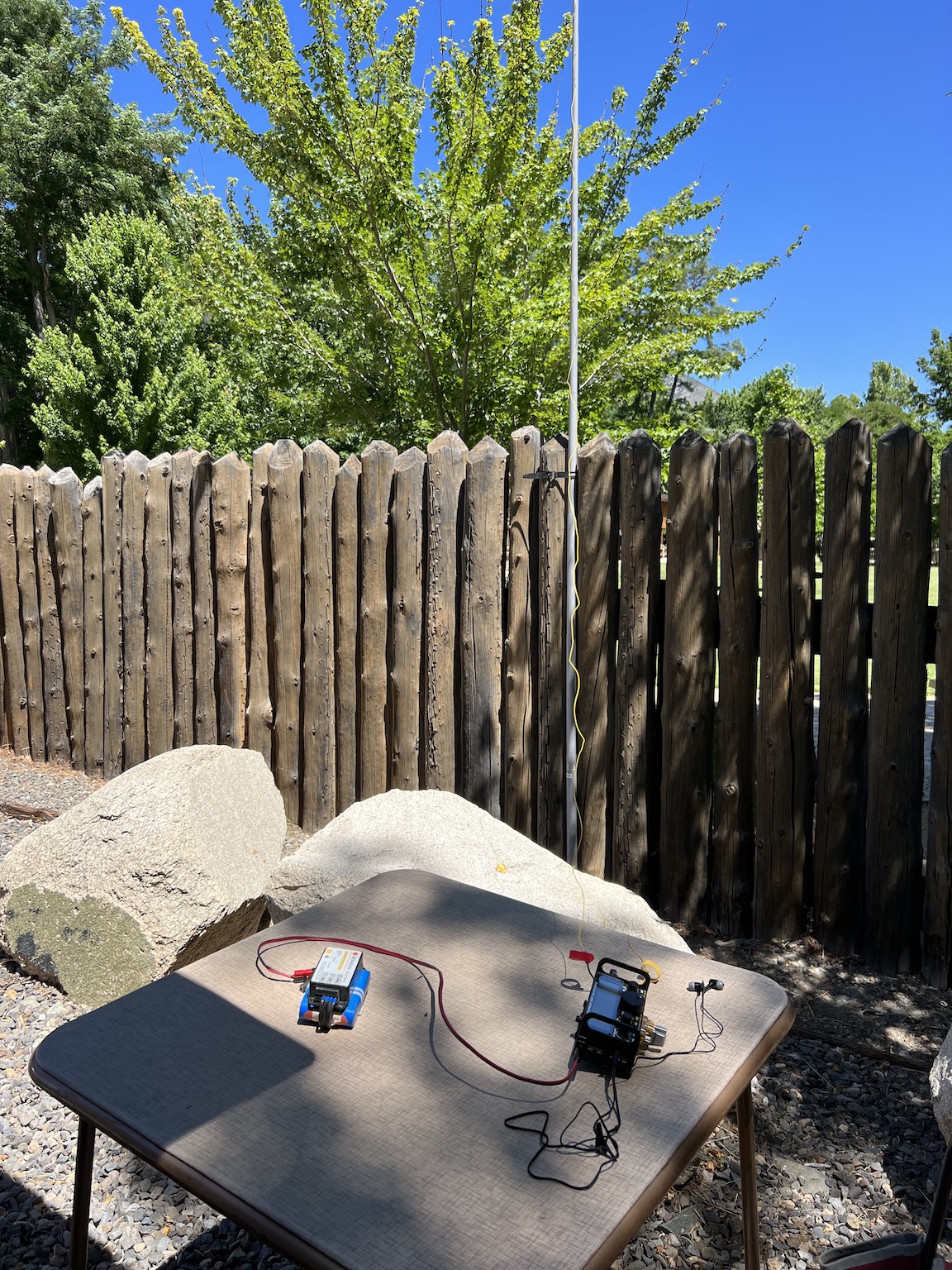
I eventually deployed three antennas. The two in this image, a J-Pole for 2m/70cm and the doublet for HF. I also deployed the Chameleon MPAS 2.0 vertical later in the day.

All of that took about an hour and a half to complete. I was then ready to settle in, so The Girl and I walked over to Greg’s Place to socialize a little. She needed a walk (and really wanted to hunt the hummocks that litter the dry lake bed) and so did I. I was hot and sweaty and knew that a shower was going to be really good that evening. I checked in with my friends, who were still working on their camp, and then proceeded on to the next camp, Tom’s place.

Tom was setup and relaxing in his tent, but roused when we approached and came out to visit and play with Sera. Like all canines, Sera knows dog-people and readily takes up with Tom. As we visited, Greg rode over on his motorcycle and we continued to visit until it got dusky.

The visit complete, we returned to our camp, getting credit for a nice walk. I fed The Girl then got myself some supper and began settling in for the night. I was tired, hot, and sweaty. The camper was cooling down with the sun behind the mountains and the fan running. So I got a shower and listened to the radio a bit. Then I hit the rack, knowing I would be up as soon as the morning twilight came.

This is my galley. I was working up my second cup of coffee and cooking some bacon. The Girl gets the bacon fat and then I make some eggs. She generally gets a nibble of my bacon and maybe a bite of egg as well.
Sure enough, I was up as the sky brightened in the east. I rolled out of bed, stepped outside to relieve myself and enjoy the sky, then returned to the camper to make a cup of coffee. While I worked through my first cup, I turned on the radio to listen for any stations. The upper part of the 40m band was full of Asian broadcast stations, as usual. There were some other stations working in the phone portion of the band below that. I heard nothing I was interested in working, so I just enjoyed listening to the stations.

I made another mug of coffee and started breakfast. It was my usual camp fare — bacon and eggs. I can tell that I am my father’s son. I think he ate bacon and eggs almost every morning, at least as long as I knew him.

Of course, I pour the bacon fat over The Girl’s kibbles. That is her treat and once it cools a bit, she eats it. Then she wanders over to see what I have and if I will share.

After breakfast I wandered through the adjacent camps, in part to visit and check on folks and in part to get in a walk for both of us. Tom was just finishing his breakfast and gave a bite to Sera. It was not long before Greg wandered over and all chatted (yes, the bull was shot) for awhile.

As starting time approached, I headed back to my rig. I moved the station outdoors, thinking I would operate outside under the shade of the 4Runner’s hatch. I really prefer being outdoors.

Greg organized a local net, knowing the craziness that occurs during the first hour of an international event (like Field Day). I do not recall why, but after making the circuit on the two-meter band (simplex), Greg excused himself and handed off “net control” to me. So we worked 70cm, then turned to 10m, and then those of us who know Morse Code exchanged information on 10m CW mode.

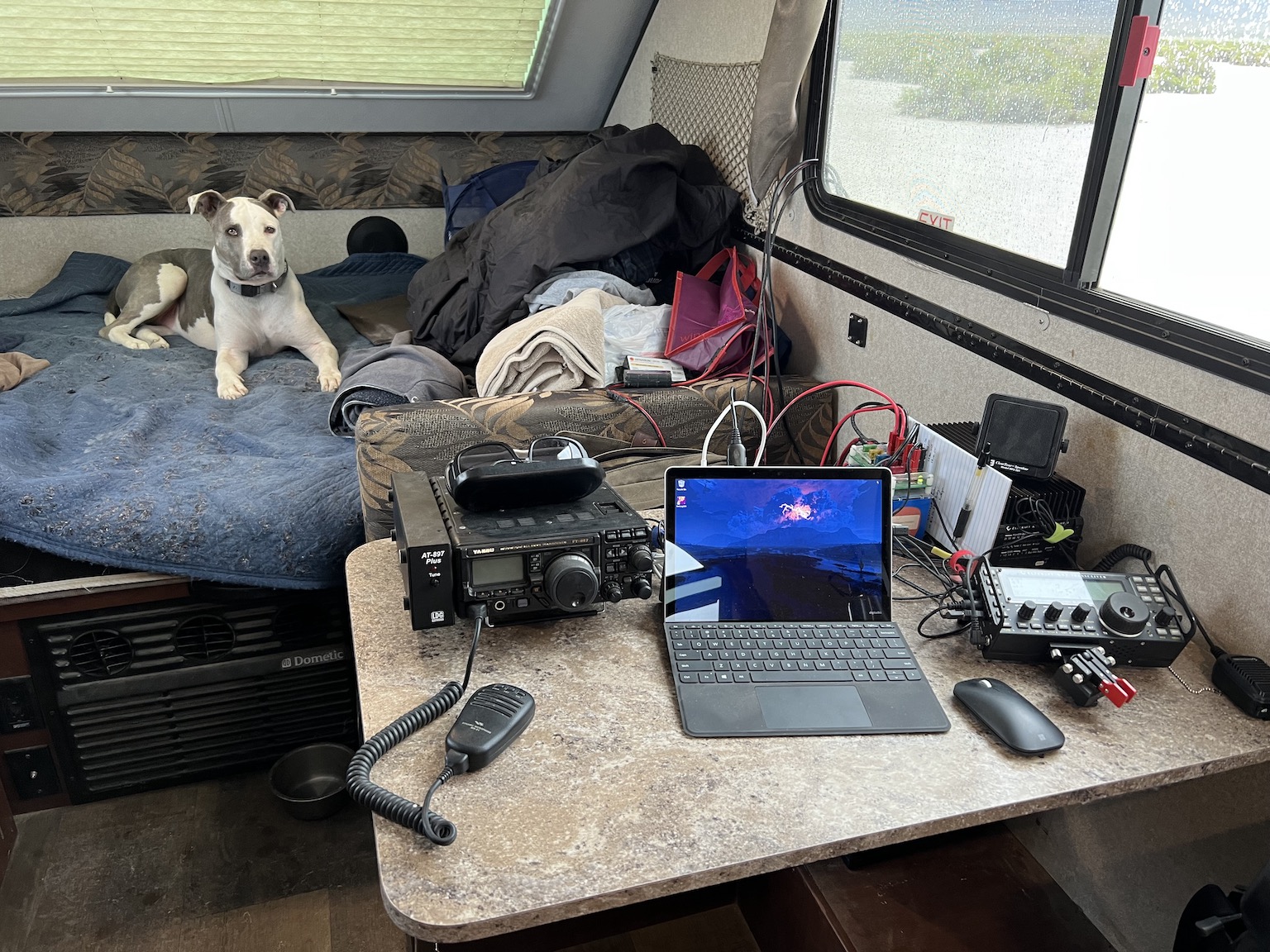
I had an issue with my logging program when we moved to the 10m band (which was the KX3). (The VHF/UHF exchanges were on the FT-897D, which was not connected to the computer and logging software.) So it took me a couple of minutes to solve the problem. This was good, because I would be logging with this software for the duration of Field Day.

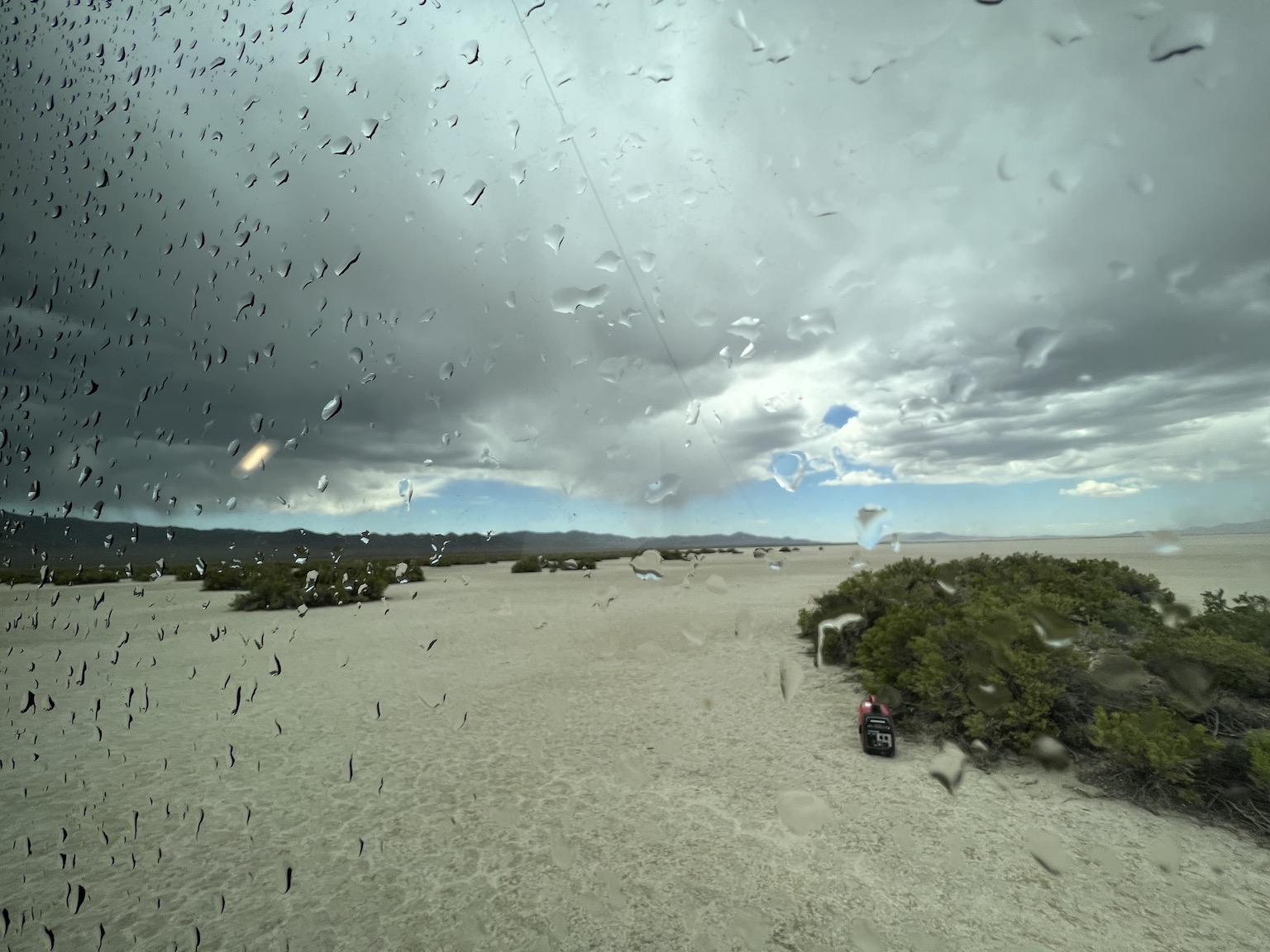
Not long after Field Day 2022 started, a small shower approached and drove me indoors. I saw it coming, so I had plenty of time to move the equipment. What I didn’t know is what happened to others in our expedition.
As we concluded, I noticed a shower moving in from the south, so I tore down my outside deployment and moved the equipment indoors. As I was finishing putting away the folding table and chair, the wind gusted and a few drops of rain fell. Everything outdoors that could be impacted by rain was moved indoors or to cover.

I moved indoors.

I sat down at my station and listened for calling station and chased a few of the runners. I was listening to our shared frequency on 2m and heard a call.

“Are you alright?” came the call.

“Yes, I’m in the camper running the radio.”

“I was just checking. Tom’s tent and EZ-up folded up in the wind.”

“Really?”

“Yes.”

After the rain drove me indoors, this was my station for Field Day 2022, including the Yaesu FT-897D used for local communications on 2m.
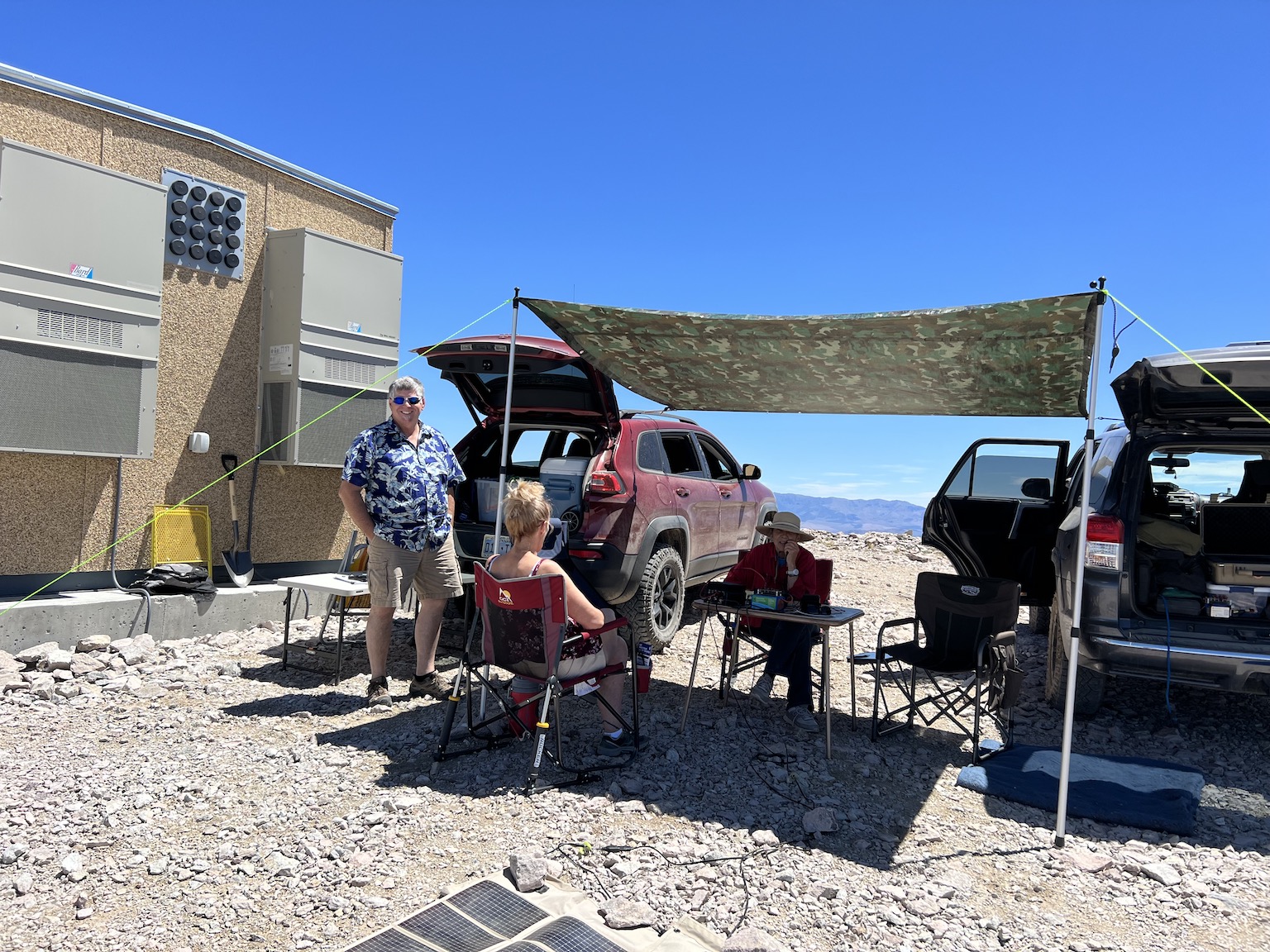
As it turned out, our group lost two EZ-ups and a tent. I had no problems at my camp and neither did the other group. But it was the end of the road for one of our group, who showed up at my camp to wish me well. He had a wadded up mess in the back of his pickup. I could only shake my head.

“At least this gives me a chance at a new tent,” he said. I nodded.

Another part of our group reported sparking of equipment in their trailer. They took down their antennas and sheltered inside.

At my place, I had some light “ticking” heard on the radio and could feel some static electricity. I was getting some static buildup from the wind blowing on the wire.

About suppertime Greg pulled up outside on his bike. “You have any supper plans?”

“Not really.”

“You’re welcome to bring supper up and eat with us. I’m going to grill a steak. I’d offer you one, but we only brought enough for ourselves.”

“I have a couple of hamburger patties that need to be cooked. Would you mind?”

“Of course not, bring them over.”

He headed back to camp and I grabbed some food. Sera and I walked over to their camp. The grill was about ready to receive our dinner meat and Greg graciously cooked my hamburger patties. It was certainly good to get away from the radio for a bit.

I guess I was hungry because I ate both patties. After supper we visited for a bit before Sera and I headed back to our camp. I continued working stations until about midnight, when I called it a day. I took Sera outside to relieve herself and looked up at the sky while she sniffed about. It is dark out at Smith Creek Dry Lake and the stars are gorgeous. I heard coyotes calling and they did not sound too far away. Sera looked intently in the direction of the sound. “Leave it!” I demanded and decided it would be better to retreat to the camper.

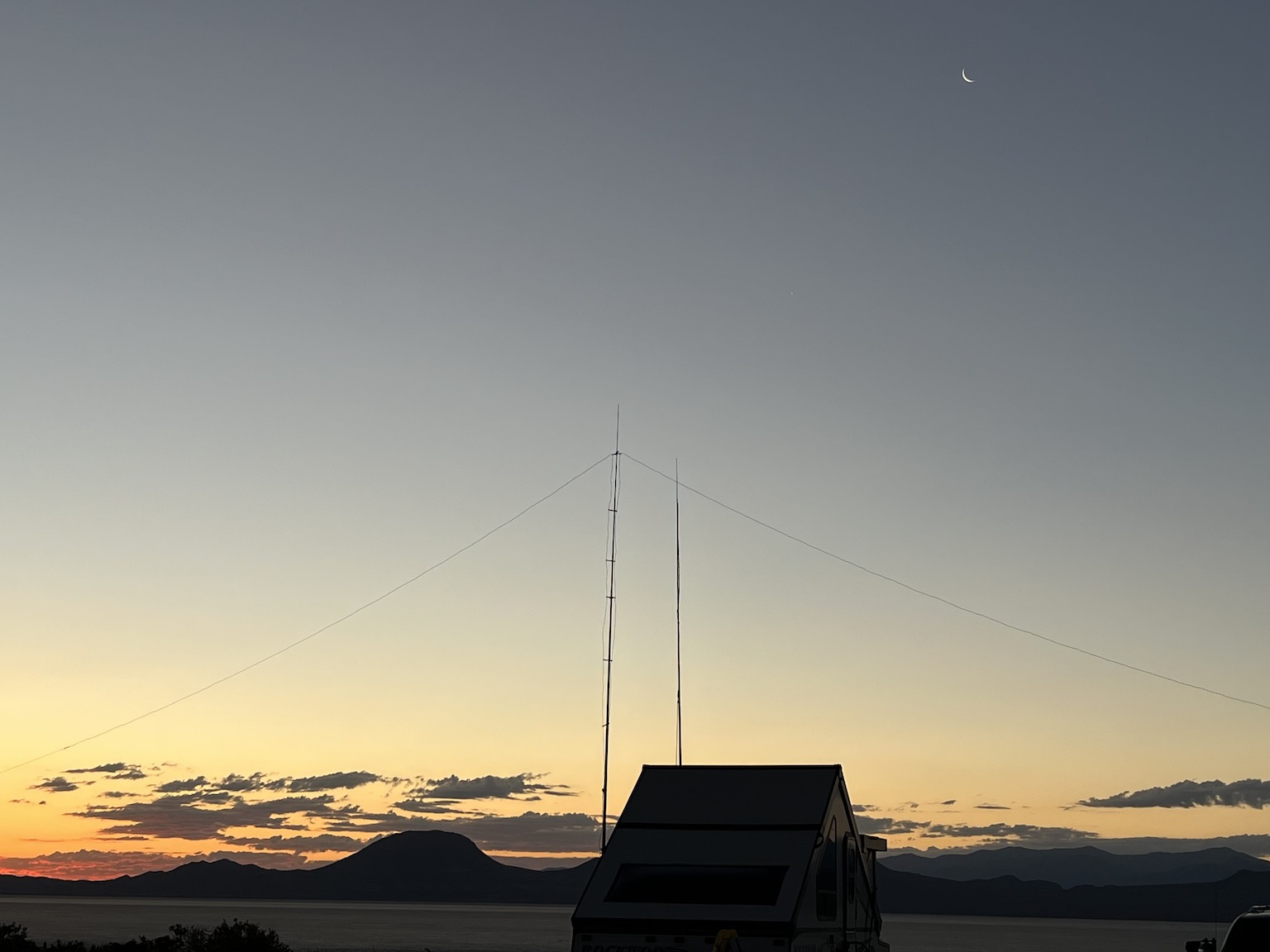
Here is my rig and a morning crescent Moon.
As the eastern sky brightened, I woke. I made a cup of coffee and enjoyed the sunrise.

After getting The Girl out for a short walk, I returned to the radio and worked stations until about 1000h. By that time I had enough and decided to shut down. The Girl and I walked down to Greg’s Place and checked in with our friends.

As the day wore on, I took a break and caught a nap. Sera is (almost) always willing to nap with me. It is one of the things I love about dogs. They are such wonderful companions.

After Field Day 2022 ended, we celebrated the weekend and the fellowship. The remainder of our group had already departed. We stayed over./caption]After Field Day 2022 ended, we celebrated the weekend and the fellowship. The remainder of our group had already departed. We stayed over.
It was time to gather for our Field Day 2022 celebration. When we are on expedition, we always gather for a close-out party of some kind. Greg and Subrina graciously provided hamburgers. I brought what I had (at least a bottle of wine). And we visited, laughed, and shared a meal.

It was just the three of us plus Sera. The remainder of our group had left. That is alright — it is often the four of who do things together. Others come and go from our circle, but the four of us are a constant.

We decided to drive around the playa. We intended to use the hot spring. When we arrived at the hot spring, someone had drained the tank. The water was too hot to get in without it having time to cool. So, our Nevada hot spring bath would have to wait.

Greg wanted to check out the smaller dry lake north of the larger one, so we headed out that way. It would also make a good operating spot and would not have any land sailors to deal with. (Although they have never been a problem.)

We split and headed to camp. I began to put away the doublet I had setup and the J-pole I was using for local 2-meter communications. I put away the Yaesu FT-897D as well. But I left the Elecraft KX3 out and left the Chameleon MPAS 2.0 setup so I could play a little more radio before calling it an expedition.

It was break time for me. I wandered over to Greg’s Place, brought my supper along, and then we relaxed with a campfire before The Girl and I headed home.
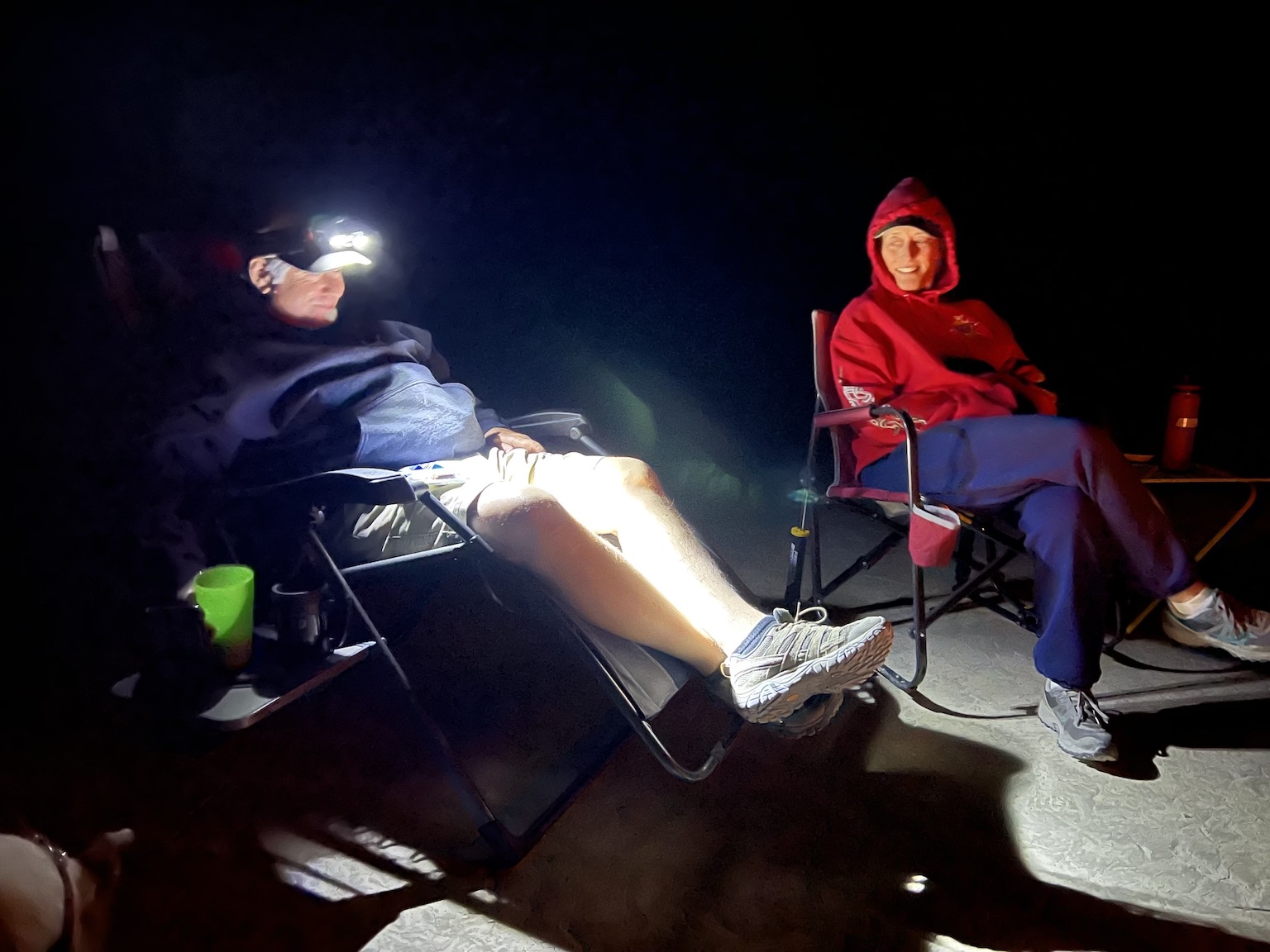
It was break time for me. I wandered over to Greg’s Place, brought my supper along, and then we relaxed with a campfire before The Girl and I headed home.[/caption]As dusk approached, I needed a cover and wanted to feed Sera. So I fed her and then we headed over to Greg’s Place to complete our celebration of Field Day 2022. Greg built a campfire in his burn barrel. The wind was cooperative (for a change) and did not blow smoke at us (most of the time). I kept Sera close because it is very dark.

I woke early, again, made some coffee (while Sera looked at me for a moment, sleepily), and stepped outside. The morning horizon was so beautiful. As I finished my coffee, I got the small drone out to see if I could get some video or stills.

Once again, the DJI Mini refused to fly reliably. There was little wind, but it just would not maintain altitude. I cannot figure out what I am doing wrong, but I was disappointed to leave without some aerial images.

So I made another coffee, played a little radio (mostly just listened), and prepared for the final tear down of camp and loading up of everything. It only took me about an hour to get done and I was just finishing up when Greg/Subrina pulled up.

It was mid-morning, or a bit later. We were not in a hurry. We headed out, but I noticed the vent hatch on their trailer was flopping. It needed to be secured, so I called them (radios are great) and we stopped so they could secure it.

As we climbed over the hill, Subrina called… “Is it too soon for lunch? I was thinking we should stop at Middlegate.”

“I’m always up for some Middlegate.”

“Very good… let’s do it.”

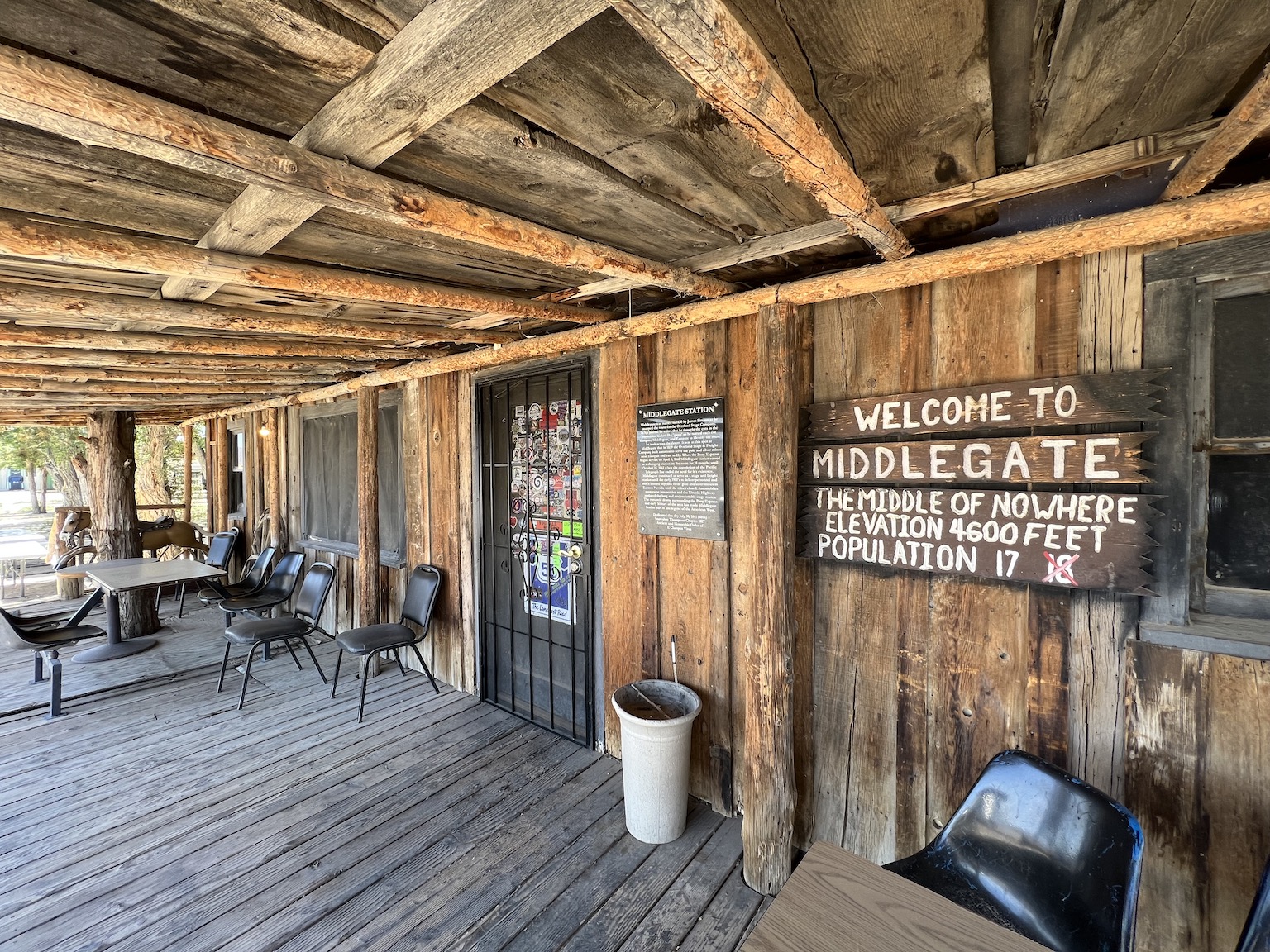
“Roger, roger!” I smiled. One of my favorite places in Nevada is the Middlegate Station bar/grill. It is a favorite stop for all sorts of travelers through central Nevada. I stop there whenever I am out that way and it is about lunchtime.

Middlegate Station, a favorite place for a respite in the “middle of nowhere.”

What was even better is that Subrina was buying! Instead of my usual cheeseburger (very good), I ordered a pastrami melt. It was super good and the home fries were excellent. I do not eat as many potatoes now as I used to, but I get them and share them with Sera.

Too soon, once again, it was time to go. We headed out to the rigs and then on down the road, west on U.S. 50 to Fallon and then on to Carson City.

I called and told Greg/Subrina that I needed to refuel. Greg suggested the Speedway in Fallon but indicated that there was now a Maverick store there. He did not know where.

As we entered Fallon, the Maverick store is near the Speedway location. So I stopped there to refuel. I cleaned up the windows as well. And, I noticed an RV dump there that I could use. So I took a few minutes to empty the blackwater tank and then wash my hands.

Greg/Subrina had continued on. They were going to refuel and dump in Carson City. On my way west, I called them a couple of times and we could hilltop. They were a few miles ahead of me. I did catch them at the Maverick in Carson City, where I stopped to say my goodbyes and thanks for the weekend.

I really, really did not want it to end. These people are family to me. They might as well be blood.

It was only a short final hop to the house. I backed the camper into my driveway, unhooked, parked the rig, and raised the camper. With Sera secured in the house, it took only about a half-hour to unload those things necessary to unload. I then got myself a glass of wine, let the swamp cooler do its thing, and relaxed.

Field Day 2022 was over. It was time to think about cleaning up after the trip and to think about finishing the work in front of me.

As I always do, I learned a few things during Field Day 2022. Here are a few of them:

  • The Yaesu FT-897D is a great radio. It is also a big radio. It takes up too much space on my work table (the dinette) for use as only a two-meter radio.
  • Using an external antenna for two-meters (the J-pole) is an excellent idea. The camper is almost a Faraday cage, especially for the two-meter band. My HT will just not get out. Given the FT-897D is too big for what I want, a smaller, dedicated two-meter rig in the camper would be a great addition to my portable station.
  • I have a Kenwood TM-V71A in my 4Runner as my mobile 2m/70cm FM radio. It is a winner in my view. While it is only FM mode, it has excellent audio, adequate power (50w), and is very easy to program from the front panel. In fact, I like the radio so much that I bought another for use at home in my workroom. I should put one of these radios in the camper and then either put a permanent mount on top of the dormer (above the galley), or use a J-pole on a telescoping mast like I did for Field Day.
  • The Microsoft Surface Go 2 is excellent as a portable logging computer. It is small enough to be easy to carry but large enough to be able to read. It also has a smallish but workable keyboard/cover. It does not use a lot of power. It is powerful enough for some light photographic editing and will probably serve well enough for digital modes.
  • The home built doublet continues to be a solid performer for portable operations. I lengthened the cordage at the end of the legs to get them a bit higher off the ground for this deployment. The best I could tell, there was no difference on receive between the doublet and the vertical antennas. I think some additional experimentation is in order. /li
  • The current doublet is built with 16ga THHN I bought at the local hardware. Although it is stranded wire, it is very stiff and difficult to stow on the line-winder without kinking it. Plus, the home built ladder line (made of the same wire) is difficult to wrangle in the field. It would be a lot easier to manage with some 16ga flexweave wire for the elements and some window line for the feed. I have a design in mind that I want to try. The THHN elements and home built ladder line would be fine for a semi-permanent installation; but not so much for a field deployment.
  • Weather will always be a potential issue. I now have a ground rod for my camper station. I need to finish preparation of a place to ground the rod to the camper chassis and provide a ground for the station. That would eliminate any static collection and is likely to improve station performance.
  • I am satisfied with my Field Day 2022 deployment. My equipment worked as planned. I had plenty to eat. I had great fellowship with my friends. It was a good deployment despite the fact that we lost two easy-ups and a tent.

I am looking forward to our next expedition. I do not know when it might be or where. But I know that I am ready and looking forward to spending time in the field with my friends.

Life is good. I am grateful.

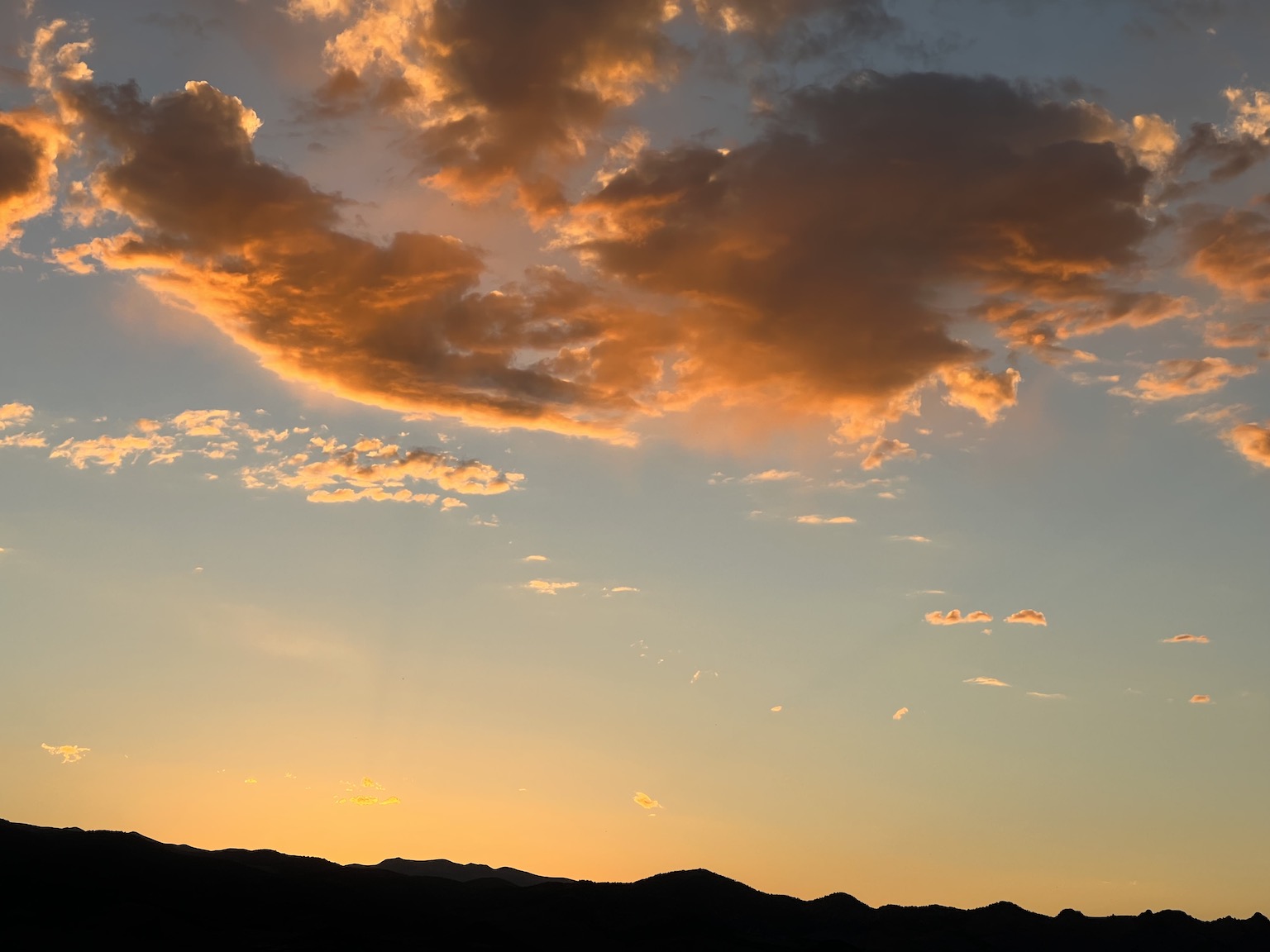
Sunset, Field Day 2022, Smith’s Creek Dry Lake, Austin, Nevada.

Flight of the Bumblebees 2022 — AAR

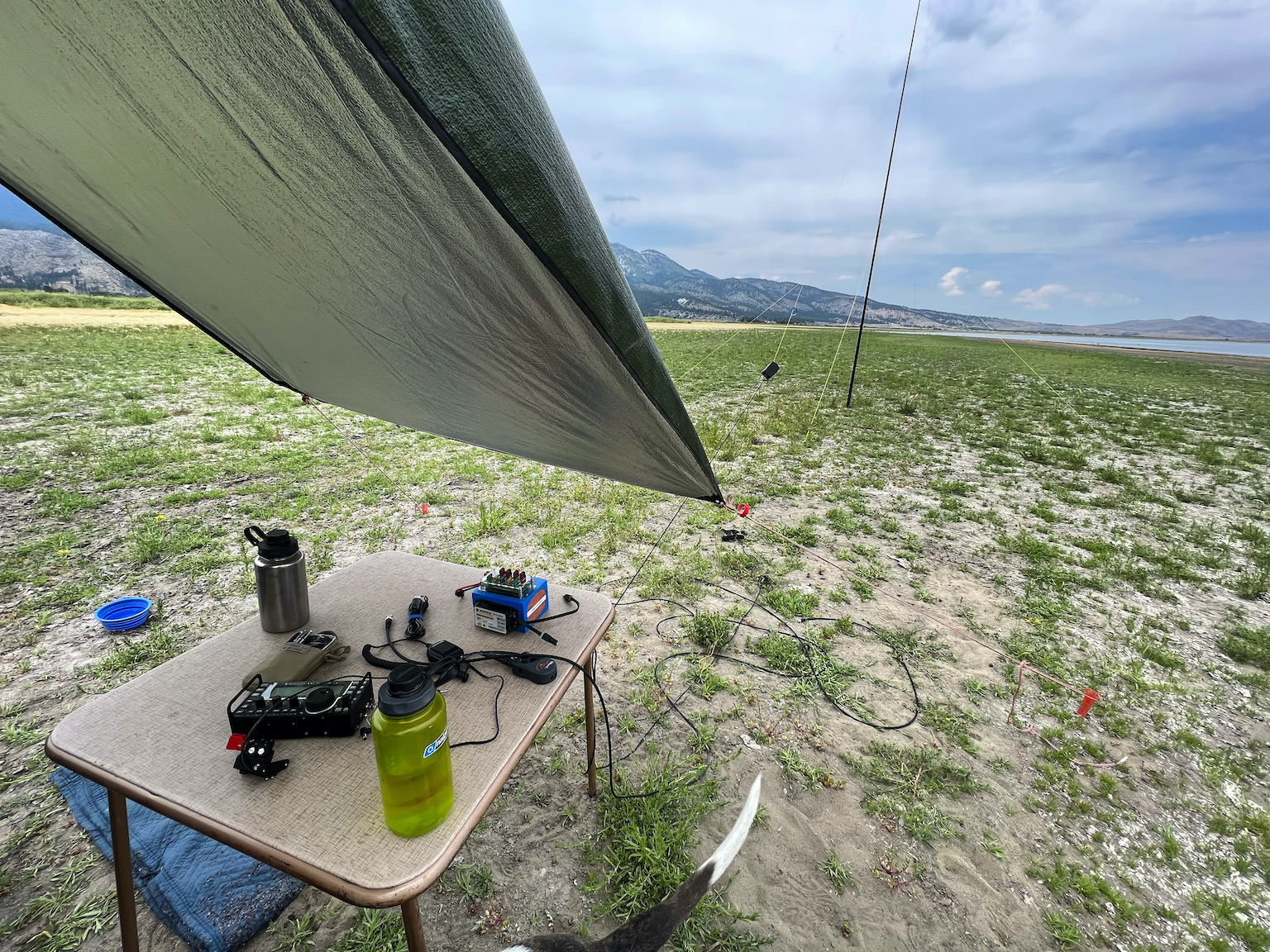
My station and operation position for the 2022 Flight of the Bumblebees contest. Yep, that’s a dog’s tail in the bottom of the frame.

This year, 2022, was my first Flight of the Bumblebees contest. This is a QRP (low power, usually 5w for CW mode) and has been going on for a number of years.

I planned to work the contest for the last few weeks. I decided to operate in the field (of course) from Washoe Lake State Park, which is also a Parks-on-the-Air park (K-2640). I often activate the park as it is only a short drive from my home and The Girl and I love to walk there. It is a win-win for both of us.

I picked up my friend, Diana (KJ7GVY) about 0900h and we made the short drive up to Washoe Lake. I prefer to operate on the west side because the take-off angles are better and there are a lot fewer people. We picked a spot and started setting up the equipment.

I elected to hang a tarp over the back of the 4Runner to provide extra shade as it has been very hot in the afternoons here. Although there was overcast, the wind was down and the humidity was up. By the time we got the station set up, I was quite soaked in sweat. This is unusual for me.

The station was my Elecraft KX3 at five watts to an end-fed half wave antenna. The antenna is built on a Balun Designs 49:1 matching transformer, but I cut the wire and counterpoise for the antenna and tuned them.

Aside: I have in mind another design for an EFHW. After reading a paper on these antennas, it seems that a 36:1 matching transformer with a 200pf capacitor about a third of the way from the feed point will make a 40m EFHW work better on the upper bands. I am going to try one. I just about have everything I need to build the transformer and radiating elements.

I think I started operating about 1030h local. I heard nothing on 40m. I was hoping for some California and close-in Oregon stations, but nothing heard. The 20m band had quite a few operators around 14.060MHz. I chased a couple of them and then looked over at my friend.

“I’m going to run a frequency. I think I’ll do better if I just pick and place and go.”

So I found a place about 14.062MHz and started calling CQ CQ BB de AG7TX AG7TX/BB AR. After a few calls I started picking up some callers and worked them as I could. I am still learning CW and CW operating practice. This was the first time I ran a frequency in a CW contest.

But all the practice running a frequency for POTA and SOTA activations paid off. I picked off call signs or fragments and worked the callers. It is such good brain work and I had a blast.

Each time the well ran dry, I would check another band. I worked a friend on 40m, but I’m confident he was running more than five watts. I also worked him on 20m, but he never got below 20w. So he does not count for the contest (but will get a POTA credit).

The 20m band was the band to work here in western Nevada. I made a total of 35 contacts, dropping those that I did not get a power from or that I new were operating more than five watts. This included 19 Bumblebees.

After the contest ended, we walked The Girl a bit. Then we headed back to Carson City and made a stop at the Sonic. The chili dog and shake just topped off the day. The Girl got a few tater tots for her contributions as well.

I had a blast. It was a good day. Life is good.

Mormon Station SP POTA

Here is the operating position for my activation of Mormon Station SP.
On Thursday, 30 June 2022, The Girl and I visited two Parks On the Air parks — Mormon Station SP in Genoa, Nevada and Washoe Lake SP in Washoe Valley. After the intensity of the last several months, I did not get enough of other-than-work time on Field Day. My Field Day AAR still needs to be written. I will get to it, probably over the weekend.

I find Mormon Station difficult to activate. It is a small park. There is a lot of traffic at the park. There is a lot of traffic through Genoa. So there is not a good place for a good antenna and there is lots of audio noise from all the traffic.

For this activation, I set up on the south side of the park, just outside the timber wall. A handy timber in said wall provided an excellent anchor for a 10m telescopic mast. The random wire antenna I keep in my kit was the right length to connect directly to the Elecraft KX2 via a binding post to BNC adapter. The counterpoise wire was laid on the ground out of the way of any potential foot traffic.

When I turned on the radio, there was some noise. A quick look around revealed overhead power lines across the street. I already had noticed the electrical equipment 20 feet from my operating position.

I decided to try anyway. I ran the KX2 barefoot at ten watts. After a bit more than an hour, I made my required ten contacts. But I noticed the radio frequency noise and used earbuds to mitigate the audio noise (a bit).

The choice of operating position was not optimal. I need to find another place to activate Mormon Station.

The Girl and I drove up to Washoe Lake SP to activate that park too. I prefer the west side of the lake/park as there is less congestion there. For this activation, I set up the Elecraft KX3 and the KXPA100 amplifier. The antenna was the Wolf River Coils vertical with my own ground field.

Not long after I bought the WRC antenna, I read Rudy Severns’ series of articles about verticals and ground fields. So I built a set of 18 radials from cheap lamp cord for my ground field. They connect six into one and then to the base of the antenna via Anderson powerpoles. The entire systems is quick to deploy and quick to tune.

The antenna is not band agile. But if one is running a frequency (like activating a park), then agility is not the most important feature of the antenna. The antenna is resonant on the selected band, so no matching transformer is needed and there is no transformer loss. It will make SWRs of 1.5:1 or less in my location.

I used my 15Ah Bioenno LiFePO4 battery with a 30w PowerFilm solar panel and Genasun charge controller to keep the battery topped off. I planned to run phone first, then CW mode on each band. For phone I run 100w; for CW mode I typically run 50w or less.

The setup took me about 20 minutes. I then checked the solar conditions and decided to start on 40m to see if I could get some California contacts and then move up the bands.

I had a handful of 40m contacts not long into my activation. After I received no more calls in phone mode, I switched to CW and worked a few more stations.

I then moved up to the 30m band and made a few more contacts. Then it was on to 20m where I continued working stations until the well ran dry, or the hole was fished out. You can choose your preferred metaphor.

My buddy Dick texted me and ask “Should I call 911?” He was concerned when he saw me spotted using sideband.

“Not everyone knows Morse Code and phone operators might want to hunt this park. So I decided I might catch more fish if I also run phone.”

Yes, it felt odd calling CQ using my voice. But I got into the rhythm before long and I know there are hunters out there who only do voice comms. I think it was the right decision.

I was about to move up to 17m when I noticed it was about 1500h. I had an exam session last night to give a new operator a chance to earn her Technician class license. I wanted a shower before heading to the exam site. So I packed up the station and we returned home.

I forgot to make an image of my deployment at Washoe Lake. That is too bad as it was another simple setup. It would have made a nice image.

As usual, I learned a few things:

  • I still have work to do to find the best operating point at Mormon Station. There has to be at least one good place to run the radio.
  • It is better to activate Mormon Station away from the weekends. Genoa has a lot more traffic on the weekends when tourists come to town. The park is busier. Genoa is busier. There is a lot more audio noise as a result.
  • I have to remember to make an image of my deployment. There is something elegant about a simple radio setup with the park or surrounding landscape in the background. Washoe Lake was really pretty Thursday. My bad…
  • Including phone operation in my activation is a good idea. Although more and more amateur operators are learning Morse Code (it is part of being a well-rounded operator), there are a lot of POTA hunters that do not know code. That means there are missed opportunities for contacts if I only activate CW mode.
  • I should allow more time to activate more bands. Thursday I did three bands — 40m, 30m, and 20m. While it is true that propagation is not as good on the higher bands right now, it was better and will get better as we move farther into Solar Cycle 25. The higher bands offer good opportunities for DX (long distance) radio contacts.
  • Logging on my iPhone is a Pain-In-The-Ass. But so is setting up a logging computer, even if it is the little Surface Go 2.
  • HAMRS is a useful logging software. It has a template for Parks On the Air (as well as SOTA). That mitigates, to some extent, the PITA nature of logging on my iPhone. (Yes, I know it runs on my Surface Go 2.)

I know there will be more lessons as I learn more about portable operations. Now I think I want to get The Girl out and go play radio for a few hours up at Washoe Lake.

Washoe Lake State Park Activation — 18-19 June 2022

The vehicle is my 4Runner positioned to get a little shelter from the wind on a cold Saturday afternoon.

After returning from a fast trip to Summit Lake for field work, I wanted some recreational outdoor time for the weekend. The Girl and I like Washoe Lake State Park, in particular the west side that is undeveloped and less used. There is a great place to setup a radio station and activate the park for Parks on the Air. Plus we can walk the west shoreline without encountering a lot of other people.

Saturday was cold and cloudy for the middle of June. Nonplussed, after working a good part of the morning, I put a few things into the rig and The Girl and I headed north for some outdoor time. On the way out of town, I stopped at McDonald’s for a fish sandwich and then at C-A-L Ranch to pick up a few tent stakes. I am moving away from the plastic stakes, which break easily in the desert, to the aluminum stakes that are more hardy.

It is a short trip to the lake and we were there in short order. I parked the rig in the lee of a sand dune on the west side. The Girl and I got out and went for a 20-minute walk. That allows her to burn off some energy and provides me the opportunity to move my blood around.

On return to the rig, I affixed a new antenna to the 7m SOTAbeams mast and then deployed the guy lines for the mast. I would normally strap the mast to a support, but at the lake site none was available.

The new antenna is a 40m off-center fed dipole. I checked it with the antenna analyzer at is is resonant on 40m, 20m, 15m, and 10m. So it is a four-band antenna and those are four useful bands. And, for those bands, no additional matching transformation is needed.

I used the Discovery TX-500 and the PA-500 radio and amplifier for the activation. There was no heard activity on 40m and 10m was not open, so I tried 15m. After spotting myself and calling for five minutes, nothing was heard. So I re-spotted myself on 20m and started calling.

That resulted in a number of calling stations. I worked them as they came in, sometimes singletons and sometimes in groups of two or three. I had my activation by about 1630h local time and took more calls until about 1645h, logging 16 stations. The 20m band was quite noisy, popping and sizzling with sunspot activity. QSB (fading) was moderate with some of the weaker stations requiring a few repetitions to make the exchange.

When I quit, I was cold. The wind had stolen my heat. I retrieved the packable anorak from the rig and put it over my hoodie. I then tore down the station and stowed everything. Then I got The Girl out for another walk and we called it a day.

On the way home I stopped at Francisco’s Mexican Restaurant, a favorite place, and bought Tacos de Asada. It was a lovely, spicy meal, and the hot chow did me good.

This was my station for the Sunday afternoon activation of Washoe Lake SP.

Sunday morning I had in mind to return to Washoe Lake SP and do some testing of another old antenna, the Wolf River Coils vertical. Because of the way I operate, it does not get a lot of use. I typically change frequencies often, hunting other stations. But for running a frequency, the use of a resonant antenna is more efficient. Plus the antenna is simply and quickly setup and tuned. And, because I intended to activate the park, a single band would be fine for this mode of operation.

So, again we drove up to the park and to the operating point. There I found a man, Nelton, who had bogged his pickup truck in a mud hole. It was not buried, but he could not get enough traction to roll out. We attempted to pull it out with what he had for a tow strap (not much), but it was not strong enough for even the slightest pressure. As I prepared to help dig him out his son arrived in his pickup with a tow strap. So, off The Girl and I went to continue our day.

I picked my spot, on a mudflat where I expected good ground conductivity (but did not get stuck). I parked the rig, got The Girl out, and we walked. She played, threatened to run out into the lake (too muddy), and then threatened to roll in a dead carp (no go). On the way back she chased me and we played a little.

This perspective provides a little better view of the WRC antenna as deployed Sunday afternoon. I stake it down to keep it from tipping over in the wind. It is also set for the 20m band and no coil is needed. The coil is bypassed and the whip shortened a couple of feet for resonance on 20m.
Back at the rig, I let her lay out in the sun while I setup my table and chair, then got out the equipment. The antenna came first and took only a few minutes to assemble. Then came the power supply — a Bioenno battery, Genasun charge controller, and 30w PowerFilm solar panel. With the battery charging, I assembled the station. I used the Elecraft KX3 transceiver with the Elecraft KXPA100 amplifier. I then adjusted the antenna for resonance on the 40m band and returned to the operating position.

I turned on the radio and listened on 7.2835MHz for the 40m Noontime Net. It was not quite 1300h local and I heard nothing. I checked the Internet for solar conditions and it looked like we had a bit of X-ray influx that disturbed the Ionosphere and frequencies below 14MHz were blacked out. So I returned to the antenna and adjusted it for the 20m band. I got a good match on 20m.

The Elecraft KX3 station setup to activate Washoe Lake SP Sunday afternoon. The antenna in the background is the Wolf River Coils vertical.
Back to radio (only 15ft away from the antenna) I turned it on, switched to the 20m band, and listened. I saw a station spotted activating phone on 20m, so I found the frequency and listened for an opportunity to call. I made my first park-to-park contact.

I chased a few more activators and then decided I was having no fun with phone. So I found an unused frequency in the CW portion of the band and spotted myself on the POTA website. I adjusted my logging software (HAMRS on my iPhone) for the new frequency and started calling.

Again I worked a steady stream of stations who returned my general call. A few were calling pretty slowly (10-12wpm), so I slowed down. The lazy way is to keep the keyer set at your speed and add spacing between characters. The good operator approach is to turn down the keyer speed to match the other station. With the Elecraft radios, that is easy to do. So, that is what I did.

After fishing the 20m hole dry, I switched to the 17m band. That required a trip to the antenna, with the analyzer, and an adjustment of the radiator length (a telescoping stainless steel whip). That took only a few minutes and then I was back at the station.

The 17m band generated quite a few calls in response to my general call and spot. I worked those stations one by one.

Once I start working a station, particularly one that is weak to me, I ignore other callers as I send the part of the call I heard and request a fill. It usually does not take long for the other caller(s) to figure out I will work the current station before I accept another call and they shut up. After I work the station and send TU (thank you) and 73 (best wishes), I send “DE AG7TX POTA AR” (which means AG7TX is calling POTA and standing by) and wait. If I hear nothing, then I start the general call again, “CQ CQ CQ POTA DE AG7TX AG7TX POTA AR” and listen for a few seconds.

When 17m went dry, I switched to 15m after seeing a couple of spots for the 12m band on the POTA website. Again I adjusted the antenna and returned to my station to call. After a few attempts, I heard nothing. About that time a text message from my buddy Dick came in that he had not noticed me on the park. I responded that I would return to 20m to take his call.

Which I then did.

After I re-spotted myself on the POTA website and started calling, Dick came in LOUD. I worked him and put him in my log. I then worked several more stations, including several in California.

I almost never hear California station on 20m. I think those I worked were far enough south that I was in the first “skip” zone for the 20m band. In any event, I was happy to work them.

When no more calls came, I signed off “QRT DE AG7TX SK” and listened for a moment. I often pick up a straggler or two after signing off. If I am called, I answer. But, hearing nothing, I turned off the radio and put away the station.

I got The Girl out and we went for another walk. She was very playful, attacking my boots and zooming around. She again threatened to run into the muddy water and roll on the dead fish. I laughed and called her in, which resulted in more attacks on my (new) boots.

Back at the rig, we hopped inside and warmed up a bit. It was a cool June day in western Nevada. As we headed home, I reflected on my weekend. I was satisfied that I made progress on several tasks, including some work. I decided to order a pizza for supper (and several more meals). It was a good day and a good weekend. I am grateful.

Again, I learned things over the weekend.

  • Always take an extra cover in the rig. I do get cold.
  • Put the makings for a hot drink (coffee, tea, cocoa) in the rig and the material to heat water and make a hot drink.
  • Put a couple of dehydrated meals in the rig and the material to make hot water to rehydrate the food. Hot chow is a good thing when cold.
  • I am not certain that a band-limited antenna is right for me. It probably depends on the particular operation and whether (or not) there is a contest ongoing.
  • In light of the above, it makes sense to have access to a couple of antennas in the rig. This is not generally an issue for me.
  • I need to study the tools available for measuring and predicting propagation. I am learning, but I think there is more to learn and some additional tools that will inform when a particular band (or bands) is open.
  • There is no reason to waste time calling on a closed band. Over the last few outings, I tried 15m several times without success. Although I was experimenting (testing), my time would be better spent working bands where I can make contacts.
  • The WRC antenna is a solid performer when running a frequency. It is not band agile and is not appropriate for that application. But for a POTA (or SOTA) activator who will run a frequency, it is easily tunable to the desired band/frequency and is reasonably efficient.
  • I want to experiment with the WRC antenna some more. It would be very interesting to take it to the coast and operate from the beach. Hmmm… a camping trip???
  • My Morse Code skills are improving.
  • I am easily frustrated operating phone, particularly when trying to call an activator.

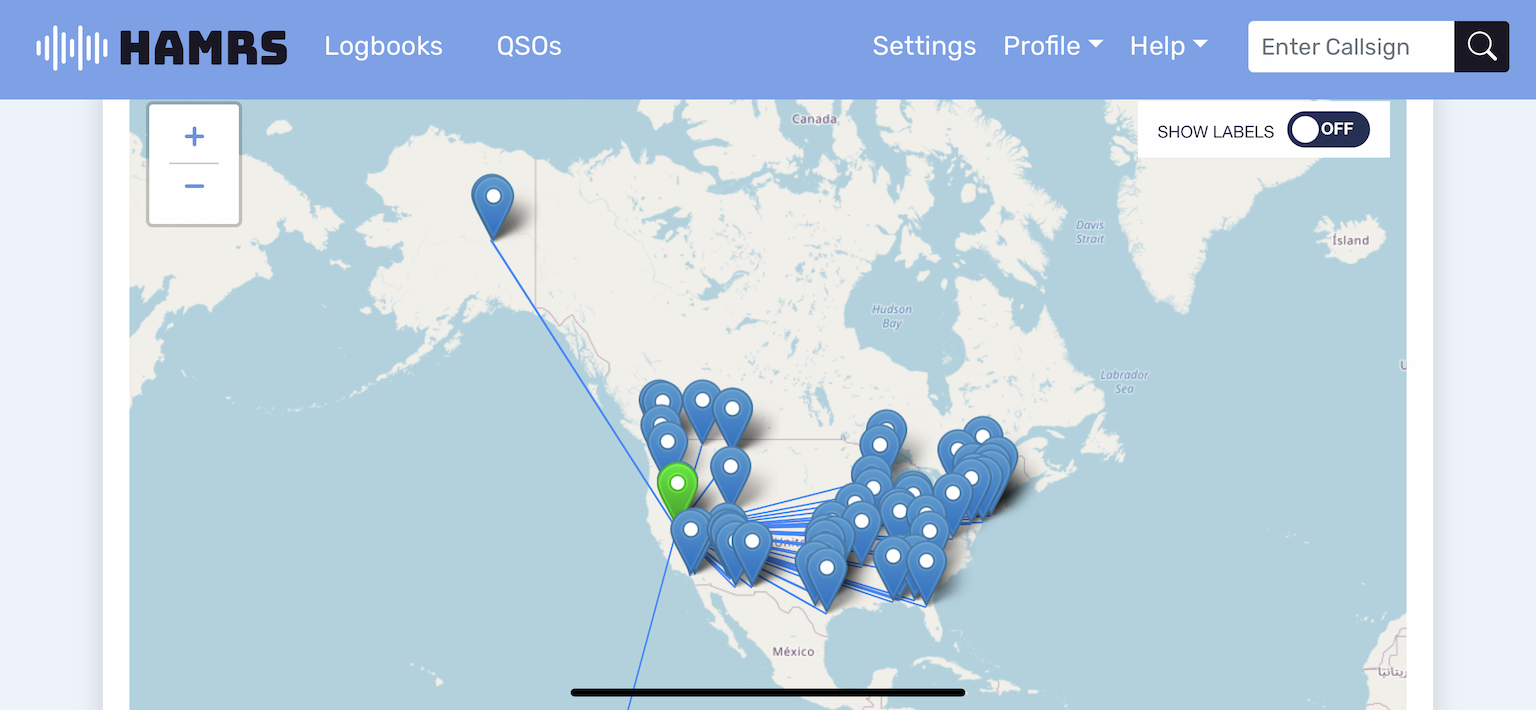
Over the weekend, I logged 62 contacts at Washoe Lake State Park. Again, it was a good weekend.
This is a map of the contacts made for the weekend activation of Washoe Lake SP.

Weekend Radio Play

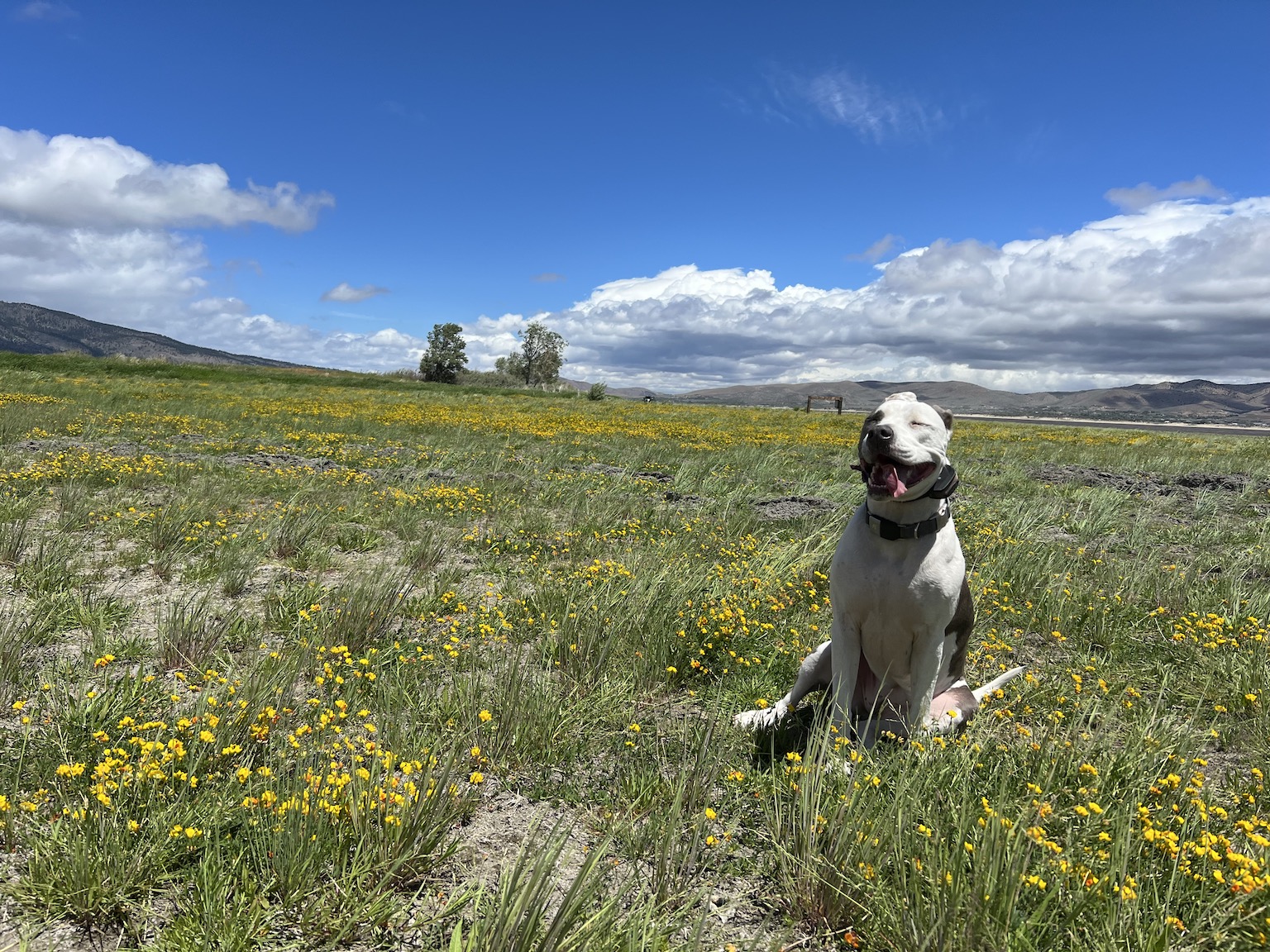
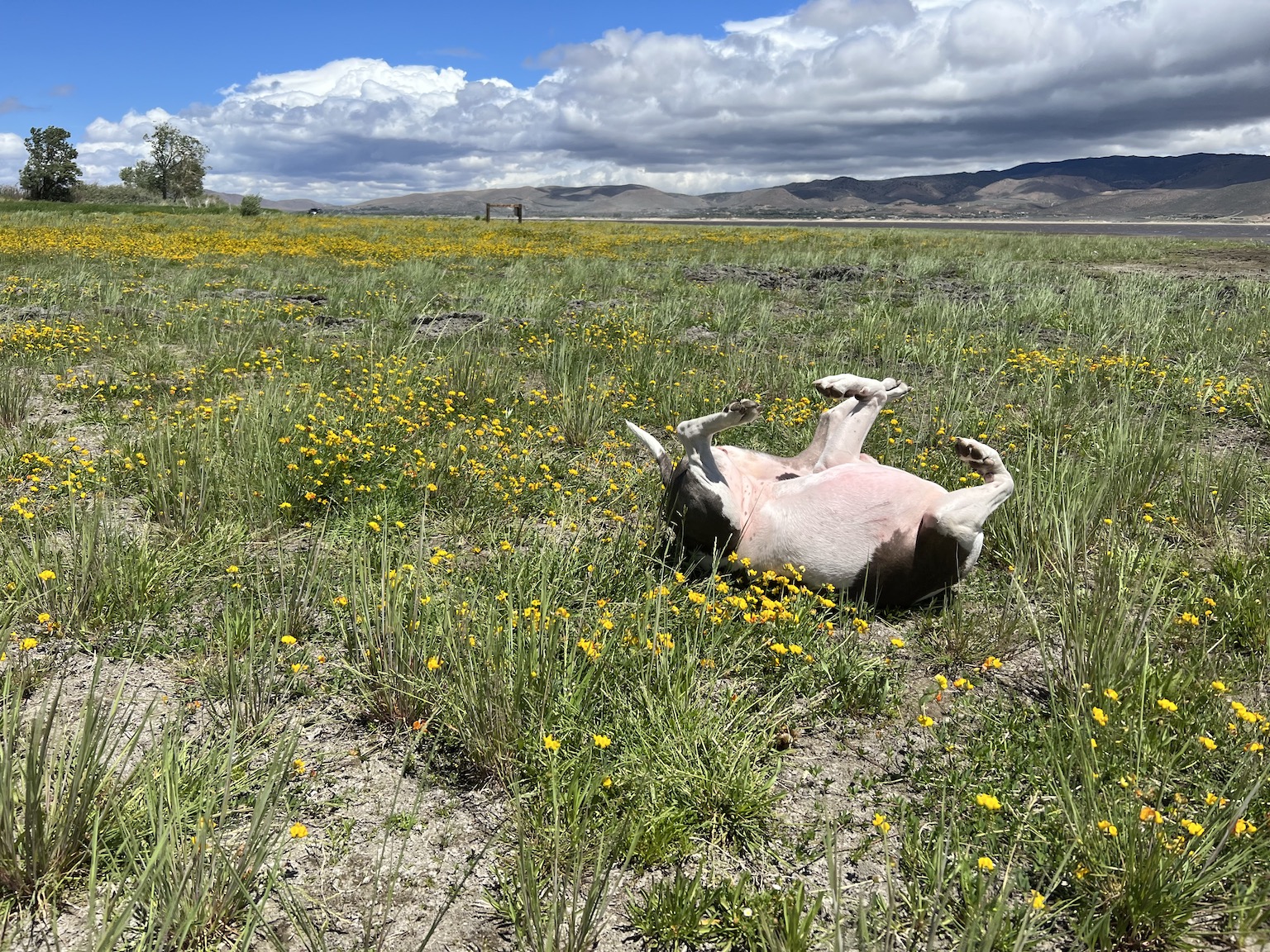
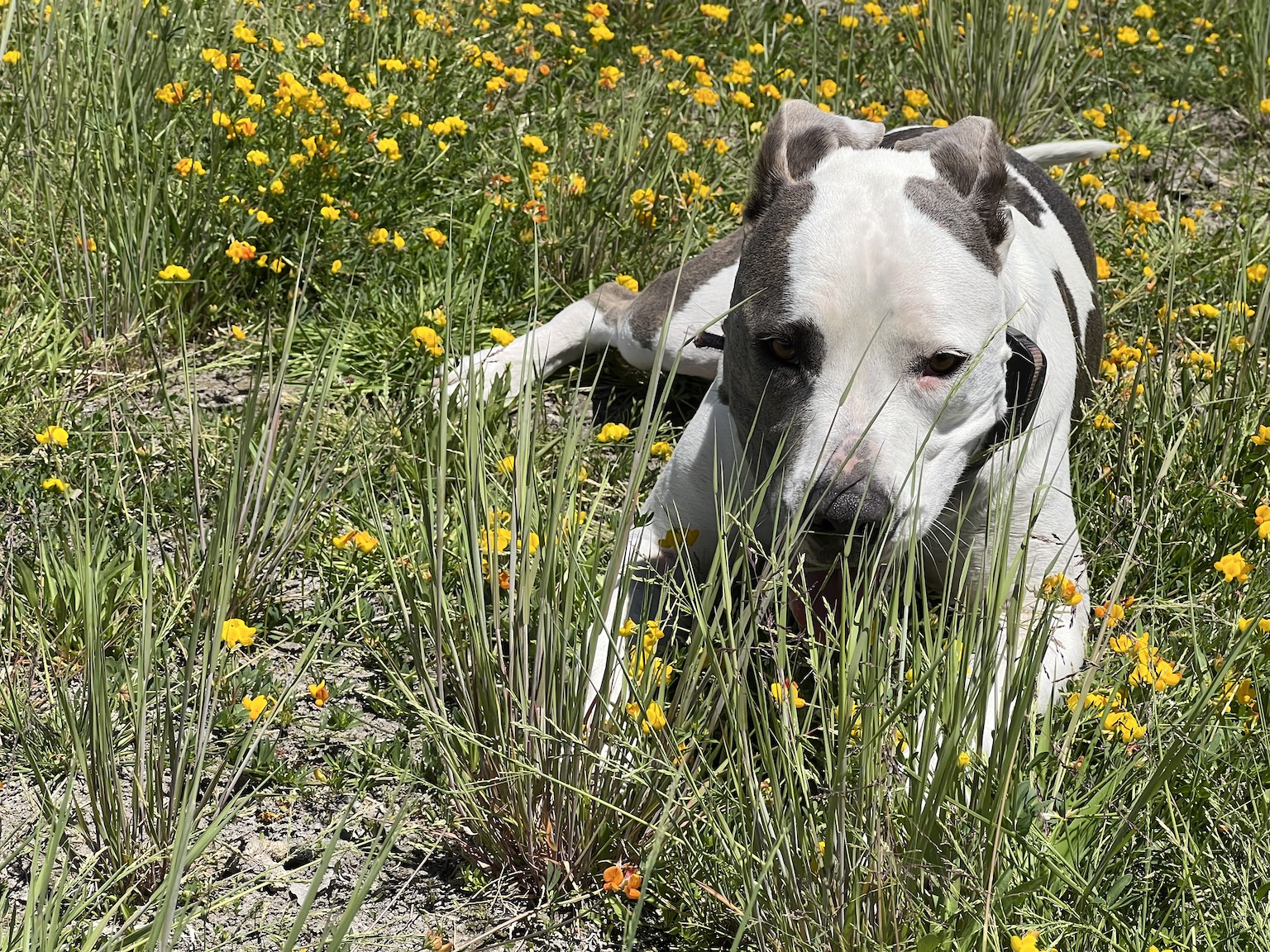
Before going for a big roll in the grass, Sera posed for me sniffing at the flowers.

Late last week I decided that I wanted some time outdoors and wanted some radio play. The previous weekend I was recovering from travel and testimony and just did not feel like doing much. This weekend I did not want to stay indoors all weekend.

The gang decided to activate Fairview Peak (W7N/PC-032) again this year. What a gorgeous day to be on the mountain!
So I sent an email to the usual suspects who like to spend time outdoors and like radio. I thought that an Summits On the Air (SOTA) activation of Fairview Peak (W7N/PC-032) would be fun. It is a familiar place (we activated it last year, I think), is high enough to be cool on a hot day, and is not too far from home. Of our group, I had three takers. So it was a go.

We drove out Saturday morning, then worked our way up the steep trail to the activation zone. I setup the radio while the others setup shade and a table to work from. I used the KX3 with the KXPA100 for this outing. I knew that the phone operators would need more power to get out. I also setup the Chameleon MPAS 2.0 in the vertical configuration. I put out a couple of solar panels to keep the battery topped off.

We were ready to go before my scheduled time, so I chased another operator activating a summit on phone and logged him. Then I handed off the mike to another operator.

After an hour or so the other two operators almost had their quota. It takes four contacts to make a SOTA activation. Both operators had three contacts and a couple of summit-to-summit contacts as well. Those count extra because one receives both points as an activator and as a hunter. They were ready for a break, so I sat at the radio, listened on 15m, and then spotted myself on the SOTA website.

I was running CW Mode (Morse Code) and started sending my CQ so chasers would see/hear my signal. It did not take long until I had my first contact. I continued to work stations and also chased a few other SOTA activators during my turn.

After an hour or so I had a dozen contacts, more than enough for my activation. I handed over the radio to another operator so she could finish her quota.

Both other operators made their activation of Fairview Peak. It is more difficult when running phone than running code. It is one of the primary reasons I elected to learn Morse Code.

We were both glad to be outdoors on a cool June morning. I stopped to make a few images and Sera posed for me.

Sunday morning I decided I wanted to be outside. The weather was to be cooler, if more windy. I thought about doing another summit, but decided that the wind would be worse at elevation. Therefore I elected to do a park activation.

The Girl and I had breakfast, I finished cleaning up the dishes, and I put a load of laundry in. I grabbed the Discovery TX-500 transceiver and PA500 amplifier and carried them out to the rig. The Girl and I headed out and I noticed the wind was already up. I knew it was going to be windy at the lake.

I decided to activate Washoe Lake State Park again. I intended to do some testing of a new off-center fed dipole, but decided that it was too windy. So I used the Chameleon MPAS 2.0 in vertical configuration again. It is one of my go-to antennas.

We walked before the wind rose. Sera had a blast and could not resist rolling in the grass.
Before setting up the station, The Girl and I had a nice walk along the shore of Washoe Lake. There were lots of pretty flowers. A very pretty Girl posed for me in the flowers, and then went on a crazy roll to demonstrate she is no lady.

On return to the rig, I put down her mat so she could be comfortable while I deployed the station. I put up the antenna near the water and brought the coaxial cable back to my table. I got out the Discovery TX-500 and the PA500 and assembled them. I also put out a solar panel to keep the 4.5Ah Bioenno battery charged.

I staked the solar panel down. The wind was rising! After getting everything assembled (a few minutes), I put The Girl in the rig as it was just too windy.

I checked in to the 40m Noon Net (7.2835MHz) to confirm the station was working. Then I chased a few POTA activators on phone. When I tried CW mode, the monitor level from the TX-500 was too low for me to hear my sidetone. That meant I could not be sure I was sending correctly, having no audible feedback.

So, after futzing with that for awhile, I put the TX-500 away and got out the Elecraft KX2. I know this radio and was able to run my frequency easily. I completed my quota with a couple of stations to spare.

I was freakin’ miserable. The wind was strong enough to make me cold, even in the lee behind my rig. I was sandblasted. I was worried the antenna might fail. My hands were cold so sending was difficult.

When other operators stopped answering my call, I paused for a few minutes to see if there would be any stragglers. Then I posted myself QRT (done) and started putting away my station. Again, this took only a few minutes.

I then got The Girl out of the rig for a final walk (very short) and made an image of the lake shore. The wind was strong enough that the lake retreated from the western shore by about ten feet. That meant there was enough setup of the lake surface to lower it on my side by three or four inches. (It would be three or four inches higher on the lee side of the lake as well.)

I knew that this is an observable physical phenomena. It is one reason why dams have freeboard required (extra height from the nominal water surface elevation to the dam crest). Winds can push the water around and by more than one might think. This was a perfect example, in real life, of something I have known was possible my entire professional career.

How cool is that?

In any event, I came away with a few lessons:

  • Setting up and operating in marginal conditions is an important part of training for operations when conditions are poor.
  • I have a guying kit for the MPAS 2.0 vertical. I should get it out and test it. It would have been a good addition to Sunday’s deployment.
  • Be prepared to stake things down. I staked the solar panel Sunday. If I had not, then it would have blown away.
  • Even if the weather looks good, always have a cover to keep warm. It is possible to get cold even when the temperature is 70°F.
  • I must figure out how to adjust the monitor volume on the TX-500. If I cannot hear the sidetone, I cannot reliably send code.
  • Always have an alternative setup planned. Redundancy is the key to making an operation work. In this case, it was having an alternative antenna (the vertical) and a backup radio (the KX2).
  • It would be good to have the ability to make hot drinks and hot chow in the rig. If I (or someone else) gets cold, then hot chow will help get me warm again. I have a spare campstove and kettle. I just need to put them into the rig.
  • Always have a few spare parts at hand. I needed an coaxial cable adapter and had to scrounge one from another radio kit. I should assemble a small kit of adapters and jumpers.

I suppose there are more lessons learned this couple of trips. I need to start a new list in my notebook.

In the end, it was a very good weekend. I spent time outdoors. I spent time with The Girl. We spent time with friends. I operated the radio.

Life is good.

Sunday afternoon, the wind blew Washoe Lake to the northeast. This left about ten feet of the lake bed exposed. I expect the setup was about three or four inches and demonstrates the impact of wind shear on a lake surface.

Reno QRP Net AAR — 09 June 2022

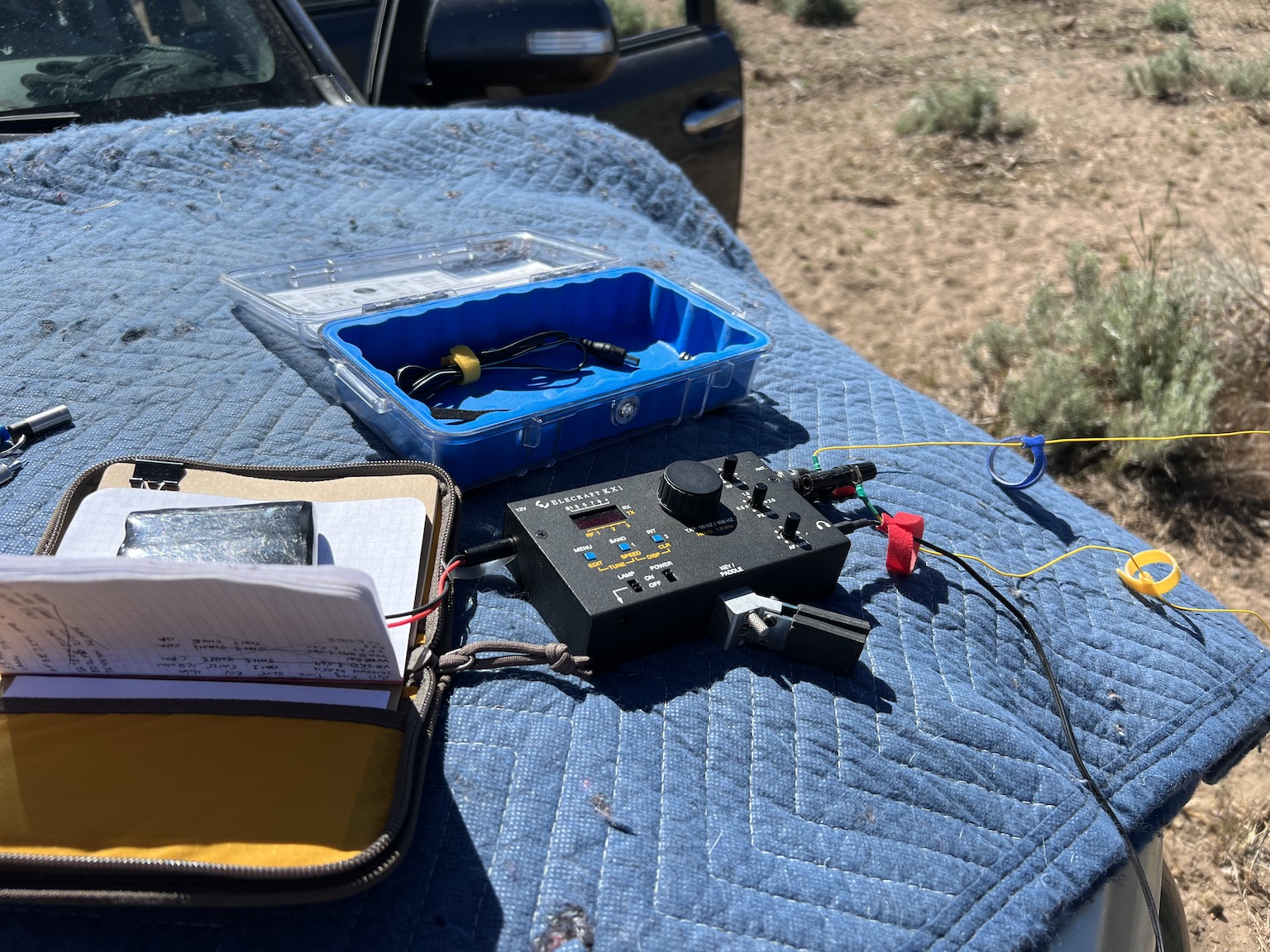
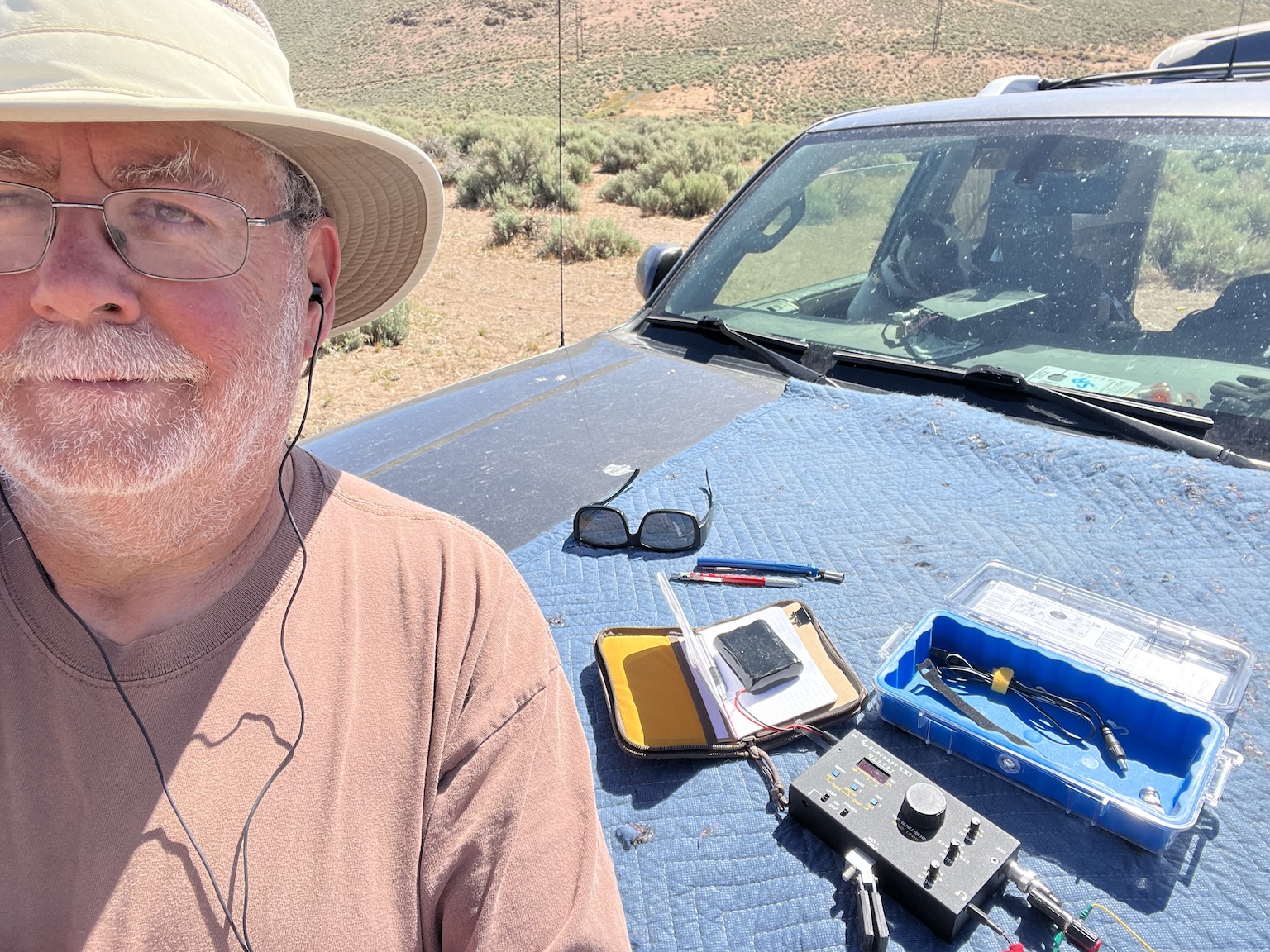
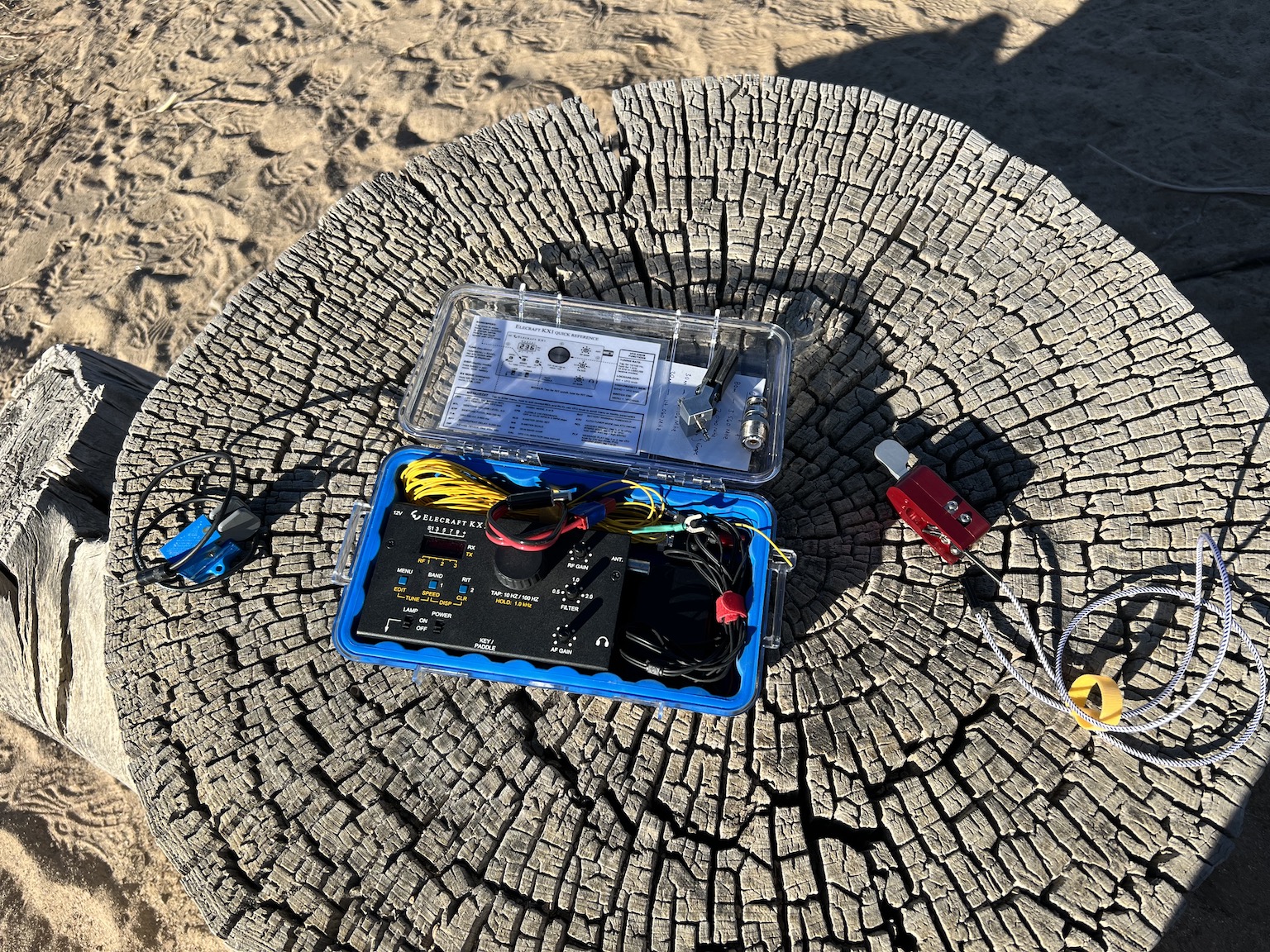
This is my Elecraft KX1 shack-in-a-box that I often take to the field. It has almost everything in the box to make a radio station — the radio, battery, key, headphones, and antenna. All that I need is a way to elevate the antenna (a mast or tree).

After a long dry spell, I am back at the weblog. The reason for my absence is simple — there was so much work to prepare for my testimony in Austin, Texas that by the end of the day there was little energy to write.

I had things to write about. I spent some of my time in the field running the radio (Parks On the Air activations, mostly) and enjoying time with The Girl. But there just was not enough energy left in the tank at the end of the day.

My testimony was completed last week. I returned home Friday morning, quite early. After retrieving The Girl from her trainer’s, we got in some exercise and then I came home and crashed. I am getting better and attending to my other project work now. I am spending time with my Girl and even doing a little radio play.

There is a small group of operators in Reno that are strictly QRP (low power) CW Mode (Morse Code) operators. They are a club of sorts, but really an anti-club because they do not have a formal structure. Now that the pandemic is less of a concern, monthly meetings for breakfast and chat are happening again. Every ten days or so there is an net (which is ham-speak for a group chat on the air). The net provides an opportunity to run the radio, practice Morse Code, and check in with friends.

The net protocol is simple:

  • Net control issues a general call (CQ) announcing the net.
  • Net control calls for station check-ins.
  • Net control acknowledges each station and asks for a repeat of the call sign if it was not copied the first time.
  • Net control calls each station in turn for the exchange.
  • Net control calls for any late check-ins and then works any that respond.
  • Net control closes the net.

The exchange is simple as well. It is operator name, signal report, location, rig, antenna, and power. The speed is slow speed, with net control calling at ten words per minute (that’s quite slow) and responding to calling stations at their speed.

I drove up Goni Road about 0900h (net meets at 1000h local in the summer), turned west on a trail, and parked the rig on an open spot off the trail. The antenna was a length of wire (25f) thrown over the top of the sagebrush (the Sagebrush Antenna) and a second length of wire about the same length thrown on the ground. The wires were directly connected to the radio. I used my Elecraft KX1 radio for this outing, which contains an excellent antenna matching unit and makes about four watts on the 40-meter band.

I readily heard net control call from his location at Hidden Valley Park on the eastern side of Reno. I listened as the other stations called and he acknowledged them and made his list. When the check-ins slowed, I sent my call, identified myself as a portable station (AG7TX/P) and was acknowledged.

I then listened as each station sent their information. I copied some of it, but not all of it. This is a mode that I am not used to. Most of my operations are contest-like, being SOTA, POTA, QSO parties, and contests. So it is excellent practice for me to listen to this code and work at catching the words.

My turn came and I sent my exchange, fumbling a bit with the KX1 key. I do not usually use the factory key for the KX1 and its touch is different than my usual keys. But I got my exchange sent and was acknowledged.

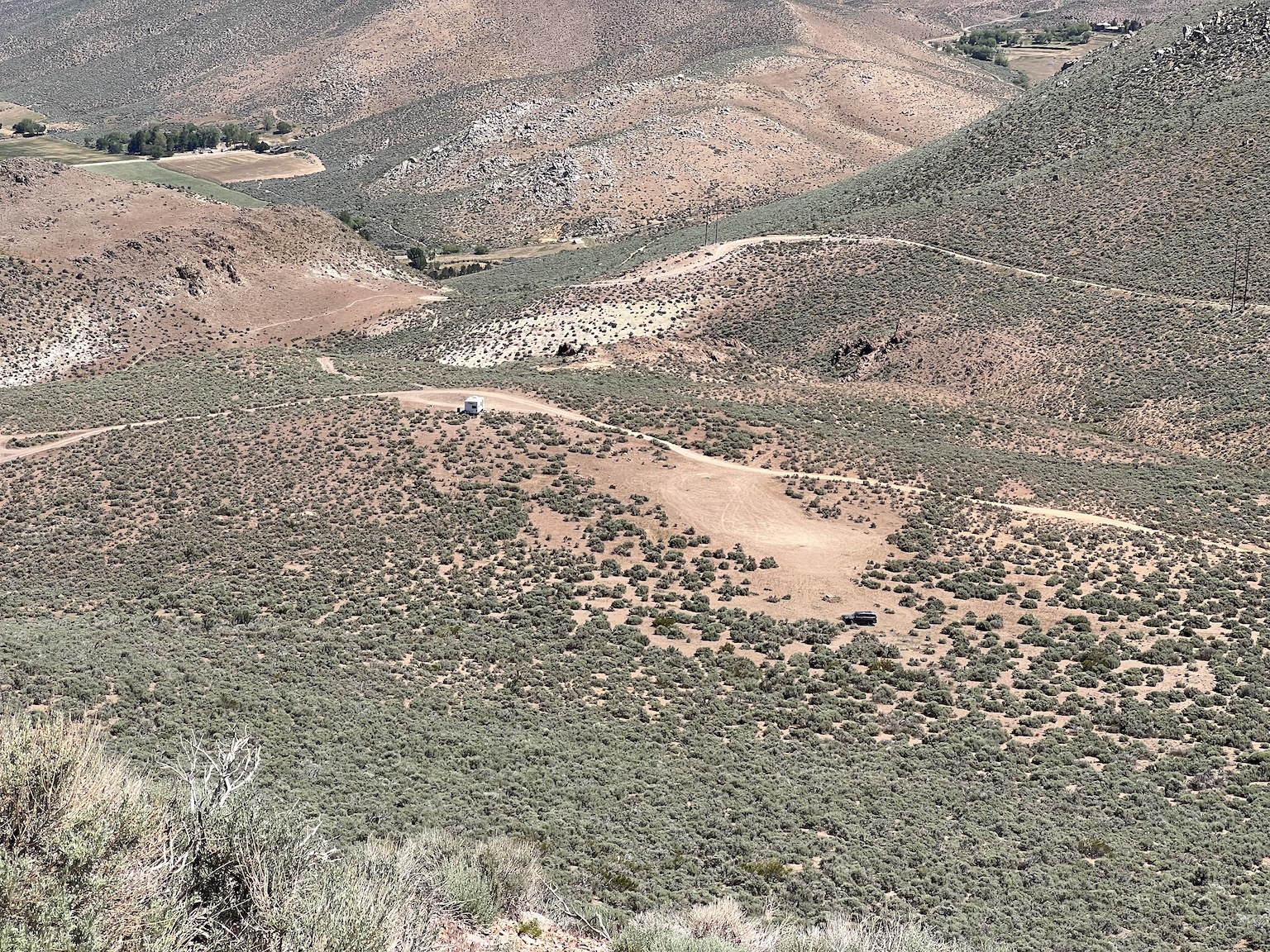
The 4Runner is visible in the lower right quarter of this image.
Net control closed the net. I put away my station (which took only a few minutes). Then I got The Girl out for a hike. We were both ready and I wanted to get it done before the heat came. So, up the hill we went.

This hill is straight up. There are no flat spots. So I climbed until I needed to pause and catch my breath. Then I climbed again until I needed to catch my breath. You can induct…

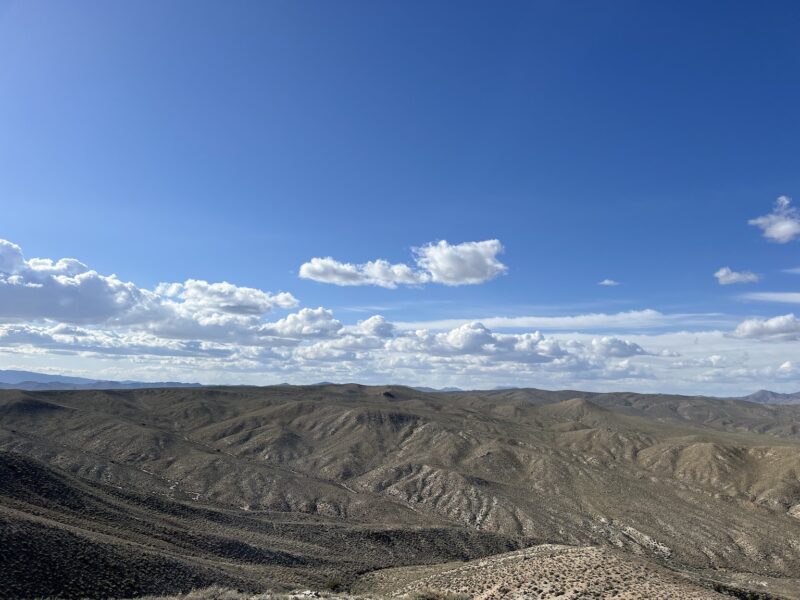
It was a good climb and good for my legs. At the top we paused to walk around a bit and for me to drink a little water to wet my throat. While there, I admired the view of Washoe Lake with Slide Mountain in the background.

This is the wonderful view from a hilltop south from Washoe Lake.

After my rest, we headed back down the hill. It was a great workout for my old legs, which had been cooped up too much over the last ten days. I was pretty spent when we reached the bottom of the hill and turned toward the 4Runner.

There I paused to send a text message to friends along with a couple of photographs. My ham buddies like to see the countryside here.

It was a good outing and a good net. Life is good.

After the net, I paused for a selfie with my radio and The Girl in the background.

Nightingale Trip

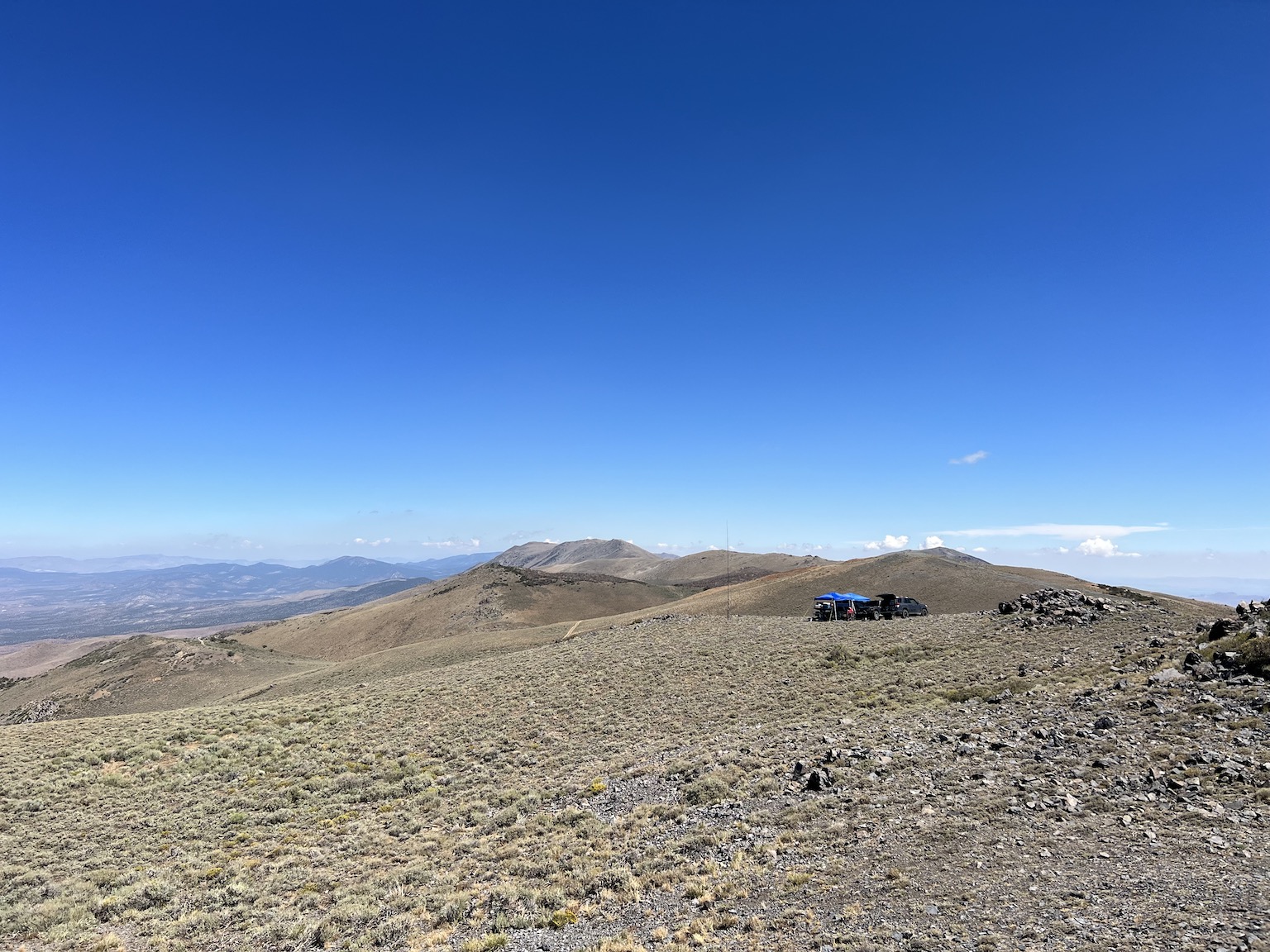
The view from my hilltop.

My friend emailed early yesterday (Saturday) indicating they were headed out to Nightingale to ride the desert race trail and spend some time outdoors. He invited us along.

The Girl and I had a recheck appointment at her vet about 1100h, so I knew I would be late getting out there. On the way down to the vet, I decided it would be a good day to get out and get away from the house. I figured I could stop at the Maverick on the way back towards Carson City, pick up a snack, and then head out towards Lovelock and the Nightingale exit.

The Girl was more interested in hunting for critters. It was windy.
The vet check went well — Sera’s toe is healing well and the infection is under control. Her nail is growing out and the new tissue is healthy.

That out of the way, we headed north from the vet. I stopped at the Minden Maverick, picked up a wrap and some chips, and we headed north. On the way, I called for my friend on the SNARS Mount Rose repeater. After a couple of calls, another friend answered and we chatted a couple minutes. They were tied up with chores and could not join us. That was too bad as they are both fun.

I made one wrong turn on the way north on the trail from the Nightingale exit but that was quickly rectified and I arrived at camp. I had a nice visit with the female half of my friends and soon the male half arrived. We chatted and shared a meal and then headed northwest from the staging area to a site they wanted to show me.

One of my friends riding to the next hilltop to check the view.

It was not a long trail drive and the trails are in excellent shape. We arrived at the hill top and my friend asked if I was going to run the radio. The wind was already up and I was cold, even with the moderate temperature (70F). I hunted around from a windbreak, but the shape of the hilltop was such that there was no wind break.

I decided to get out the triple mag-mount and try a hamstick. They headed off to ride and said “We’ll meet you at camp in a bit.” That was good enough for me.

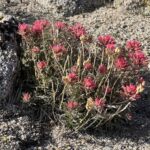
Is this Indian Paintbrush? I don’t know, but they were very pretty on the hillside.
After setting up the antenna, I got the Elecraft KX2 out of its bag and also one of my American Morse Equipment keys. There were a few Parks on the Air (POTA) activators working 20m so I thought I might be able to work them. I could hear a couple of them, but they were not very strong. I checked the solar weather conditions, but there was not a lot of geomagnetic activity and the sun was not producing a lot of X-rays. The base noise level was a little elevated, but that did not explain why the stations were weak.

I was probably in the wrong location for skip to be working for me. So, after calling a few minutes, I decided to just enjoy the day, get out with The Girl, and move around a little.

I put away the radio and antenna (that did not take long), then started my tracker and we walked around the hilltop. She bounced from bush to bush, looking for critters. (It was too cold for them.) The wind was blowing pretty strongly. NOAA Weather Radio reported sustained winds of 20–25mph with gusts to 30mph in Carson City. Along the ridge I suspect it was greater. (That’s why my hat is blown back in the selfie above.)

We still had a good walk around the hill. I had worked my way downhill a ways so I would have a climb back to the rig. That was good for me. We clambered back into the rig and headed back down the trail to camp.

When we arrived, they were just about ready to go. We headed out and stopped in the Red’s Grill in Fernley for a bite of supper. The Girl and I then blasted on home, tired by satisfied.

It was a good day.

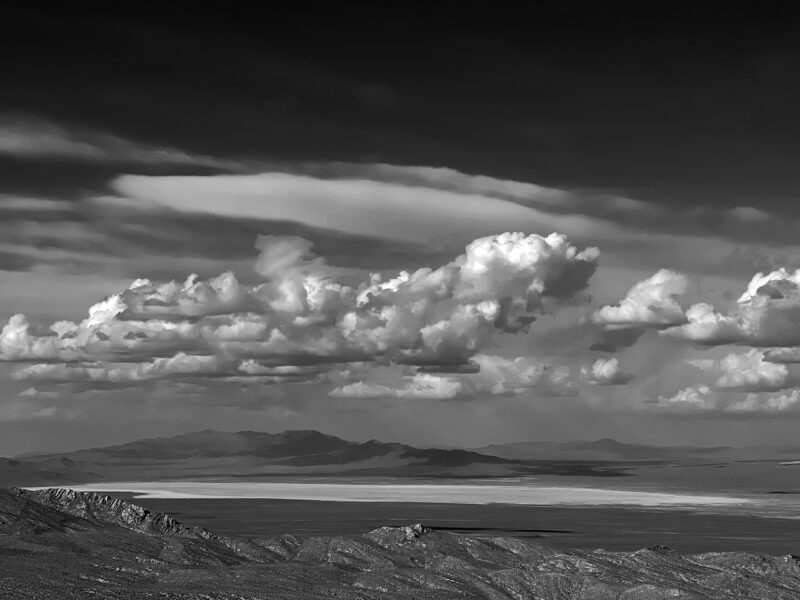
Another Nevada playa lake that might make a good campsite and operating point.

A Little Radio Play


After a long hiatus, I am getting back to my weblog again. Work kept me exceptionally busy over the last few months. Most of my energy went into project work and the writing associated therewith. There was little writing energy left over after all that. What little was left went into my journal, which is also suffering from neglect.

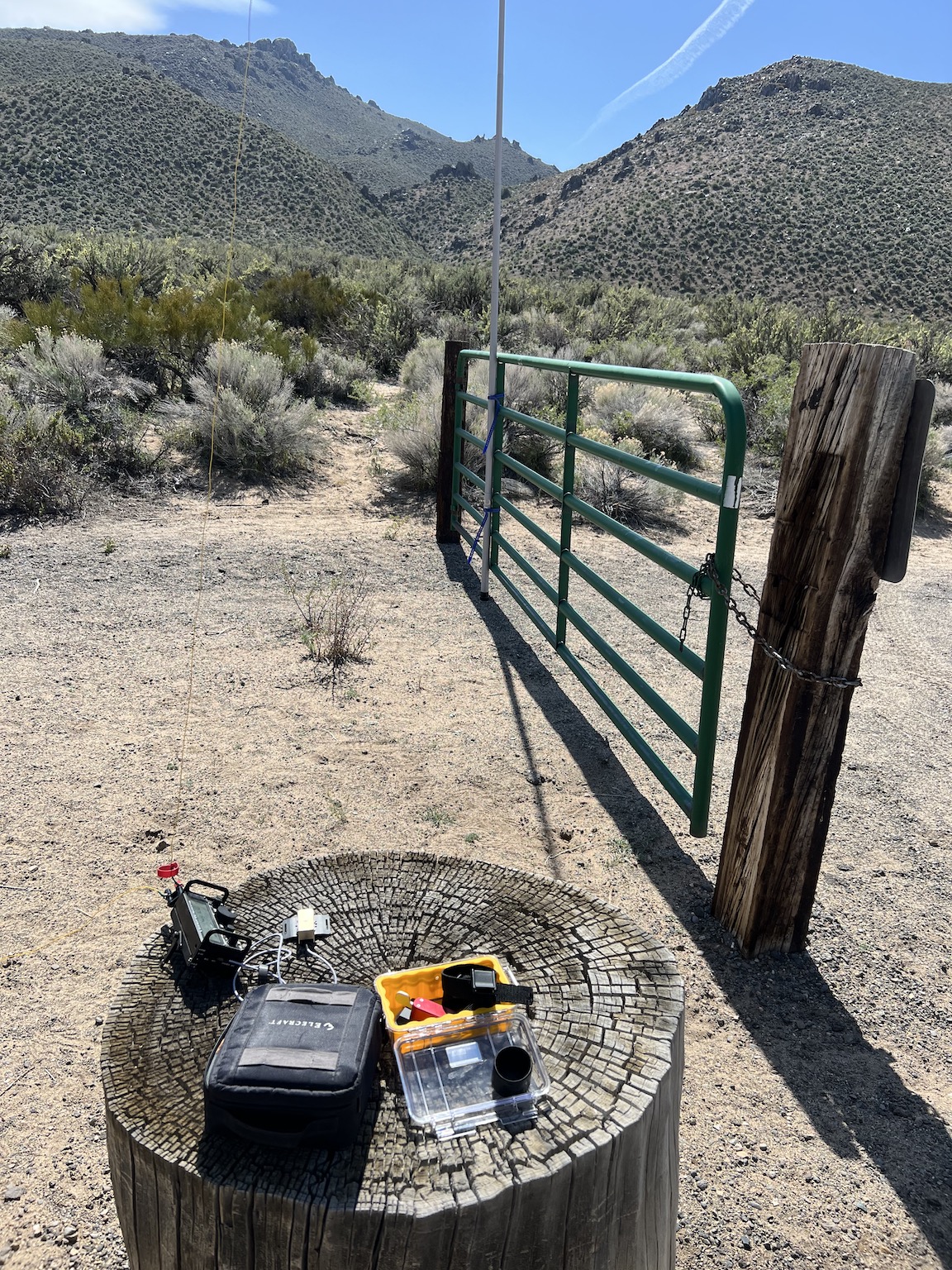
This is my Elecraft KX2 quick deployment station in place. The mast is a 10-m SOTAbeams telescopic mast affixed to the gate with Voile straps. The antenna is a 25-ft random wire. The key is an American Morse Equipment Porta Paddle 2. I used the KX2 internal battery for this operation.
Downtime was spent either building a couple of new antennas or in the field either as a Parks on the Air activator or chasing POTA and Summits on the Air (SOTA) stations.

I built (and revised) a 25-ft random wire for quick deployments. Wayne Burdick, the engineer behind the Elecraft radios, recommends such a wire for quick deployments with their radios.

It is a nonresonant antenna, meaning that is not tuned for any of the amateur radio bands. Therefore, a matching unit (sometimes called an Antenna Tuner — which it does not do, but instead transforms the impedance at the output of the matching unit to the impedance of the antenna or feedline). Burdick recommends using a BNC to binding post adapter directly to the radio. Then there is no feedline loss from the impedance mismatch and Elecraft ATUs can match a wide range of impedance presented to them.

A second wire called a counterpoise is attached to the ground side of the binding post adapter and thrown on the ground. This provides a ground connection that is necessary to complete the antenna. Both wires form the antenna and my last iteration was an adjustment to the counterpoise to use one wire instead of three (which were forever tangled).

I have not tested this configuration with an antenna analyzer. I will one day when I am in the field. But for now, in testing it on the air, it is working just fine.

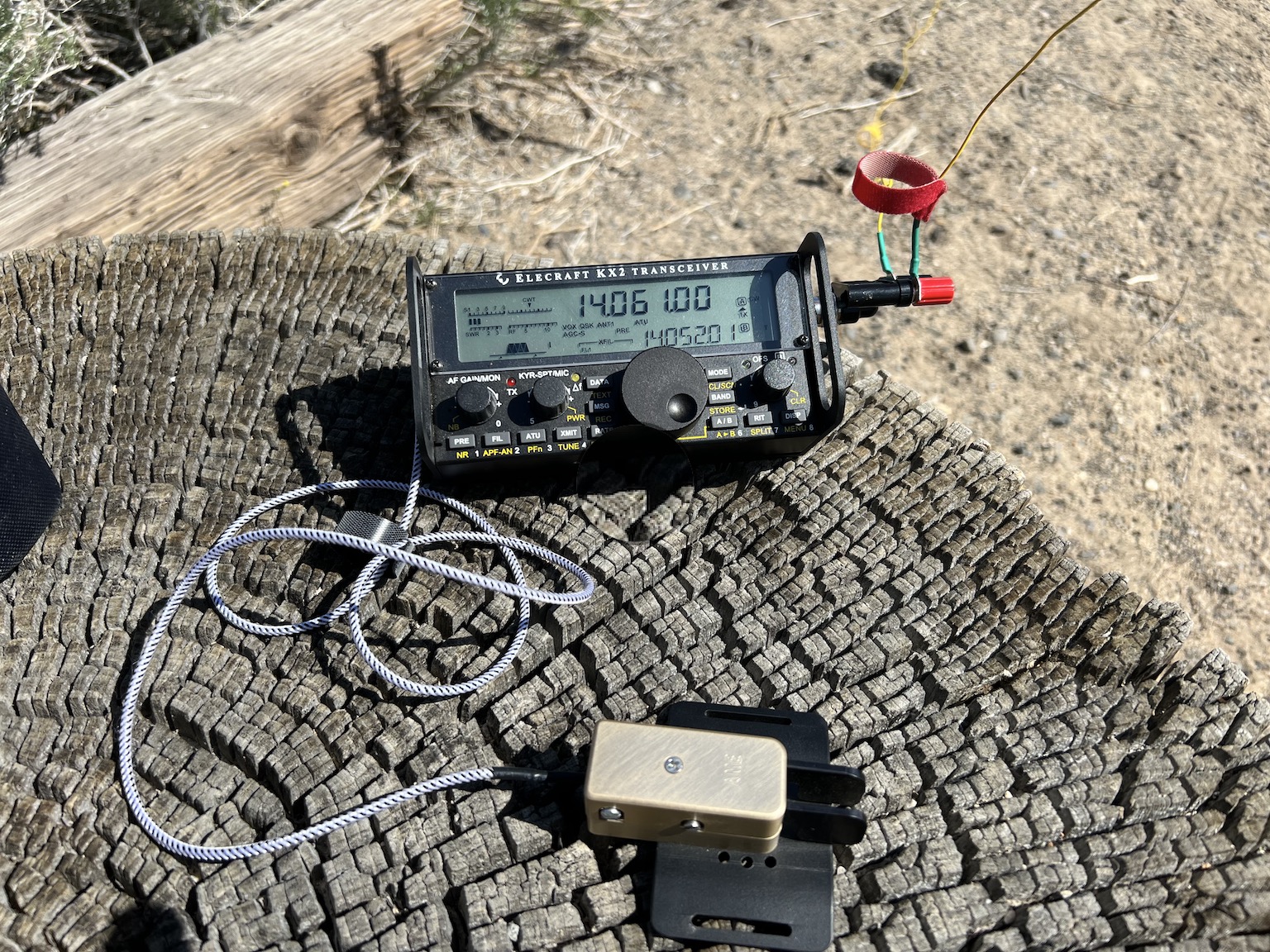
The Elecraft KX2 deployed on a stump out at Silver Saddle Ranch. On the right side of the radio is a BNC/binding post adapter. Connected to the red post is the radiating element, about 25-ft of wire affixed to a 10-m SOTAbeams telescopic mast. Connected to the black post is another wire, about 25-ft long (or so) thrown on the ground to be the counterpoise.

This afternoon The Girl and I walked our normal route out at Silver Saddle Ranch. I have a bit of a slow day before things get busy again. I checked propagation and the ionosphere is quiet today (although I think there was an X-ray burst earlier in the day that caused a temporary radio blackout). I also noticed a handful of POTA activators were working. So I decided to give myself a few minutes of fun.

I spent a few minutes rearranging some of the radio kit in my 4Runner, then retrieved the 10-m SOTAbeams mast, the KX2, the Pelican case that contains the AME PP2 and Mini-B paddles, and a couple of Voile straps. I settled The Girl in the rig and walked the 10m to my operating point, the gate into the ranch road to the borrow pit and an old block of cottonwood stump.

It took me about ten minutes to deploy the mast, antenna, radio, and key. I used my iPhone to log with the HAMRS app. I spent a few minutes listening for the activators, then when there was a gap in the pileup, I sent my call.

In a bit more than a half-an-hour, I had four contacts in my log. By then it was 1530h local and I knew the kiddos would have all dispersed from school. So my route home would be clear.

It took me another ten minutes or so to tear down the station and pack things up. I paused for a few minutes to make a couple of photographs with my iPhone. I then carried the station back to the rig and we headed home.

This is all that is required for a working amateur radio station. There is transceiver (radio) with internal battery, a Morse key, an antenna, a BNC/binding post adapter to connect the antenna to the radio, and a mast to hold one end of the antenna aloft. It is a simple station. It will send traffic across the country and beyond.

It was a good day. Life is good. My dog and I are good together.

I have more to say and some lessons learned over the last few months activating parks for Parks on the Air. I also have more antenna builds to share as well as more stories and photographs.

The Sagebrush Antenna and Self Care

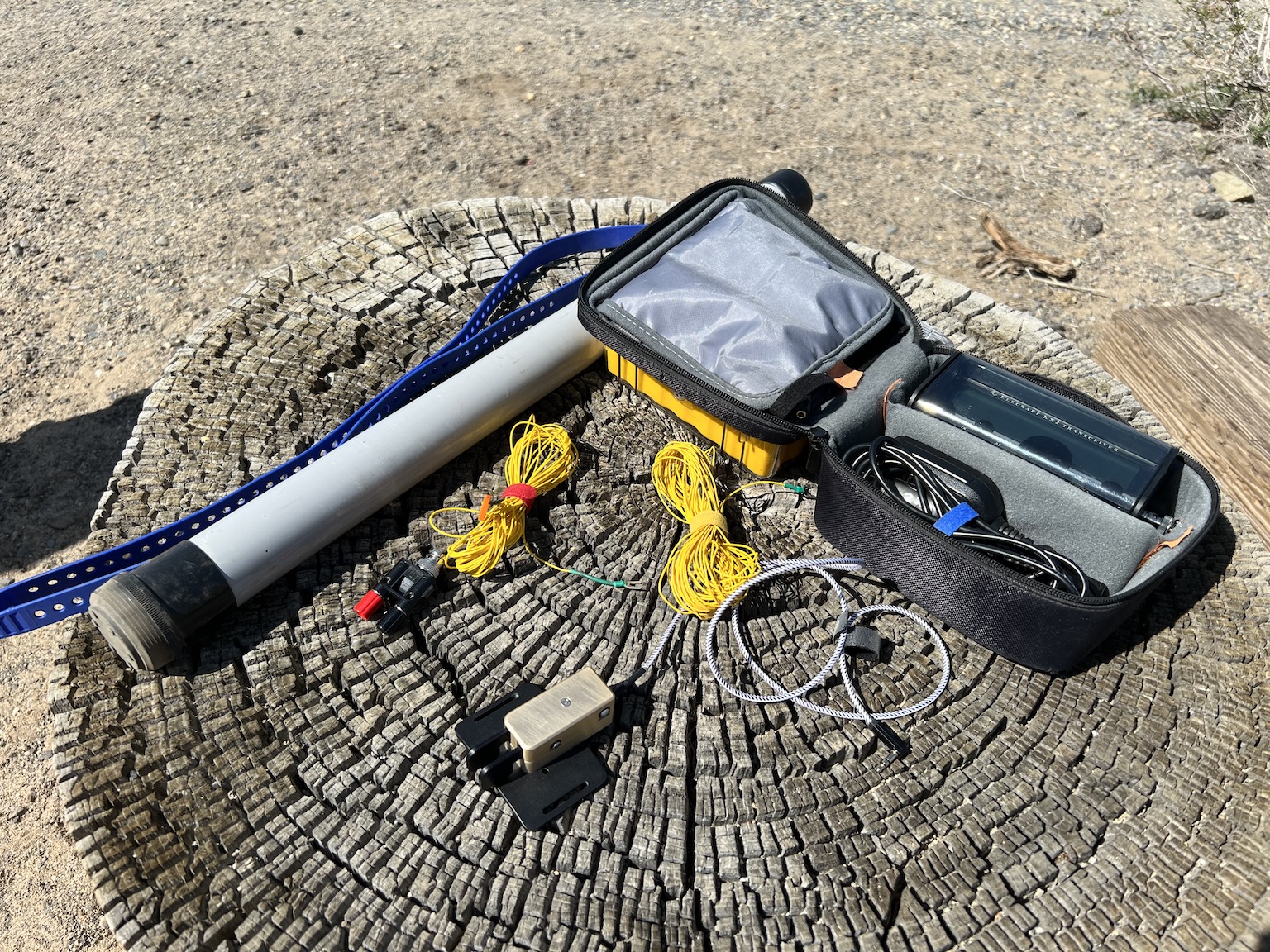
Everything that is needed to operate on four of the high frequency amateur radio bands is in or next to this box. There is a radio, the Sagebrush antenna, a battery, headphones, and a couple of Morse Code keys.

During the latter part of last year and well into January of this year, I was working very hard and burning a lot of energy. After completing a report and giving a deposition, I was quite tired and near burning out. That did not stop the pressure, though, as there are several active projects still needing attention and deliverables are coming due. There was little time for my radios and I had to cancel my planned trip to Quartzite, Arizona.

I am making progress on the work. This week I was relieved of one of the deliverables due the end of this month. I made significant progress on the other two deliverables. The pressure lightened substantially.

However, over the last few weeks I decided that I had no choice but to take time off for some self care. I will not be productive if I burn out. I am close enough that I feel the pressure to chuck everything and go into hibernation mode.

As a result, I spent more time in the outdoors the last three weekends. The Girl and I are getting our miles in every day. I am taking a few minutes every day to meditate and pray. Although this week was an exception, I am getting a couple of strength training sessions in each week.

After our daily walks, if the weather is nice (and it has been), I setup one of my portable radios. The last couple of weeks, I had the Elecraft K1 out a couple of times. I am learning to use that radio. It is not a difficult radio to use, but there are a few things to learn about its operation.

I learned that it is a very good radio. The receiver is excellent and the operating controls are well thought out and work well. It is a fun unit to operate.

An even smaller radio is my Elecraft KX1. My unit operates on four bands — 20m, 30m, 40m, and 80m. It has an internal matching unit. It will run on a set of internal batteries or an external power source. It has an excellent receiver with both RF and AF gain controls and an adjustable filter.

Some days I setup a telescopic fiberglass mast and run a wire from near the top to the radio. The wire antenna connects directly to the radio. A counterpoise is thrown on the ground to provide the required wire to match the radiator.

You’ll have to look really hard, but there is an antenna in the sagebrush. Can you see it?

Friday I decided to deploy the Sagebrush Antenna. This unique antenna comprises the wire radiator from my KX1 kit (shown above) thrown across the top of whatever sagebrush is nearby. This deployment had the distal end in a sagebrush about six feet off the ground. The near end was about five feet above the ground, with the last bit sloped down to the radio, which sat on my knee. I threw the other part of the antenna (the counterpoise) on the ground in front of me.

By the time we finished our walk most of the SOTA activators had retired. Those I listened for could not be heard at my location. I listened for the few POTA stations that were active and heard an operator in Arkansas calling. Once a few strong stations worked him, I put out my callsign. After a couple of attempts, he heard me and sent part of my callsign with a question mark (asking me to fill my call).

About the time I heard him complete my call, he faded into the noise. I continued to listen a bit more, heard his signal come up and fade away again, then decided I would either have to wait or give up. Given I needed to return home for a phone call, I gave up. (I hate to give up!)

As I put away the station, the phone rang. My buddy Dick said “You’re 5-4 or 5-5 here, what are you running????”

“I’m running the KX1 with 3 watts.”

“You’re kidding!!! You’re booming in here. Did you hear him answer?”

“Yes, but then he faded and I could not copy the exchange.”

“Aw man, you had him… what antenna are you running?”

“I’m running the Sagebrush Antenna.”

“What?”

“The Sagebrush Antenna… I threw a wire over the top of the sagebrush.”

“Oh man, a wire on the ground and 3 watts?!?!”

We chatted a bit while I put things away (not a long process and I was almost done when the phone rang), then continued on the way home. I knew I could have worked that Arkansas activator if I had waited for him to come back up out of the noise. But I wanted to make my call before I ended the day.

Perhaps you can see the Sagebrush Antenna now?
In the end, whether I made the contact or not does not matter. What matters is that I took some time for myself, to do something for myself that is fun and engaging, and to move away from work for awhile. I spent time with my dog, with my friends, and with my radios. This is helping me to reduce my burn out and keep me healthy and productive. And it is fun to deploy a simple, small, low-power radio, particularly when using an antenna as esoteric as the Sagebrush Antenna. Can you see it?

Weekend Radio

It was a good day to be outdoors. I did not mind sitting on the ground, although I was very stiff when I stood up.
The last few weekends I spent more time outside with The Girl. My weeks are mostly filled with work, either at the trading desk or at the engineering desk. We do get out everyday for some exercise, but there is always the pressure to return to the home office and get things done.

After working a slew of weekends the last quarter of 2021 and into January of 2022, I am at risk of burnout. So I am gave myself permission to take some time off on the weekends, work on some personal projects, and play. Weekend before last was a little Winter Field Day play. After passing the morning at the house waiting for the air to warm, we spent the afternoons in the hills out east of town. We had some great hikes out there, the old man huffing up the hills with The Girl looking over her shoulder or running back to encourage the old man to huff a little harder.

Then we returned to the rig where I put out an old furniture blanket for The Girl while I setup a radio and either chased SOTA and POTA activators or played search-and-pounce after the Winter Field Day runners.

Last weekend we had a friend accompany us on Saturday. She is another ham who loves to hike and especially loves The Girl. The Girl begins wiggling before we even get close to our friend’s place. And then she will greet friend with more intense wiggles and lots of love. We drove out to my new favorite spot, parked the rig, and hiked out two more hills. The overlook from there is spectacular, with view of the Carson Range to the west, Carson Valley to the south, and Carson City to the northwest. We paused at the summit to look around, enjoy the view, and enjoy the sun on us.

We returned to the rig for water and a snack. Then I setup the Elecraft KX3 with a magnetic loop antenna. There were plenty of operators running for the three QSO parties in progress. But I did not want to work that hard, so I looked for POTA and SOTA activators. I saw their spots on my phone and listened for them on their spotted frequency. I logged four contacts Saturday. On completing each exchange, I offered our friend the key. But she declined, not feeling quite ready to take to the air.

We had a bit of an adventure on the way home, though. I violated the “first rule of the day” and went north, forgetting I was on the third peak and not the second. It was only about a hundred yards when I realized I was not on the trail I came up and that this one was steeper and more narrow than I preferred.

After a couple of failed attempts to back up the trail, I managed to get mostly turned around. But the ass-end of the rig was still too far off the trail to get squared away. So I stepped out to survey the situation, saw that I was still making progress, and returned to the cabin of the vehicle.

After a couple more tries, I got close enough that I was able to back down the trail about 20 feet. I made a run at the snowfield and made it about halfway. I backed up and made another run and got about three-quarters of the way. The third attempt I made it 90 percent, but had enough traction to continue crawling until the right front hit soil and drug us out of the snow.

It was then easy going back to the correct trail. I was not looking forward to calling another friend for help and having to eat crow.

The Girl and I returned Sunday about noon for more outside time. I parked the rig and we got out to walk to the site of our previous day’s experience so I could make a couple of photographs. Then we turned south and climbed the same route as Saturday. A group of off-road bikers passed us on the way up to the summit in two parts. I saw the first group peel off the trail to some single-track and then turn back south. The second group stopped near where the first dropped over the edge of the ridge, but did not see where their compatriots had gone. One rider returned to our location and to the summit. He then turned around and coasted a bit, calling “Sorry buddy for driving past so many times. I lost the rest of the group.”

“No worries!” I called back. The Girl and I finished our ascent and paused at the top, as I like to do. I heard dirt bikes approach as we headed back down. We walked up to them paused on the slope, chatting. One called to The Girl “here buddy!” and she immediately responded.

I chatted with them a couple of minutes and then we parted ways, The Girl and I returning to the rig. There I setup my table and the KX3, but this time chose a different antenna I wanted to test. The Girl relaxed on her mat while I played a little radio. Again I was chasing SOTA and POTA activators, not wanting to work so hard working the QSO parties.

About mid-afternoon I put everything away, tired, a little cool, and ready to be home for the rest of the day. We crawled back down off the hill and toward the house, listening to some chatter on the local repeaters as we moved.

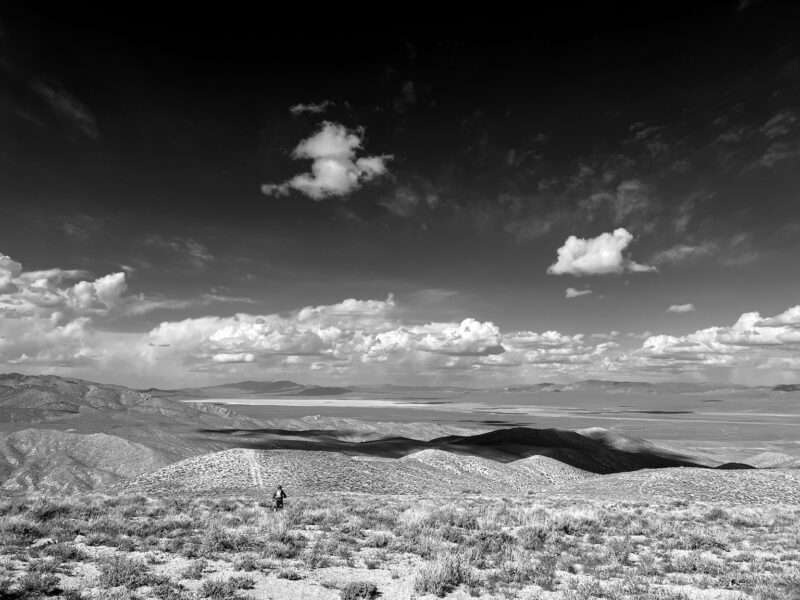
In the end, it was another good day. I came away with some contacts, knowledge of the antenna under testing, and a couple of nice images. Below is an example of why I love the west and why I love being in the mountains.

Life is good. I am grateful.

The view of Carson City from the third peak south from Sedge Road is startling. This is why I love living in the west.