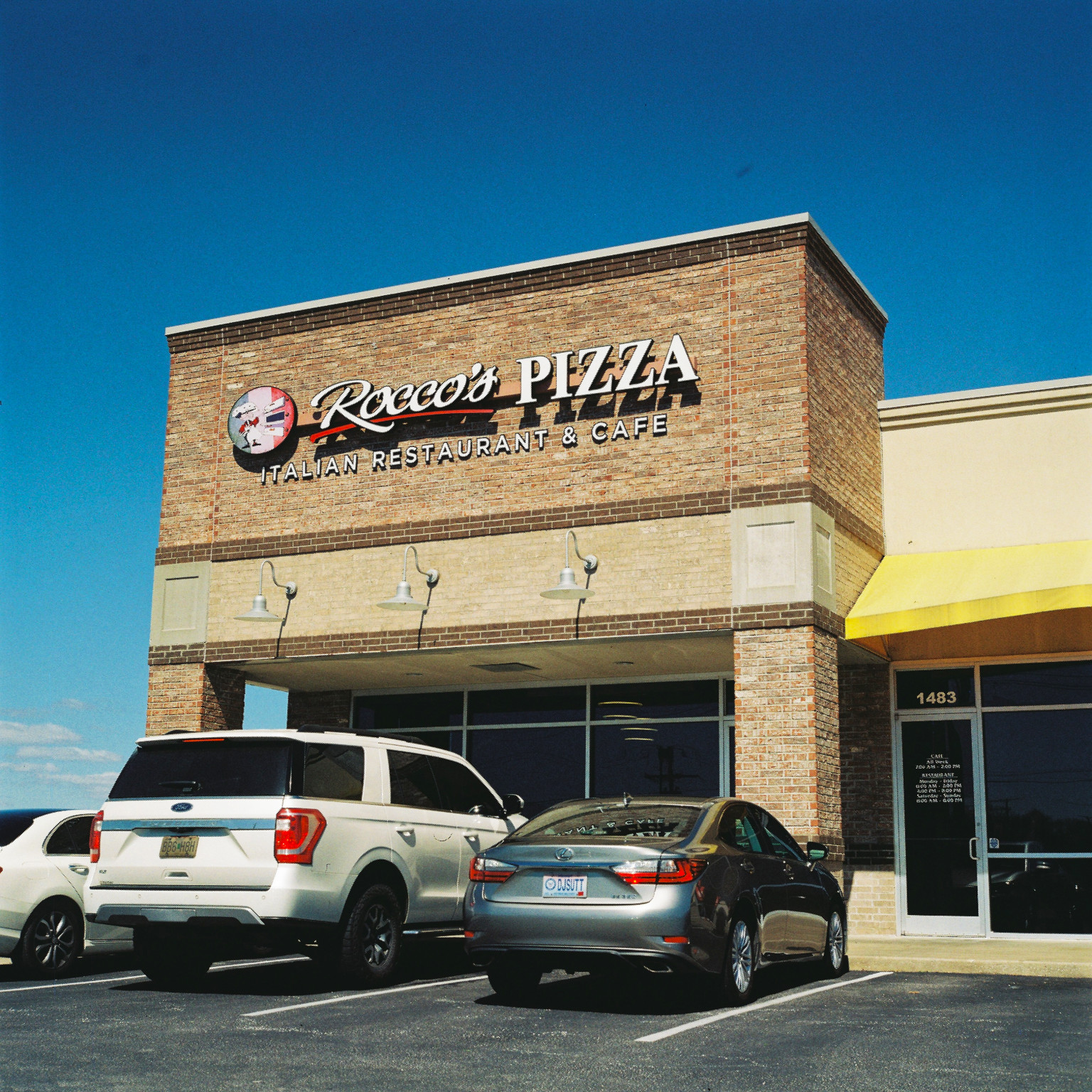
Daily Image: Rocco’s Pizza 28 March 2024

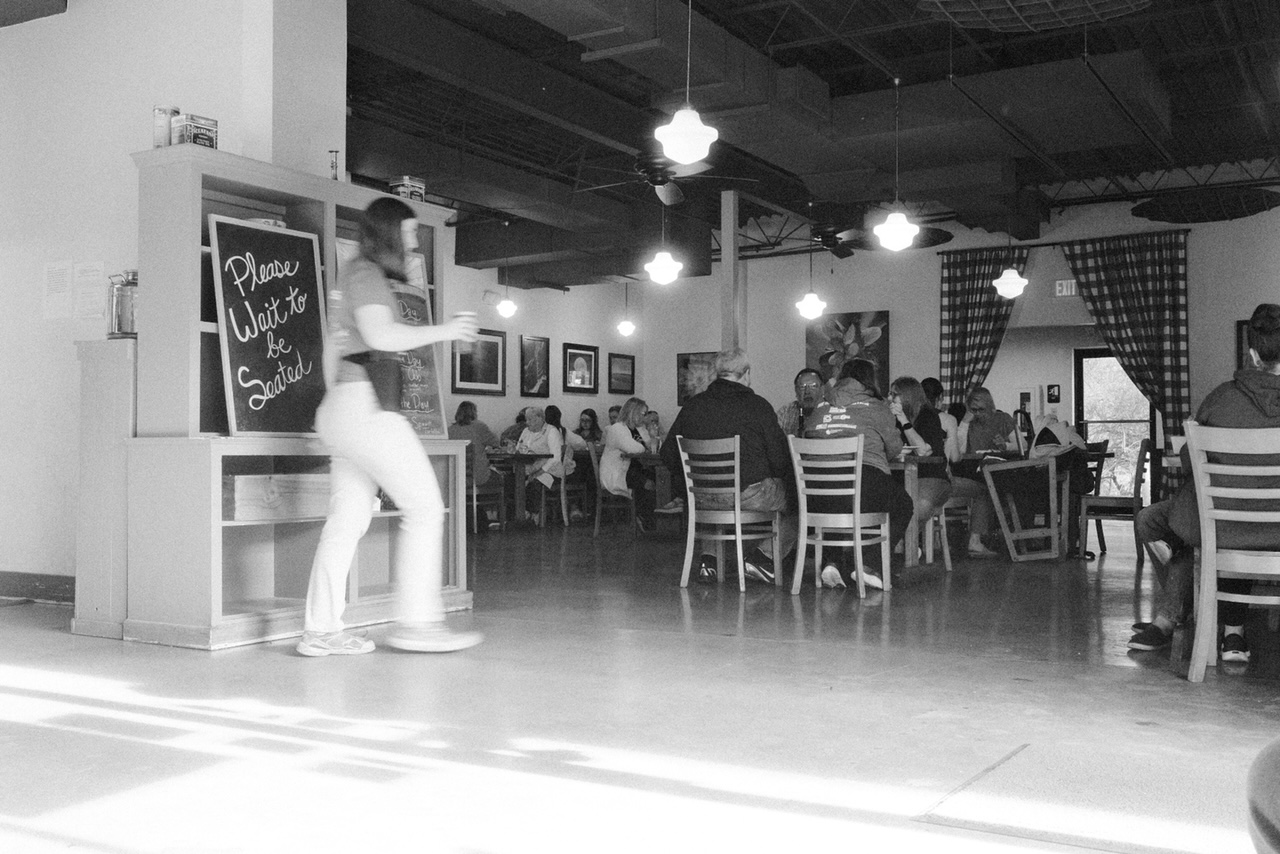
This is a favorite Italian joint here in Ozark, Missouri. Shot with Bronica S2A and the Nikkor 75mm f/2.8 at about f/8 with Kodak Gold 200 film.

I shot this image a couple of weeks ago using Kodak Gold 200 film. It is from the first roll of color film through the new-to-me Bronica S2A medium format camera. The Bronica is my first square format camera and is a beast of a brick! I think it weighs in at about four pounds with the standard Nikkor 75mm f/2.8 lens and a film back.

The firing of the shutter is a thing that has to be experienced to be appreciated! There is a lot of movement inside the camera body with the moving of the mirror and focal plane shutter. It is also loud. However, although I have read of motion blur complaints, I am not quite sure that I believe them. A tripod will be required for slow shutter speeds.

Kodak Gold 200 works well in bright sun. I like the color rendition. I think I will shoot some more of it and send it for processing at a place that can produce higher resolution scans.

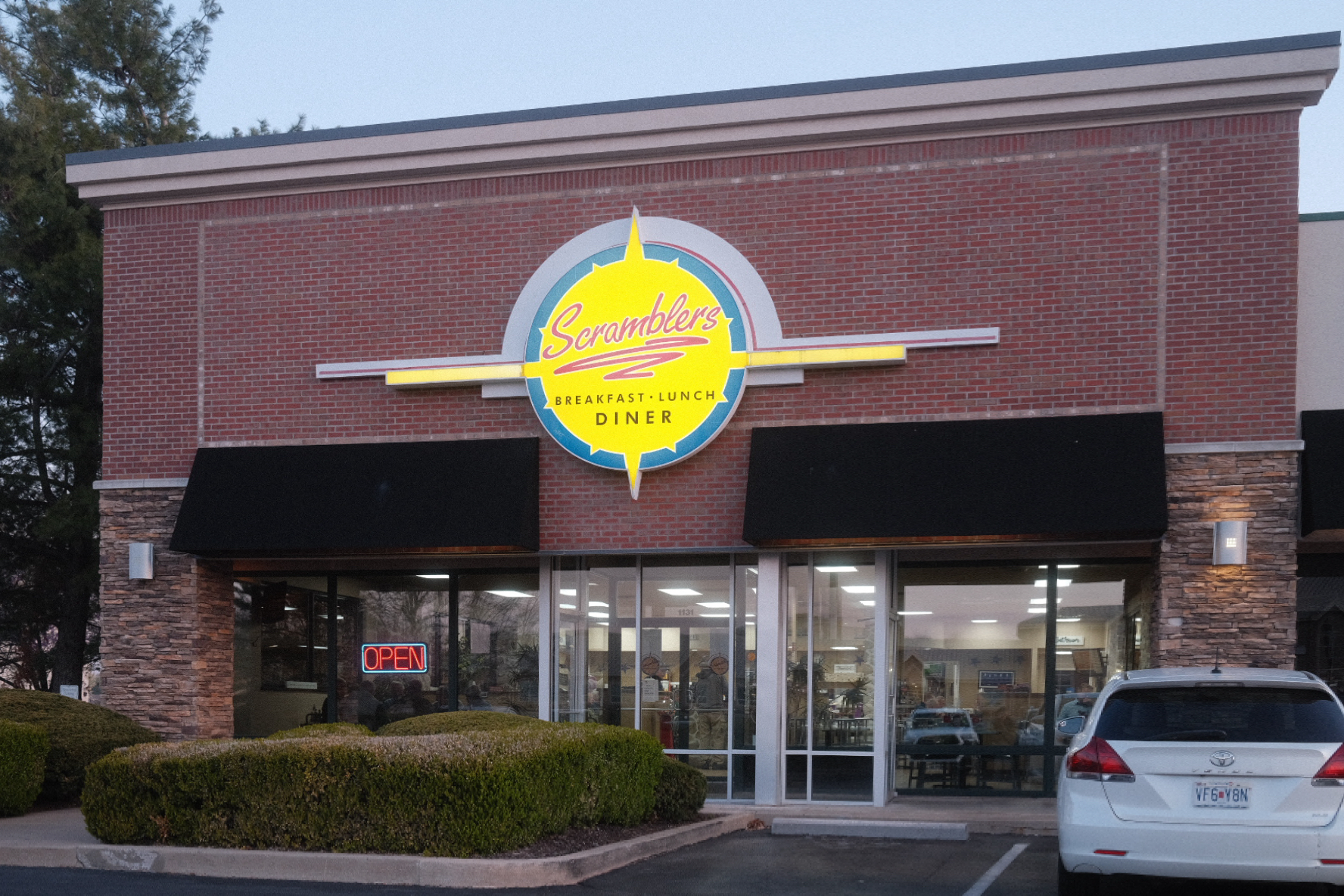
Daily Image: Scramblers, 20 March 2024

A new favorite breakfast restaurant here in Springfield, MO. Capture with Fujifilm X100V and Reggie’s Portra 400 film simulation, SOOC.

A week ago DiL took me to breakfast at the subject venue. They produce solid American Diner food and the breakfast was good. I had an appointment to drop off the 4Runner for maintenance and the shop is only a couple of miles from Scramblers. So I decided to treat myself to breakfast.

They were not busy at 0700h this morning so I was seated quickly. Coffee was at hand shortly thereafter. I made my order and working on an image to post to Vero. My food appeared before I finished my edits.

Once again, the food was good and priced reasonably. I enjoyed it, put a little bit in a napkin to pay the dog tax, and then finished my edits and posted my image to Vero while finishing my coffee.

Then it was off the Christian Brothers Auto to have the 4Runner serviced. There is a long list of scheduled maintenance to do. I was on the fence about keeping my 2013 Fifth Gen 4Runner or trading for a new one. My rig has 200,000 miles on it, but has no known mechanical issues.

I have decided to try for another 100,000 miles. So, I am going to clean up a few minor issues and keep running the mileage clock.

AAR: Blue Slip Tower Site POTA, K-11225, 08 March 2024

My pack and radio kit for the K-11225 Blue Slip Tower Site activation. Shot with iPhone 13 Pro Max.

When I went to bed Thursday night, I was pretty sure that I wanted to get out and activate a park. I had my eye on Blue Slip Tower Site State Conservation Area for a week or so. It was unactivated and I did not have any first activations to my credit.

After dealing with my morning duties and getting some food at Rosie Jo’s Diner, I fed The Girl, gathered up my radio bag and KX2 shack-in-a-bag, and headed out to the rig. I put the location of the park into my iPhone and we headed out. Too late I realized that I had not brought a camera with me. But, there is always the camera in my iPhone.

The drive out took about an hour. I had posted my activation so hunters would know I would be there. I was not sure if I would have mobile phone service, but should not have been. There are two cell towers on the hilltop as well as the fire watch tower.

When I arrived at the site, the gate was closed but not locked. It was posted, though, that unauthorized vehicles were not allowed on the access road. There was not a no trespassing sign, however. There should not be — it is public land and a conservation area open to hunting.

The Girl on Overwatch. Shot with iPhone 13 Pro Max.
I got The Girl out the rig, put my radio and antenna bags into my pack, and grabbed the SOTAbeams 10m Travel Mast from the back of the rig. It was a bit of a struggle to keep her out of the mud, but she complied.

The hump up the access road to the top of the hill was neither long nor too taxing. It was a nice climb through the woodlot with a lot of birds calling just ahead of us. The Girl kept an eye open for the dreaded bushytail, not wanting to let one sneak up on us. She also kept an eye on me, I noticed. I had to call her back in a couple of times because she tends to range out a 75 meters if I do not keep her reeled in.

The fire watch tower at Blue Slip Tower Site. Shot with iPhone 13 Pro Max.
As mentioned above, I needed not worry about mobile phone signal because there are two cell towers on top of the hill. I had a good signal. I was tempted to climb the fire watch tower and operate near the top, but I worried that Sera might not pay attention and fall. So, I elected to sit on one of the footings and use the structure to support my antenna.

Although the wire is not visible, the SOTAbeams 10m Travel Mast that supports it certainly is. I affixed the mast to the tower leg. The antenna is an end-fed random wire about 28ft long. Shot with iPhone 13 Pro Max.
It did not take long to deploy the antenna. I considered using the end-fed half-wave for this activation, but decided that the slightly shorter end-fed random wire fit the setting better. I used a cobrahead (binding post adapter) affixed directly to the Electaft KX2 and threw the counterpoise wire out in the grass.

I fastened my kneeboard to my leg and set the rig on it. I grabbed a spare battery (lesson learned) and set it behind the little rig. The Girl settled into a spot in the grass to keep overwatch. I tuned the radio to the 30m band and selected 10.111MHz as my operating frequency. After listening a couple of minutes, I sent QRL? (is the frequency in use) and listened. I sent it again and listened again.

Nothing heard, so I set the radio to call CQ POTA DE AG7TX K and repeat while I opened the web browser on my iPhone and posted my spot. After a few cycles I checked the Reverse Beacon Network (again on my iPhone) and noticed that one of the spotting stations heard me. I knew I was getting out.

About that time the first call came in and I began working stations. The 30m band actually produced quite a few contacts, especially given I was running QRP (5 watts; low power). I worked stations to the east, mostly.

In the middle of my operation, a rancher drove up in his truck. “Did you see a cow come up here?” he called.

“Nope, nothing here.” I pointed out he had something hung under the passenger side of his rig so he got out to clear it. I sent AS AS (stand by) and chatted for just a few seconds before wishing him luck finding his missing cow. I then returned my attention to the radio as he drove off down the hill.

My Elecraft KX2 deployed on my kneeboard and ready to rock and roll. Shot with iPhone 13 Pro Max.
When that fishing hole was fished out, I moved to the 20m band and repeated the process. Twenty meters provided a lot more action and I worked a pretty good pileup until the calls thinned out. By that time I had about 30 calls in my log, so my activation was made. The skies were quite gray and I had missed some rain by only a few minutes. I really thought it might rain again.

I elected to move up to the 17m band, found an open frequency, and called a few times. Seventeen meters was quite a bit more noisy that the previous two bands. I figured I might take a call or two and then call it a day. I was starting to get cold and was ready for some food. I worked a couple of stations and then called QRT and shut off the radio.

In the end, I collected about 30 contacts and one DX station in Italy. It was a good day.

It did not take long to recover the station. The Girl and I enjoyed the walk back down the hill. The gate was open, so I left it. I was taught to leave gates in the condition I found them.

As I loaded The Girl and my kit into my rig, the rancher drove up.

“Did you find your cow?”

“Yes! She was stuck between two trees and calving! I managed to get the calf out, but now I need to get a chainsaw to free the cow.”

“Good luck!” I called and watched him hurry off to his place to get the tools needed to free his cow. It reminded me of the so many times I worked around the farm when I was a young man. Those are good memories. It was good work.

On the way home I stopped a Hucklebuck BBQ for a bite. The place is billed as the best BBQ around. They were not kidding — the brisket is the best I have had since I left Texas. I left warm and full and even brought the dog tax to The Girl.

I do not have a long list of lessons learned from this expedition. There were things I might have done differently, but they were not big changes. This one was pretty routine.

Life is good.

AAR Parks on the Air — K-10387 Joe Crighton SRA

This was my KX2 station setup at K-10387, Joe Crighton State Recreation Area. Shot with iPhone 13 Pro Max.

I was up early Wednesday morning to see Older Son off to work. He leaves the house about 0630h and I like to get up and spend an hour or so with him as he readies himself for the day. I have a cup of coffee and chat with him and DiL. She also gets up to spend time with him before he heads off and her day starts.

DiL runs the Springfield Barnes & Noble, so her hours are variable. She sometimes leaves just after Older Son. And sometimes she leaves much later. That is the nature of retail work. But she always gets up with him and I respect that.

After he leaves I sometimes return to nap for a few more minutes. It all depends on how well I slept the night before. As I age, I find that sometimes I do not sleep as well. I am sure my experience is not unusual.

Fortunately, my work permits me a lot of flexibility. I like that and take advantage of it.

But, Wednesday morning I warmed my cup of coffee and sat at the desk. A hydraulic model I am working on completed late last night and I wanted to review the work and decide what to do next. In reviewing the results, I had good ideas for what needed to be done. So, I got started on it. I worked until my brain rebelled, so I decided it was time to take a break.

DiL had returned to bed, so I got a shower and dressed for my day. That brought Sera out to see what I was doing. I decided I needed a waffle in my face and Sera could tell I was moving with purpose.

So, she went with me. We drove up to the Waffle House and I had sausage and eggs and a pecan waffle. I saved some of my sausage and my hash browns for Sera. She was very excited when I returned to the rig with a treat. 🙂

We drove home and I returned to my hydraulic model. I finished the amendments about noon and started a run. Once the preprocessor finished developing the solution grid and the computational engine started, I knew it would be a few hours before I had any results.

That meant — I had a few hours to play. The weather was gorgeous so I decided to get out and activate a new park. Sera and I headed out, I bought a sandwich and a bottle of water, and we arrived at the park in a few minutes. I got lunch and Sera out and we shared my sandwich and chips. She sniffed around while I deployed an antenna.

It took four or five tries to get a line over a branch. This is a new skill for me and I can tell I need practice judging where to aim to get the line over the branch I want. But the equipment I have is just about right for the light wires that I typically use.

I setup the little Elecraft KX2 with the Tufteln end-fed random wire antenna, connected directly to the radio. I brought a small Bioenno LFP battery, which I connected. I also brought a N3ZN key along as well. It took longer to get the antenna setup than any of the other equipment.

I had a cellular signal, so I was able to spot myself on the POTA website with my iPhone. I also used my iPhone to log contacts with the HAMRS app. I find it easy to log on the iPhone, although I am sometimes a bit fumbly and fat-finger the text.

I have a CQ message stored in the radio, so I set it off to call while I finished getting ready to take calls. And take calls I did. Even running just five watts of power, I worked a pile-up on the 20m band for nearly 45 minutes. When the hole was fished out, I changed to the 17m band, found an open frequency, and started calling. The Reverse Beacon Network picked me up and the POTA scraper respotted my activation at the new frequency.

I worked another pile-up for another half hour or so.

One thing I noticed was that my passband was a little too narrow. I had it set that way during my last activation, probably trying to improve the signal-to-noise ratio or because another operator work working on a nearby frequency. Nonetheless, I could hear a couple of station outside the passband, so I opened it up a bit so I could copy the signals and worked those callers too.

After a couple of hours, I had 32 or 33 contacts in my log, plenty for the activation. The sun was starting to get low in the sky and I still wanted a walk before the day ended. I also needed to attend to the model run and see what needed to be done, if anything.

It did not take long to recover the station and we were off towards home.

When Older Son arrived, we got The Girl out for a good walk. We got home just after the Sun fell below the horizon.

As usual, I learned a few more things.

  • Using an arborist throw kit is a learned skill. I need more practice to get the weight and line over my target branch. It is just practice.
  • I really like the lighter throw weight and the 1.7mm or 1.8mm line that I got on my second buy. The first kit is too heavy for what I do. The lighter kit will be perfect for the light wires I use and is a lot less weight and bulk to carry, should I decide to pack the kit in.
  • I need to work with the Tufteln EFRW antenna more. I could not get a good match on the 30m band (10MHz) with the KX2 and the EFRW antenna connected directly to the radio. This should work. I have an adjustment to make, I think.
  • The little KX2 is a fine radio for this kind of application. It is not as good as the larger KX3, but it is a lot smaller rig.
  • I should have used headphones for the activation. There was enough traffic noise to be distracting and interfere with my ability to copy the calling stations. I do not like to be isolated from the surroundings, however. So I have to get my powered headphones setup to wear while running the radio. They are also active ear protection, so they have microphones to provide situational awareness with control over the balance between communications and environmental sound levels.

All in all, it was a good day. I am grateful. Life is good!

Valves

Valves at Lowes Hardware. Shot with Bronica S2A, Nikkor 75mm f/2.8 at f/4 (or close) on Ilford XP2.

As I write, it is about noon on Wednesday here in Ozark, Missouri. The Sun is shining and the temperature is supposed to get up to about 60ºF this afternoon. I have a modeling running that will need a review in a few hours (it is a long run) so I have some time to do other things.

One of those will be to get The Girl out for a walk. Given that it is sunny, I might actually go somewhere else and make a few photographs. I am still testing some new equipment and learning to use film again.

I am enjoying the Sun and the warmer weather. I heard from the RV shop yesterday and my camper should be done soon, probably by Friday. It will be time to retrieve it and check everything out.

I also want to get in some radio play while the weather is nice. The forecast calls for clouds and rain this weekend, so this seems to be the time to strike. I have my eye on another park that I have not activated and it is not far away. The Girl and I could go over there and play a little.

The image is another from my test roll in the Bronica. I am a civil engineer. Valves are something I know a little about. The cluster of valves (fire outlet I think) caught my eye on a very cloudy, very cold day. So I made the capture.

Now for some outdoor time while the model runs. Life is good.

New Drone for 2024

This is along one of my regular walking paths in Ozark, Missouri. I had the new drone out for a test run and made this capture. I like having the ability to get an aerial image of an area.

Late last year I determined to upgrade my DJI Mini to the newest version, the Mini Pro 4. There are a lot of upgrades to the smallest DJI drone, but the one I wanted the most was an independent controller. I have never liked using my iPhone as the controller and was always concerned I would get a phone call in the middle of a flight. I had no idea what that might do to the controls and I get a log of spam calls.

I had a pretty good chunk of Best Buy store credits from my computer upgrades last year. So I elected to use them against the purchase of the new drone. I got about a ten percent discount as a result.

I like the ability to add aerial shots to my photography and will need to get Part 107 certification so I can legally use my drone on field walks. The imagery will help provide context for the ground shots. This will be a good thing.

The drone flies well, too. Life is good.

Tree in James River — Test Frame Bronica S2A Nikkor-P 75mm f/2.8

Fallen tree on James River. Shot with Bronica S2A and Nikkor-P 75mm f/2.8 at f/4 on Ilford XP2.

I recently acquired a Zenza Bronica S2A medium format camera. It shoots 6x6cm frames and came with a Nikkor-P 75mm f/2.8 lens. I have a lot more to say about the camera but will save it for another day.

I ran a roll of Ilford XP2 through the camera as a test roll before I decided to accept it. The scans came in on Saturday and I started to review them.

What I can say so far is that the camera is working correctly, at least for the test conditions used. The scan of the negative looks good, but a review of the negative with a loupe and good light will tell me more detail than the scan can. Nonetheless, I think this is a keeper.

I am looking forward to spending a lot more time with this camera. I want to shoot some real black and white film, such as Tri-X, FP4+, or HP5+, and then develop the negatives myself. I will figure out the scanning later, but I could use a DSLR to do the scans or dig out my film scanner.

I am grateful. Life is good.

The Complexity of Modern Cameras

The above YouTube video is by a favorite content creator, Alex Kilbee. He is an excellent photographer and a great teacher. It is definitely worth the watch. If you have not watched the video, then I suggest you watch it first. Then the following will make more sense.

Although I think I am a bit older than Kilbee (heh), I grew up with a simple mechanical camera and film. I was young and had little money to spend on equipment, so I made do with what I had… A body, a 50mm lens, and two aftermarket lenses — a 35mm and a 135mm. That was my kit.

I shot semi-pro back in the 90s with a pair of Canon AE-1 bodies and a few lenses. I made a few bucks, helped out some students and bands, and had a blast. Then I moved into the digital realm and got sucked into the quagmire of increasing cost and complexity.

I set my cameras aside nearly 10-years ago and used the iPhone for snapshots. Last year I was so busy I decided to pick up my cameras again so I could do something creative while hiking with my dog. I upgraded the Fuji X-T1 to the X-T5 and was astonished at the increase in quality and complexity, although the latter camera was far more refined than the former. I also picked up a Fuji X100V and found that to be the camera I carried most of the time… because of its simplicity in comparison to the more capable and more complex X-T5.

And therein is the key, I think, to Kilbee’s thesis for the video. I (we) need simplicity to focus on what is important, the image and working the subject. Digital is nice because the incremental cost of shooting is minimal whereas film is a real expense for each frame.

So, now I find myself with three old (but new to me) cameras: A Bronica S2A, a Nikon F2, and a Contax TVS point and shoot. Why? I have two reasons… well, perhaps three reasons.

First, I really like film. I am not shooting for hire or for publication; I am shooting to please myself. It is a creative outlet.

Second, there is a simplicity in the cameras. The point-and-shoot has some settings, but the camera mostly handles everything once you drop the film cassette into it. I find it an easy way of having a film camera handy when something interesting shows up. The Bronica and Nikon are simple, but capable cameras. The Bronica has no metering system — an external meter is required. The Nikon has a metering prism that uses a center-weighted meter. Both require the photographer (me) to set the shutter time and aperture. This is how I learned when I picked up a camera all those decades ago.

Third, I am learning to ignore the complexity of my digital cameras. The X-T5 will do a bagillion things in any number of ways. The X100V will do half a bagillion things in few ways. I find that setting them up for auto-ISO and auto-shutter speed, setting up back-button focus, adding one or two favorite custom settings (film simulations), and then running the aperture to create the depth of field I want is sufficient. I then forget about every other capability of the camera and just run it.

Aside: I run a black diffusion filter on my X100V — the smallest amount of diffusion possible. I find that this filter, coupled with a film simulation (Reggie’s Portra 400 and Tri-X are my favorites), provide a filmic look to the resulting JPGs. The filter also makes the X100V weather resistant, which is a bonus. I also keep the RAW files handy (sometimes) in case I want to experiment with different film simulations after the fact.

Kilbee is absolutely correct about the complexity of modern cameras and how that complexity can interfere with making photographs. It is one reason I am experimenting with film once again. But I also know that I will continue to use my digital cameras because they are capable of great images. I can dumb down the images with appropriate filtration and post processing, although I do not enjoy post processing.

The bottom line is to stop fiddling with all the camera options, pick a few to set up the camera so it works for you, then get busy looking at the world around you and making photographs.