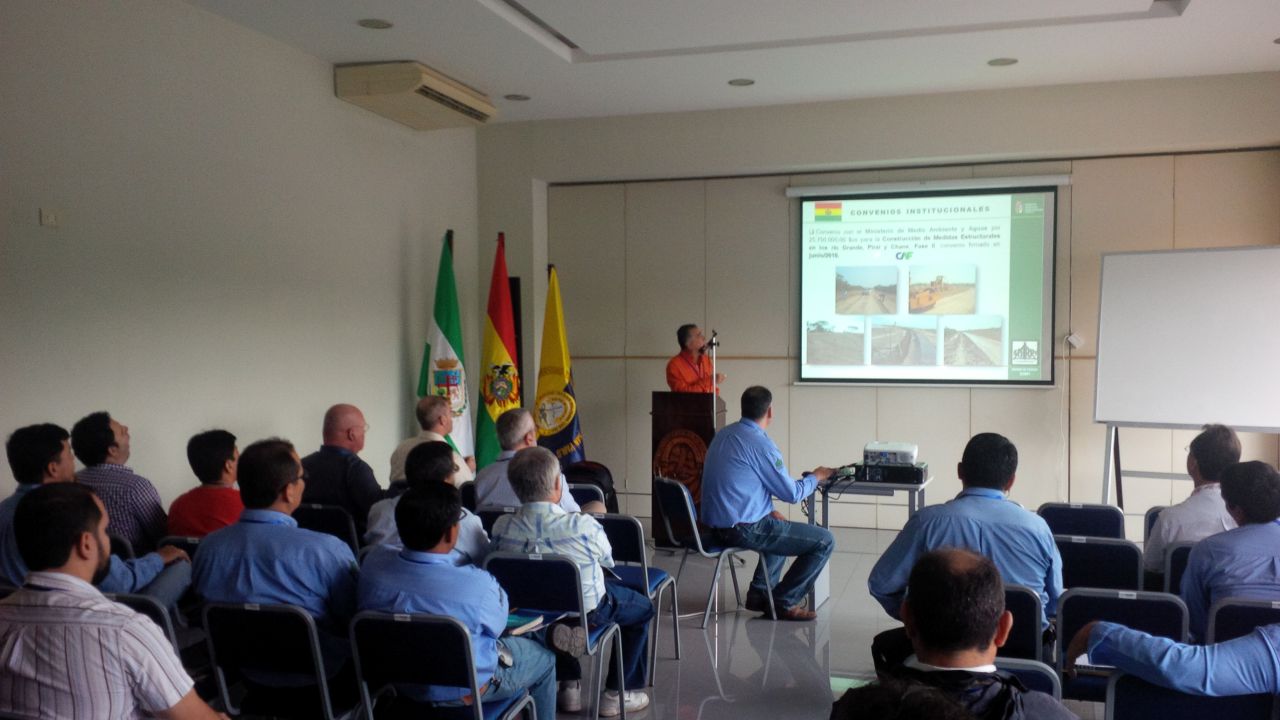
Monday Seminars

One of the first presentations on Monday was Ing. Aguilera's talk about their efforts to mitigate flooding and bank erosion of Rio Piray.
One of the first presentations on Monday was Ing. Aguilera’s talk about their efforts to mitigate flooding and bank erosion of Rio Piray.

After preparations Sunday for our first full day of workshops, a crew of us went to supper (la cena) at the Asian Fusion, an interesting juxtaposition of Bolivian cuisine and sushi. Given that I was leary of anything not cooked, I elected the llama steak, which was very good. Others in our party were more adventurous. The wine was also very good.
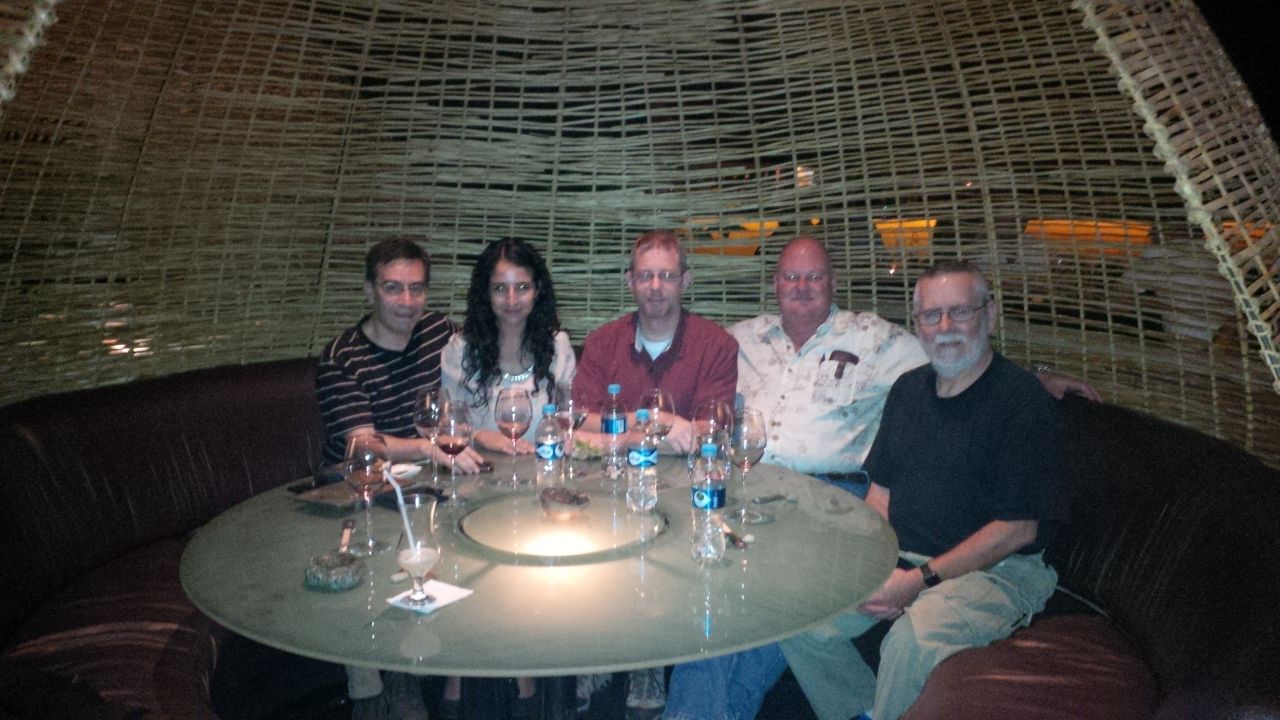
This is the supper crew from Sunday evening, minus Papá. Papá directed us to a restaurant billed as a fusion of Asian and Bolivian cuisine. It was neither, but was still an interesting place. Papá made the image.
We rose early Monday, had a bite of breakfast at Los Tajibos (very good buffet with a chef who made excellent omelettes), and then were guided to the Universidad Católica for the day’s activities. After some introductory remarks, Ing. Aguilera (the technical director for SEARPI made his presentation about their activities to mitigate flooding and bank erosion of Rio Piray. This engineer is very interesting. It was clear he has talked about SEARPI activities many times. But what fascinated me most about him was that he spoke slowly with many gestures. His delivery was excellent (¡muy excelente!) and he was very entertaining.

When we broke for lunch (la almuerza), they guided downstairs to the break room. They provided very nice sandwiches (two of them, which was too much) and plenty of warm soft drinks or bottled water. I elected the water. Ing. Aguilera and one of the translators sat with us and we chatted over lunch. We were invited to Ing. Aguilera’s home for supper.

The afternoon passed quickly. My talk was right after lunch and of course the audience had food-induced coma. I was not at all surprised. I don’t remember much else about the afternoon. Perhaps I had food-induced coma as well.

Papá made this capture of the group at Ing. Aguilera's for supper. The SEARPI staff is in the back row. The "three musketeers" are in the front row along with Jaime and Monica.
Papá made this capture of the group at Ing. Aguilera’s for supper. The SEARPI staff is in the back row. The “three musketeers” are in the front row along with Jaime and Monica.
Ing. Aguilera and one of his staff members picked us up from Los Tajibos early on a beautiful Santa Cruz evening. The drive to his home was only a few minutes. As we entered his beautiful place, we were greeted by his sister and a waiter who was there to assist with the evening festivities. There was good wine and whiskey. I stuck with the wine.

We had enough people there who were conversant with English that understanding was not an issue. We chatted before supper, drinking wine and munching appetizers. Regardless, I think I would have understood Ing. Aguilera anyway. He spoke slowly and with great elocution. I could follow most of what he was saying with my few words of Spanish and by following his hands and face. He is an excellent host.
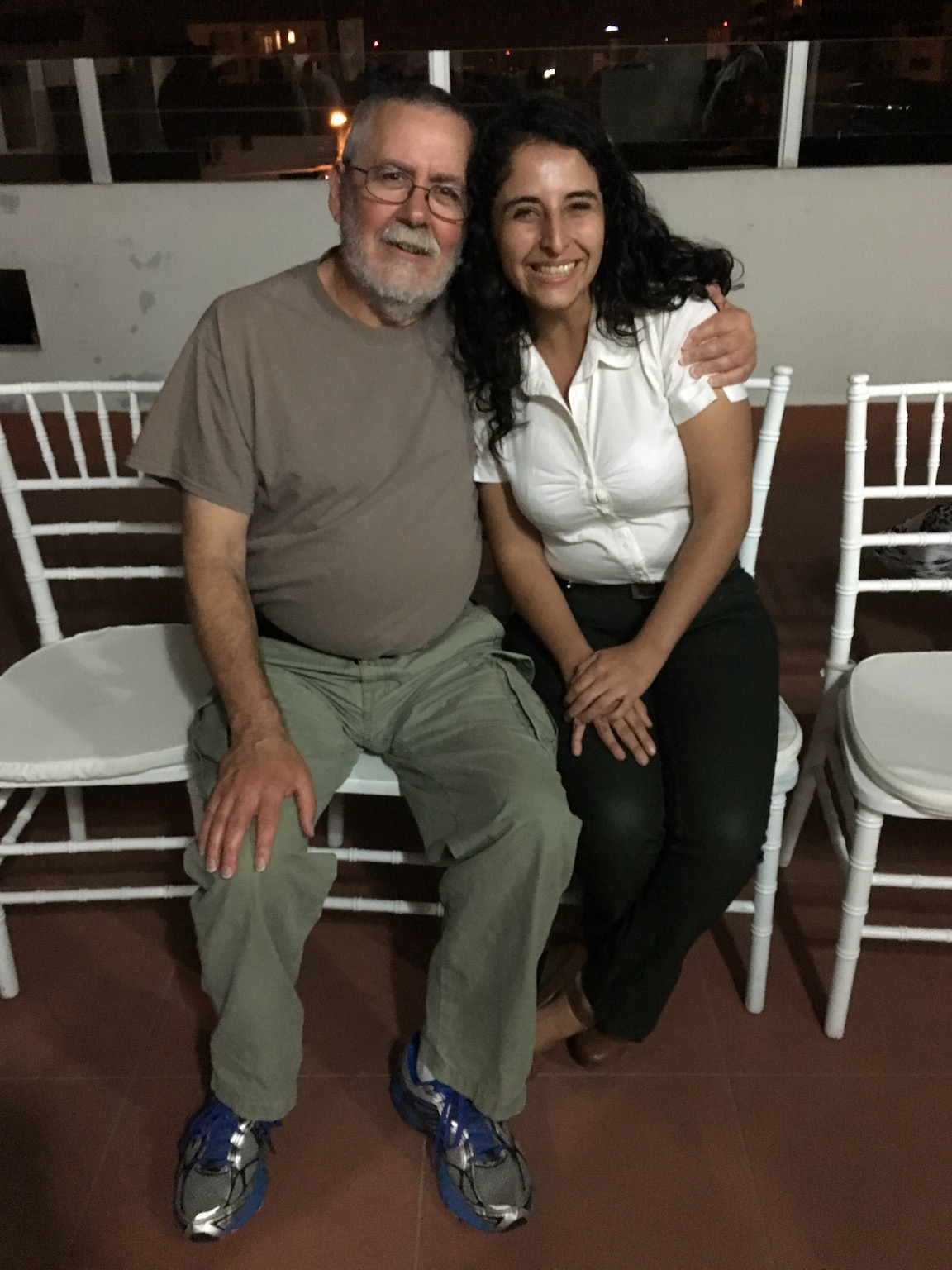
I asked Papá to make this image of Monica and I. I used it to tease my children about their new step-mother.
I asked (Jaime I think) whether Monica would be attending that evening. I was assured that she would be there. I wanted her to pose with me so I could send an image to my children to tease them about their new step-mother.

“Bolivia is a very dangerous place for a single man,” Ing. Aguilera informed me. He laughed at himself for being married not once, not twice, but four times. He told stories about himself, his life, and his work.

La cena was very interesting. I’m generally open to new foods, but couldn’t bring myself to eat the tripe or tongue. I suppose that when I return I will give both a try. Monica teased me about the traditional food and told me the tongue is really quite good. I have never eaten tongue, but have had tripe before. It’s certainly edible, but not my favorite protein source because of the texture. I can eat it, though. So, I’ll have to try the tongue.

After supper, over wine and dessert, the group chatted about water-related issues. I was impressed that technical people involved in hydrology generally have the same set of problems and concerns. It was clear from the discussion, even with the language barrier (which wasn’t that great of a barrier, really), that we share so much. The Bolivians are in a place where we here in the States were maybe 40-years ago. They have an advantage, though, in that much of the research to help them deal with their water problems has already been done. What they really lack, I think, is the institutional drive and funding to completely deal with their problems.

I was impressed that the Bolivians are intelligent, dedicated, hard-working, and capable. I left with much to think about as the evening ended too soon. Papá shooed us off to our accommodations because we had another big day to follow on Tuesday. So we said buenas noches and bid our hosts adios for the day.

Mate de Coca

The second day of my trip to Bolivia I discovered Mate de Coca, a light tea made from coca leaves. Yes, it has coca alkaloids in it. Yes, it is contraband in the States. Yes, it is a very good tea.

After Easter Almuerza, it was time to get to work. We had our first big set of presentations Monday morning and needed to edit our slides and practice our talks. Papá set us up in one of the work rooms at Los Tajibos and we got to work. After some futzing about with the equipment, we were able to use the flat panel display as a monitor and got after it.

While waiting for my turn, I decided to have a cup of tea. (The coffee is generally instant coffee and not up to my standards.) I found this bag of green tea, made from the leaves of the coca plant. So, I made a cup of Mate de Coca.

It is a very nice light tea. It has a slightly sweet flavor, even without sweetener. I did a little research on Wikipedia and learned that Mate de Coca contains coca alkaloids with a concentration of about 4 mg per cup of tea. A line of cocaine has an alkaloid concentration between 20–30 mg. My expectation is that ingestion by swallowing is very different than inhalation (or injection) and the impact of the drug is much changed in the tea form. However, on my return from Bolivia I would have tested positive for cocaine use because I drank the tea at every opportunity.

Its use is being discouraged. It is contraband in the States. I really don’t see why, unless it were to be used to refine cocaine from the leaves. The tea is a mild stimulant and I don’t think one could easily drink enough of it to get high.

This is another example of our world gone wrong where a naturally occurring substance in its organic form is banned because it is abused in its refined form. Meh…

The tea is quite good. When I get back to Bolivia, it will be one of my staple drinks. I like coffee in the morning and tea in the afternoon. I see no reason to change that habit and green teas are a nice change from black teas.

Almuerza, Los Tajibos, Santa Cruz, Bolivia

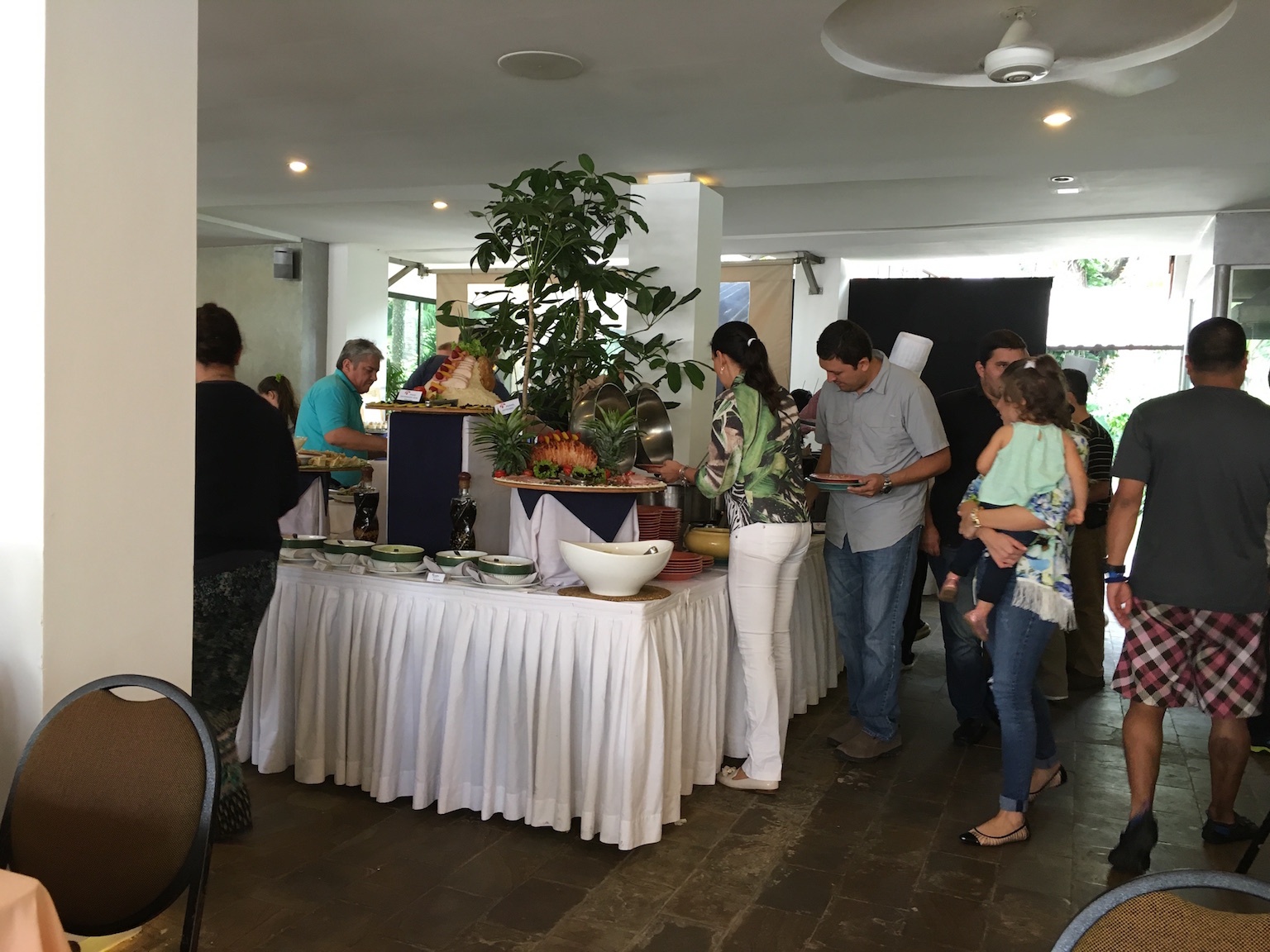
Easter Sunday is a big deal in Bolivia. Los Tajibos put out a huge almuerza spread. Many people were there to celebrate the resurrection of Christ.

The weekend right after I arrived in Santa Cruz, Bolivia, is something of a blur. Between recovering from an all-night flight from Miami to Santa Cruz, adjusting to a totally different, foreign environment, and readying myself for my talk the coming morning, I was a bit blitzed. But, I recall going to brunch (really lunch) at the big spread put out by the Los Tajibos resort. There were many interesting things to eat, all prepared according to local custom.

I was careful of anything not cooked, because I did not want to be sick and knew I was not accustomed to the local bacteria. I really wanted ensalada, but refrained. I found plenty of food to fill me, though, and enjoyed both the meal and the company. Papá took good care of us.

Selfie, Hidden Valley Regional Park

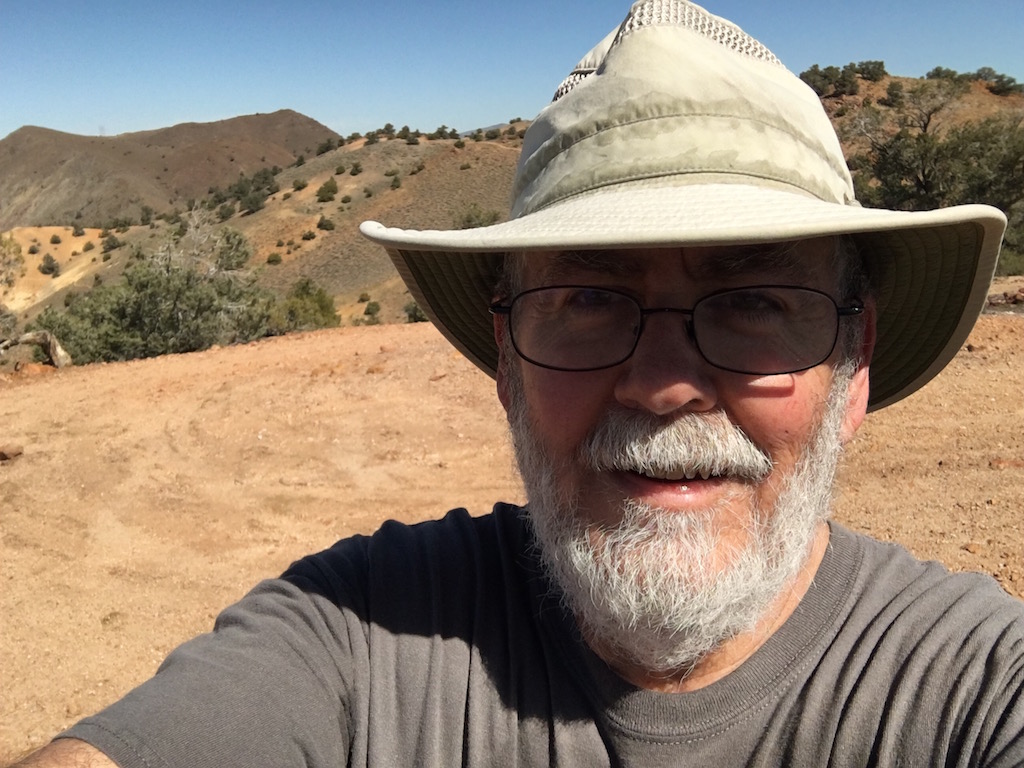
I made this selfie while hiking in Hidden Valley Regional Park a few weeks ago. It seems like it was another lifetime, but it was only in March.

One of my favorite places in the Reno/Sparks area is the Hidden Valley Regional Park. It is a gem of a place, with a fenced off-leash dog run, many trails on the flats, and many trails in the mountains east from the park. The Girl and I spent many mornings there, first in the dog park, but later (and better) hiking the mountain trails. Climbing up on those trails and tramping around, either along the ridge or side-hilling, was soul-feeding for me. The Girl didn’t care what we did, so long as she could range out, hunt, and play.

We had many good days in those mountains. Now we’re stuck in suburbia and our “trail” is a loop around the subdivision. We still walk it twice a day, but I long for open space, mountains, and a vista. I miss the mountains.

A Wizard of Earthsea

Cover: Wizard of EarthseaMany years ago, I read a book — A Wizard of Earthsea, by Ursula K. LeGuin. It was partly for fun, for I enjoyed the best works of fantasy and science fiction, and partly a class assignment. For my university literature elective I sat the Science Fiction and Fantasy as Literature class under Eugene Warren. Although the class was for credit, it was for fun that I sat it. In the process, Mr. Warren taught me a few things about literature.

I met Eugene Warren and his wife, Rose, sometime in the early 1970s. I think they were involved with the Intervarsity Fellowship group on the University of Missouri — Rolla (now Missouri University of Science and Technology) campus. But, I cannot recall.

What I do recall is that they were different than anyone else in my experience. On looking back, I think they might have been part of the Hippie Movement from the 1960s. That is what I think, but I am not sure. That they were very different than me was clear. But, they believed God and trusted Jesus and that was all I needed to know.

My interaction with them was episodic, but always pleasant. When I learned that Warren would teach the literature class, I was intrigued. I am so glad that I sat that class. I was introduced to LeGuin and other great authors and still appreciate it.

So, it was a little surprising to me that I noticed an old copy of A Wizard of Earthsea on Daughter’s bookshelf. I had been thinking about the book because Older Son and I watched a Hayao Miyazaki rendition of Tales of Earthsea while I was in Denver a few weeks ago. I pulled the old paperback from the shelf and opened it.

My name was lettered inside the front cover. I had forgotten that these were my books, given to Daughter during one of my recent purges of things. I set the book aside to read it.

Yesterday afternoon I spent some time with Older Grandson. I asked if he had read the book.

“No,” he responded.

“You should.”

“What’s it about?”

“It is the tale of a young wizard learning to be a man. It is a good story and you will like it.”

I began rereading the book, now after nearly 40 years, last night. I woke early this morning, agitated and restless from my dreams and picked it up again. I didn’t want to turn on a light, so I bought a copy for my Kindle. I listened to music and read for a bit.

Then I set it aside and rolled over to return to sleep for a few hours. I remembered Warren and the class I sat so long ago. I decided that the story was worth telling — and the book well worth rereading.

Bolivia, 26 March 2016

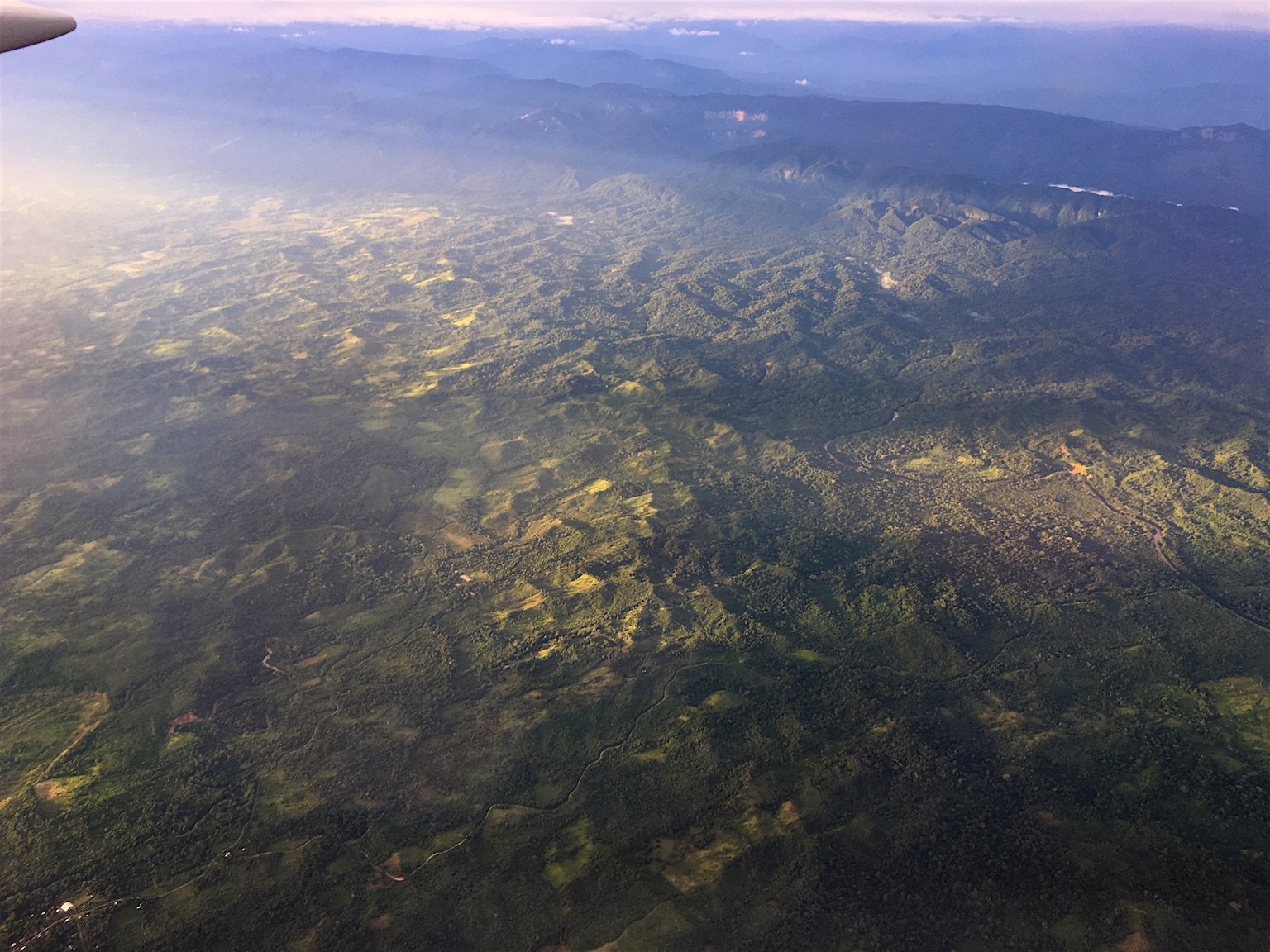
I captured this image through la ventana on our way over Bolivia from La Paz to Santa Cruz. The morning colors were gorgeous and the rugged terrain invites hiking and exploration. I wonder who lives down there.

On the leg from La Paz to Santa Cruz, I was too pumped to sleep any more. I spent too much time looking out la ventana, amazed by what I saw. What an experience it was to see Bolivia as my first (real) time out of country — to be looking at the foothills of the Andes Mountains. It was difficult to believe I was actually there, actually looking at Bolivia, and that in a few minutes I would land at Viru Viru in Santa Cruz.

I was tired from riding in airplanes all night. I was tired of sitting in cramped seats. But I was so excited by what I saw it didn’t matter that my ass complained the last hours on the trip. It was worth it.

La Paz, Bolivia

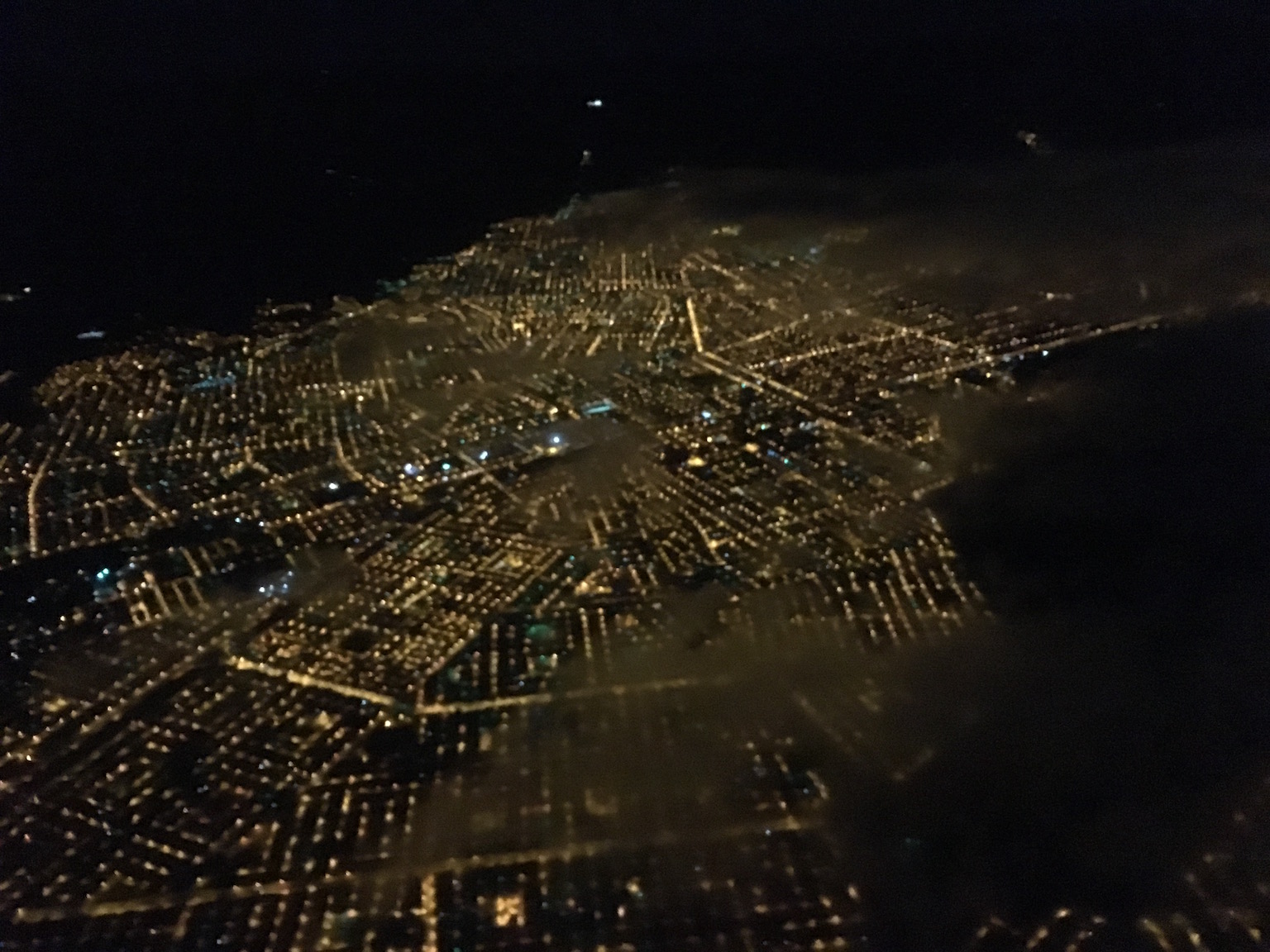
A very early morning shot from la ventana of my aircraft as we flew over La Paz. We were there only one hour in the aeropuerto and never left the aircraft. I want to return.

Although we flew over Bolivia for several hours before landing, this was my first real view of the country. It is an aerial view of La Paz just before we landed at the La Paz airport. It was only a layover, though, and we never left the aircraft.

At over 10,000 feet, it was an elevation greater than I’m accustomed to. I didn’t notice any altitude problems, although I did not have the opportunity to move around. I’m told it will take me a week or so to acclimate to the altitude, should I ever have the opportunity to visit again.

I want that opportunity. I’m ready to go back.

Los Tajibos, Santa Cruz, Bolivia

The view from my window at the Los Tajibos Resort, Santa Cruz, Bolivia

I’m going to begin posting images and snippets of story from my Bolivia Experience. I’ve been back in the Estados Unidos for a couple of weeks, nearly. The FHWA project meeting is behind me. I’m recovering with Daughter and her family in Pennsylvania. It will take me a few more days to get my feet under me, deal with the backlog of tasks that need my attention, and figure out what I want to post.

I had a great time. I met interesting people. I talked about interesting water-related problems. I saw many interesting things, both about water and just interesting. I made a few images, but not nearly enough.

Bolivia is a fascinating place. I think Bolivia captured my heart while I was there.

Huari Beer

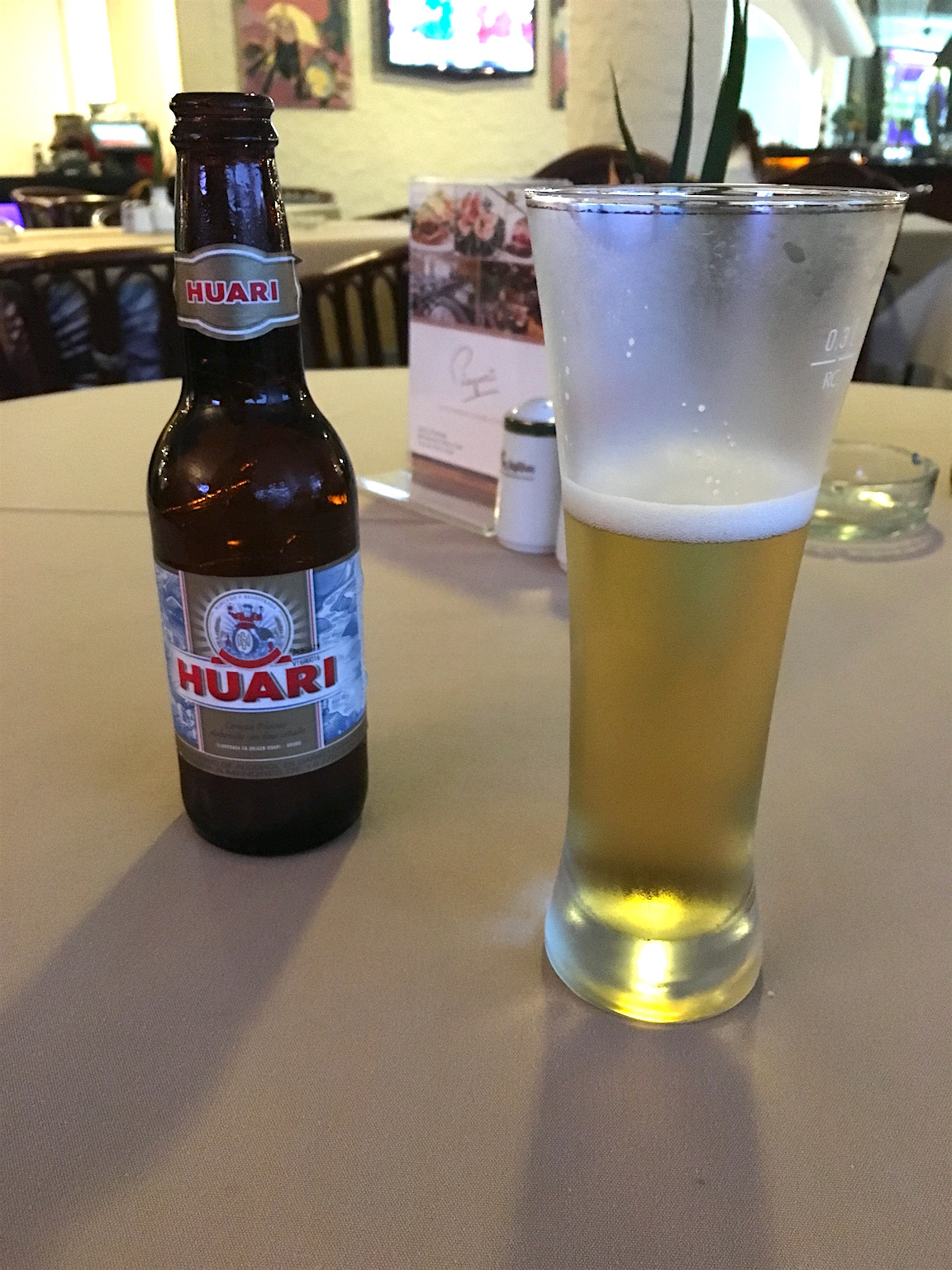
Huari is a Bolivian beer. One of my favorite things to do is to sample the local wines and beers.

Monday was one of the big days. We held seminars all day, from about 0900 to 1500 hours. Breakfast was fairly early and just before the chef began cooking omelettes. I was disappointed, a bit, but the various breads were quite good.

I might remark that the coffee here is just OK. It is brewed in a way that is unfamiliar to me. I expect that if I lived here I’d have to find a good source of beans, learn to roast my own, and then grind and brew my own coffee.

Along that line of thought, coca mate is legal here in Bolivia. Coca Mate is made from the raw leaves of the Coca plant, meaning that it contains a small amount of coca alkaloids. While we were working on our presentations Sunday afternoon, I brewed some coca mate using the hot water and tea bags provided by the hotel and added just a bit of sucralose. It is a very good tea and I enjoyed it a great deal.

Unfortunately, I cannot bring the tea home with me. It’s illegal in the United States. Also, I’ll now test positive for cocaine, although I have had none of the refined drug. I don’t actually care because the experience of tasting this wonderful tea is worth the risk of not passing a drug test.

Back to my story — we had two translators provided by the US Embassy. They are sufficiently skilled to do simultaneous translation while we are speaking. Those speaking in Spanish are translated into English and vice versa. It works amazing well… if the speaker remembers to pace him/herself such that the translators can keep up.

The morning sessions went well. One of our speakers was the head of a local resource agency, SEARPI. He is an experienced, animated speaker who has good command of his material. Even without being able to understand Spanish, his delivery of his material was highly entertaining and I enjoyed his talk. The translation was good enough that I was able to follow along.

After his talk, he invited those of us from the States to his home for dinner. That will have to be another story, I think.

Lunch was also fun. He sat down with us and one of our hosts (from Tarija) is fluent in both languages. So we were able to have a lively discussion over sandwiches.

My talk came right after lunch. I learned that I can still put them to sleep with the help of a food-induced coma. The room was warm and I was working to pace my talk to keep from getting ahead of the translators. I listened to the translation in my right ear with the volume down so I could track the translator. That worked well, although my pace was a bit slower than I usually use. It worked, nonetheless (unless you count putting them to sleep not working).

After the talks, it was time to mingle. One of the professors from Catolica Universidad Santa Cruz greeted me and we chatted a bit (small bit) in his broken English and my broken Spanish. I have his card and if I get back down here will attempt to spend some time with him discussing his work and students. A number of others asked for a photograph and then we did a group photograph under the university emblem.

Ing. Aquilera volunteered to drive us back to the hotel and we graciously accepted. That meant we had time between the seminar and supper to rest a bit. I did and it was good.

Today I’ll meet with a group of students (with my colleagues), spend some time with the dean of engineering here in Santa Cruz, and fly to Tarija this evening for more meetings tomorrow. I will have to write up my supper story in a second entry. I also need to retrieve photographs from my camera and choose some of the best.