Field Day 2025 — AAR

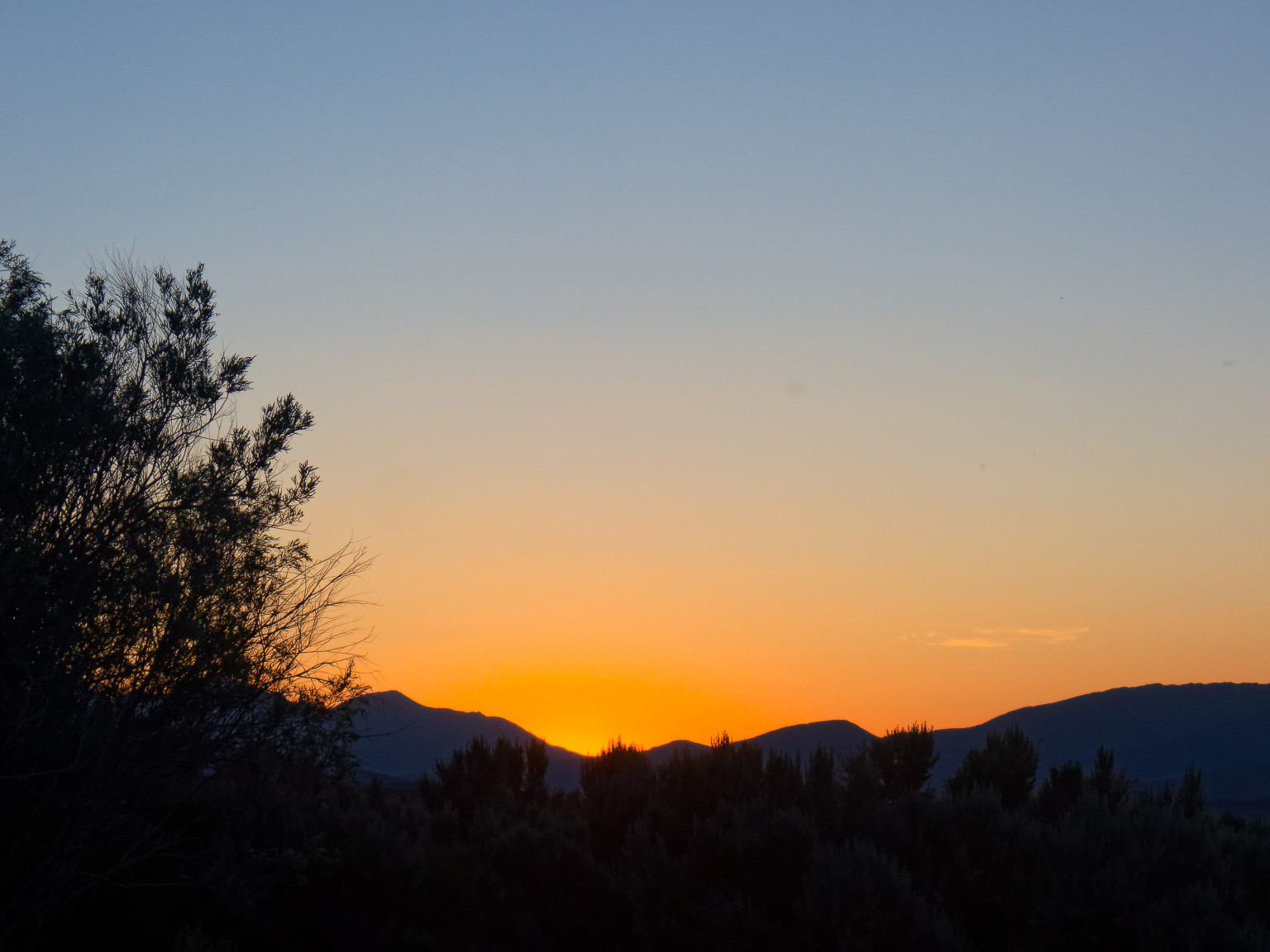
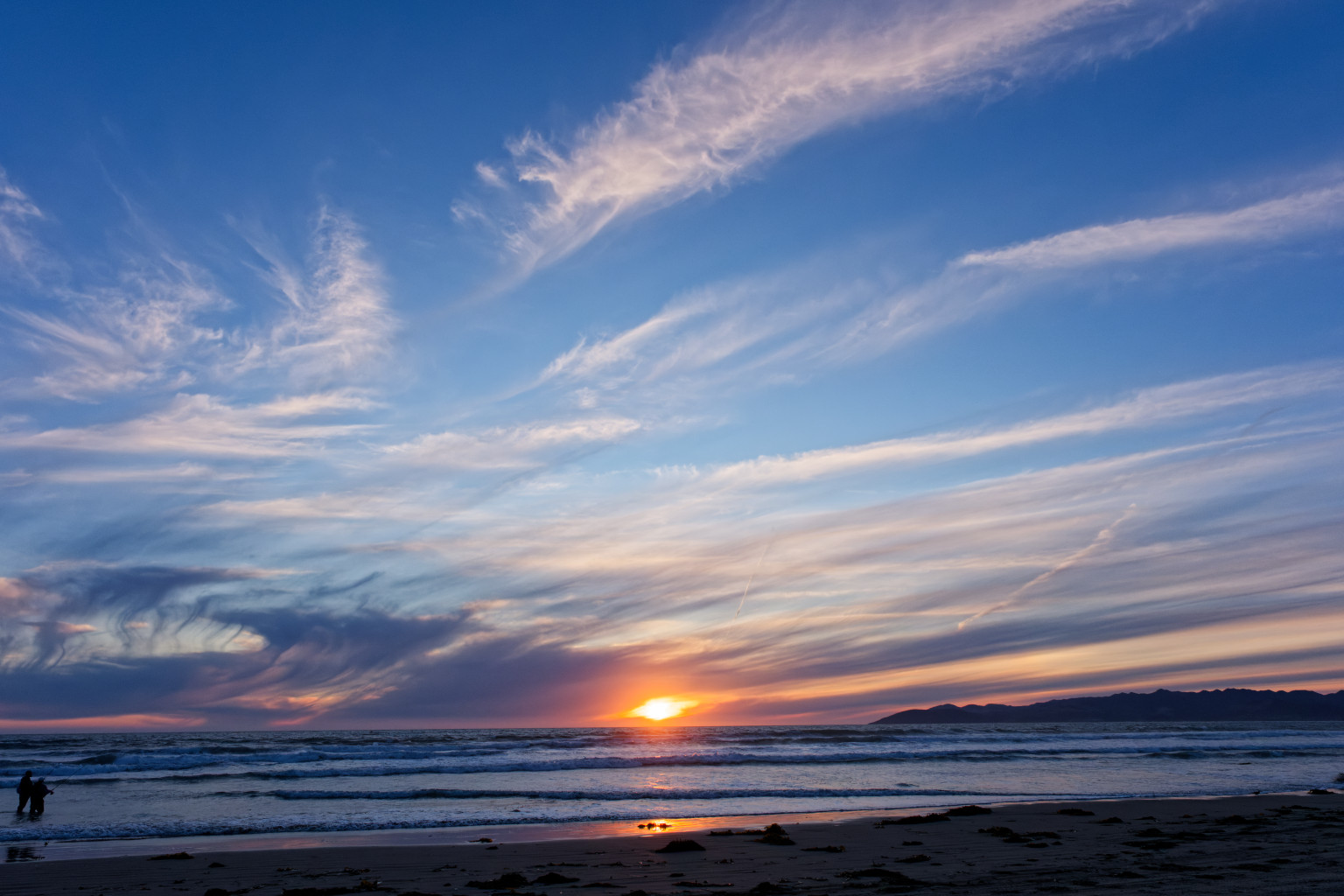
This was my last sunset for Field Day 2025. It was a good trip. Captured with TG-7, 2025-06-29 19:22:55, 18mm, 1/320sec, f/4.9, ISO-100, SOOC.

Introduction: My desire was to go camp for Field Day 2025 and spend the weekend being outdoors and playing some radio. I knew the bands would be busy, if space weather was good, and that I have been cooped up at the house too much.

Preparation or the lack thereof: I started readying the camper a few weeks before the departure date. I made sure things were working. I refilled the potable tank after the (work) trip to Summit Lake. I checked the refrigerator and did some light cleaning.

What I did not do was select a site. I considered going to one of our old favorites (there are a few). Of those selections, several are within a couple of hours of home, which was doable and preferred. But, a week or so before departure, my buddy suggested Fletcher Spring, which is out near the Aurora Mine in the direction of Bridgeport, California. He indicated the road was slow (washboardy and rocky), but not too bad. There was (non-potable) water at the spring and a nice place to camp.

“Are you planning to come out and camp?”

“No, I don’t feel like loading up the camper. I think we’ll come out for lunch on Saturday.”

“OK. I don’t plan to get started seriously until after noon. I’m not that serious about the contesting part of Field Day; I just want to play some radio and enjoy being outside.” I also just wanted to be away from the house and away from the desk for awhile.

I asked for a pin and a route, if he had one. He sent me a GPX file. I processed that and stored it in my Garmin.

I made a meal plan and grocery list. The grocery run did not take long and the camper ‘fridge was cooling, so I stored the dry goods in the camper and the perishables in the house fridge. I also assembled some personal items (clothes and dopp kit), plus some technical tools for the weekend.

Departure and Trip: I was anxious to get out of town and so I rushed the packing and loadout. After my appointments for the day, I finished the final bit of loading and then hooked up the camper to the 4Runner. The Girl and I headed south to Holbrook Junction and then east to Smith Valley. We took the Bridgeport Highway and turned off on the appointed dirt road and slowed way, way down.

The 20 miles or so from the pavement to Fletcher Spring took a long time to traverse. Most of it was pretty rough with either washboards or rocks. I was able to make 30mph over a couple of miles of the road, but most of it was 10mph or so.

We made it to the site about 2030h. There was just enough daylight left to pick a spot and deploy the camper. I did manage a short walk for The Girl and I during the growing twilight. I was mindful that there might be mosquitoes with all the water.

We settled in for the night with the windows open (thankful for screens) and enough cool air as the desert cooled down after the long day.

It was then I discovered I had forgotten my Kindle. There was no cell service, either. I checked in with my friends and family via inReach so my people would know that I was safe and on site.

I prepared to take a shower to wash off the day. The final loadout, the trip, and the comper deployment left me a little sweaty with some stress sweat. When I switched the valves to bring the water heater online, I discovered a leak in one of the T-fittings for that piping.

It did not look readily repairable. I did not have PEX tools and parts in the camper. There was another lesson.

So, I made some hot water on the range and had a spit bath. I then settled in for the night.

Radio Deployment: The following morning (Friday), I rose, made my coffee, and made some breakfast. I brought some left over refritos and arroz from a previous meal out, which are very, very good with a fried egg or two. I did share with The Girl, who always enjoys my leftovers.

I then began assembling my station. I decided to use the Elecraft KX3 and KXPA100 indoors. I knew that I would operate after dark and I did not want to be outside because of the mosquitos. I also knew that I had already setup the KX3 for digital operations and wanted to send some Winlink messages as part of Field Day operations.

That is when I discovered that I left the power adapter for my Surface Go at home. The adapter normally lives in the case for the SG. I made changes to that kit sometime over the last couple of months. I moved that adapter out and probably left it on my desk. Fortunately, I brought a Bluetti power supply (solar generator — ha!) that has USB C ports and so I was able to power the computer from that power source.

I setup my Yaesu FT-897D on the folding table outside for daytime operation. It has the LDG YT-897 ATU attached to it that makes a very nice field radio.

When I attempted to connect the Yaesu to the logging computer, I found that the cable I *thought* was a CAT cable is only a programming cable. So, there was no connecting the radio to the computer for logging. This meant I would be split logging partly on the computer and partly on paper. So, there would be extra (very tedious) work to complete my Field Day log and dupe sheet.

I finished my Friday staying out of the heat. There was enough shade from the old cottonwoods near the spring outflow that the camper was shaded in the afternoon, which significantly reduces the heat load on my house. I also had the Magic Fan running and brought a Ryobi battery-powered fan and both of those units help a lot.

Saturday dawned and I was up with the Sun. That is my way when we are camping. I made my first mug of coffee and sat down at the table to enjoy it. I turned on the general receiver and listed to a Reno AM station. It was a little crackly inside the camper, but I moved it around a bit until I got a decent enough signal. I cannot recall what they were talking about, but it was talk radio and I enjoyed hearing the voices.

Doggo snoozed on the bed, not ready to get out yet. But, that would change soon enough and she would start pestering to go out and check for critters.

I started some bacon while I enjoyed my coffee. The fat would go over Sera’s kibbles (she is very sleek) and I would share a bite of bacon and maybe a bite of egg with her as well. I cook my bacon slowly over medium-low heat, which reduces the curl and popping. It takes longer to cook at this setting, but the result is much better. (At least, that is the way I like my bacon cooked.)

The smell of cooking bacon caused The Girl to raise her head and look at me. She knows what that means. She likes her food.

I worked though my first coffee while the bacon sizzled, then started my second mug. About the time the bacon finished, the Aeropress was ready and the eggs had warmed to room temperature. So, I poured the bacon fat over her kibbles and started my eggs. While they cooked, I pressed my second coffee and got ready for breakfast.

I sat at the table with my breakfast and coffee after putting out her food. I heard her work her way through her kibbles over the voice on the radio while I enjoyed my own breakfast. I then gave her a bit of bacon and a bite of egg.

Outside, it was warming and the sun on the camper warms the interior quickly. I put the dishes in the sink after wiping them out and we headed out for a short walk.
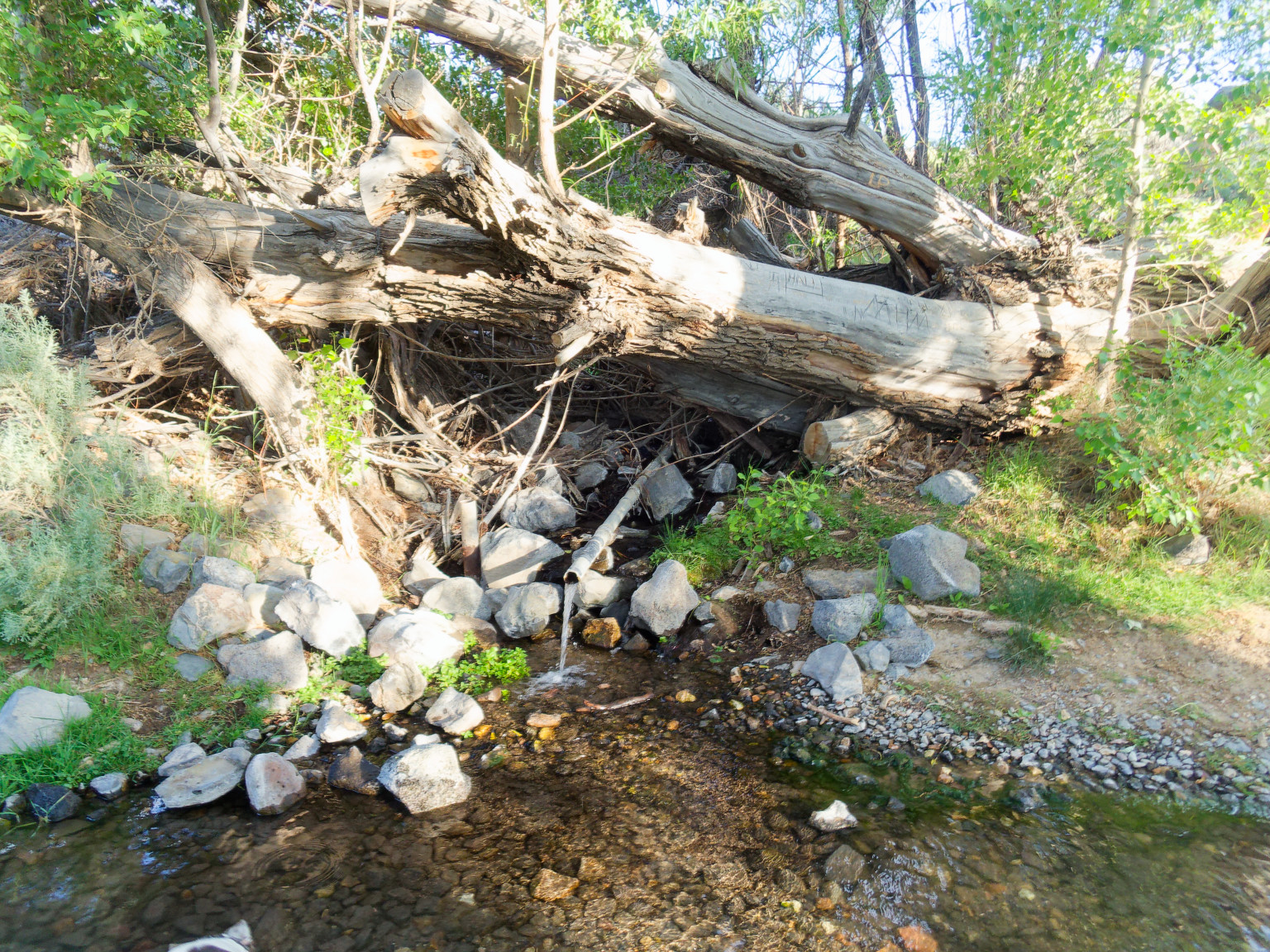
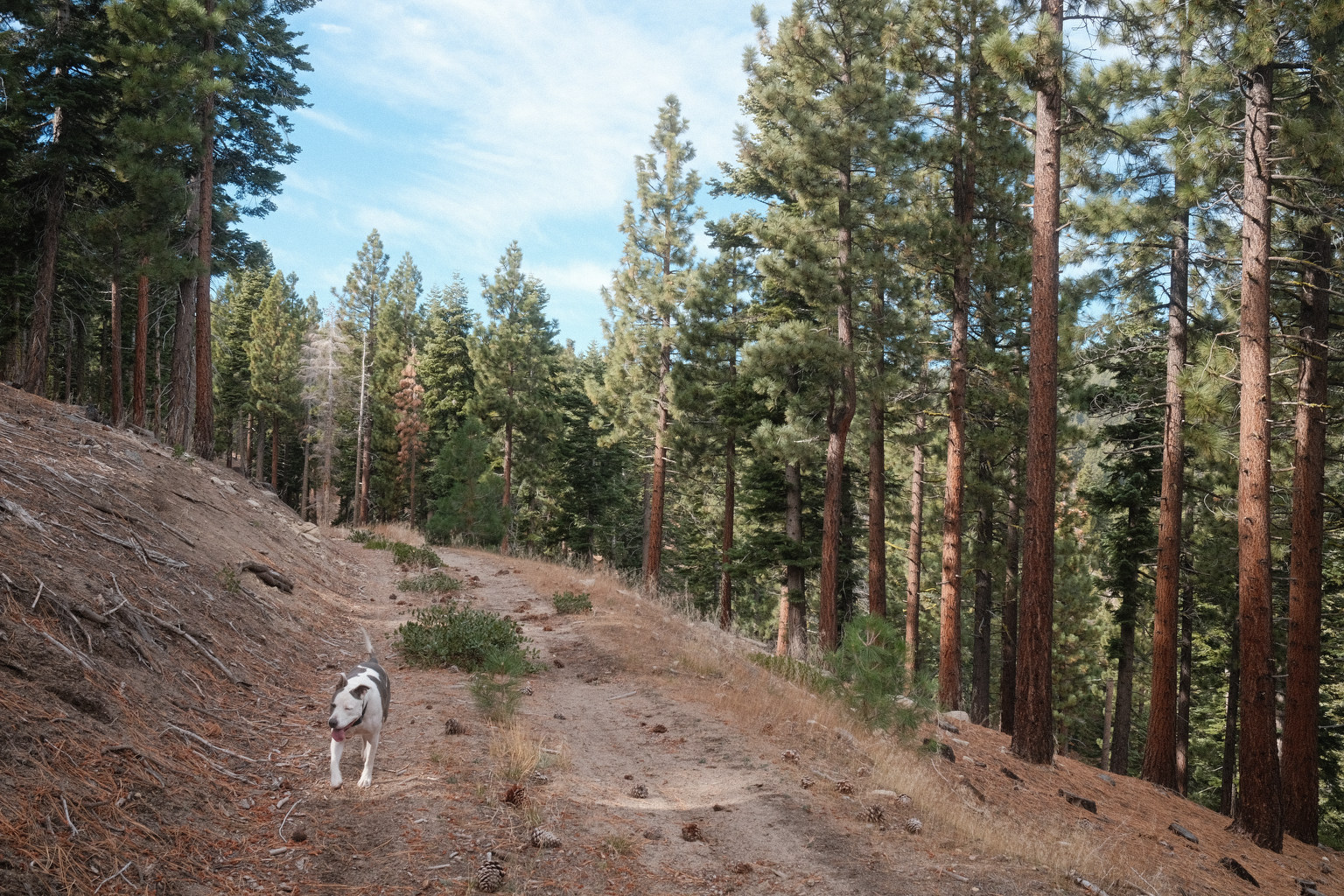
While not the spring head, this is just downstream a few meters. There was plenty of water from the spring. I can only image what a Godsend this was for pioneers and other travelers. Captured with TG-7, 2025-06-27 18:07:15, 4.5mm, 1/80sec, f/2.8, ISO-100, SOOC.

I rotated all the solar panels to maximize the energy catch, then sat down at the Yaesu, my outdoor station, turned on the radio, at started spinning the VFO. I heard a few POTA activators calling, so I made a few contacts on phone and CW modes. While I tried to work one activator, I heard him say “It’s time to get started… CQ FD CQ FD.” I glanced at my watch, it was 10:59:30h and he was early.

How do I know this? Well, I wore my Casio G-Shock GWM-5610, which synchronizes (or attempts to synchronize) to WWV (the world time radio station) every night. I checked and my watch had synchronized early Saturday morning. My watch was correct to within a second. The operator was early by about 30 seconds.

What can I say… I am an engineer and like to be accurate.

Operations: Although I knew my friends would arrive around noon for lunch, I decided to get started anyway. As I scanned the 20m band, I started hearing more callers announcing their availability to take a call. I tried on phone a few times, and made a couple of contacts. But, the frustration of fighting the (phone) pile-ups grew rapidly and I switched the Yaesu to CW mode and moved to the bottom of the 20-meter band.

There I was much more successful and started logging quite a few of the runners. I find it a lot easier to make code contacts than phone.

I also listened on the 15m and 10m bands. I worked a few stations on the 15m band, but heard nothing on 10m. I do not think that the 10m band was open during Field Day. But the stations I heard on the 15m band were quite strong and easy to work. There also seemed to be less competition on the 15m band for some reason.

I checked on Doggo now and again and made sure she was close and had water. Once we get in our morning hike/walk, she is usually good to stay nearby. I really appreciate having her near as she provides a lot of comfort and is someone to talk to.

Nearer noon, my friends arrived on their motorcycles and she ran over to greet them. I turned down the radio and sat back in my chair to socialize a bit. We visited while she pestered and it was good to catch up.

They retrieved their lunch from the cooler one carries on the luggage rack of their motorcycle and I retrieved munchies from the camper. They graciously shared part of their sandwich with me. I found out that I had left my roast turkey slices and Swiss cheese at home in the refrigerator. Another lesson…

We spent an hour or so together with few interventions by the mosquitos. They decided to head out for the rest of their ride. I watched them leave with a mixture of emotions. Once again, The Girl and I were alone.

That change in state always affects me emotionally, at least a little. Although I am an introvert by nature, there is still a social aspect to my personality. I do not have, and have never had, a large social circle. I favor a small group of friends that I spend time with. We do not have to share the same interests, although that helps. But, there is always some kind of energetic connection. I do not understand it; but it exists.

So I spent the rest of the afternoon moving my outdoor station around to keep in the shade and chasing runners. Most of my contacts were on the 20m band, with a few on 15m. As the afternoon drew into evening, I shut down the Yaesu and moved indoors. The Girl and I did get in a short walk before that move.

I started wrestling with Winlink and the KX3 station. The VARA HF modem was not working correctly. That was strange to me because it had been working the last couple of times it was used. I turned on my Internet (Starlink) and did some research and finally got it sorted.

I then proceeded to send Winlink emails to the state emergency communications coordinator and a list of friends I knew operate Winlink. That would permit me to gather some easy Field Day points.

I also learned that there must be a Winlink best practices guide somewhere out in the Interwebs. Or, if there is not, there should be. It is clear that I need training for Winlink field operations and some additional repetitions.

I also realized that I want to be able to run JS8Call (another digital mode) in the field. That is also going to take some work to get my skills up. There also should be a best practices for JS8 field operations (probably home operations, too).

About 1700h there was a knock on my door. I looked at The Girl, she did not look too alarmed, although strongly curious. And there I was, no shirt (too hot) and no one has accused me of being pretty.

I answered the door, to find two young people looking up at me. The girl (not my Girl) said “Do you mind if we camp in the area next to you.”

“Of course not, there is plenty of room.”

“Some of our party can be pretty noisy.”

“I take my hearing aids out when I sleep. I doubt you will bother me.”

“Are you sure, they can be pretty rowdy.”

“I think it will be fine. I really don’t mind at all.”

They seemed reassured and headed off to begin setting up camp. They had tents and a couple more vehicles pulled in over the next half an hour, some bringing old pallets to provide firewood.

I was curious, of course, but did not think there would be a problem.

I finished futzing about with Winlink. It took nearly a half-hour for the dozen messages to send over the 40m band. The bit rate was very low and so there was a problem my setup, propagation, or both. It was a lesson.

I made some supper and fed The Girl. The neighbors started ramping up their campout/party. I could smell some wood smoke and hear them chatting and laughing.

I then turned back to the radio and continued chasing station. There were a lot of runners on the 20-meter band, a few still operating on 15m, and then the 40-meter band started to liven up.

I gave up for the day about 2200h local. I turned off the station, and took care of the evening ablutions.

I woke a couple of times, as I normally do, and could hear my neighbors. I did not think them obtrusive. They were just young people being young people.

I later wished I had gone over and introduced myself to the group. It would have been the neighborly thing to do and I could have reassured them that they were no bother.

I woke early, as usual. The coffee was good. The smell of frying bacon was good. Breakfast was good.

I worked a few stations while my breakfast made. After breakfast, my neighbors were already on the move and it did not take them long to clear out. I moved outside to the Yaesu and continued chasing stations, after getting The Girl a morning walk around the springs.

It was a good morning and I added contacts to my log.

Recovery and R&R: After operations concluded, I put away the Yaesu and cleaned up much of the radio equipment. I left the KX3 station indoors setup in case I wanted to chase a few SOTA or POTA activators. I made a bite of lunch and got The Girl out for another walk. This gave me a chance to clear the cobwebs and make a few images.

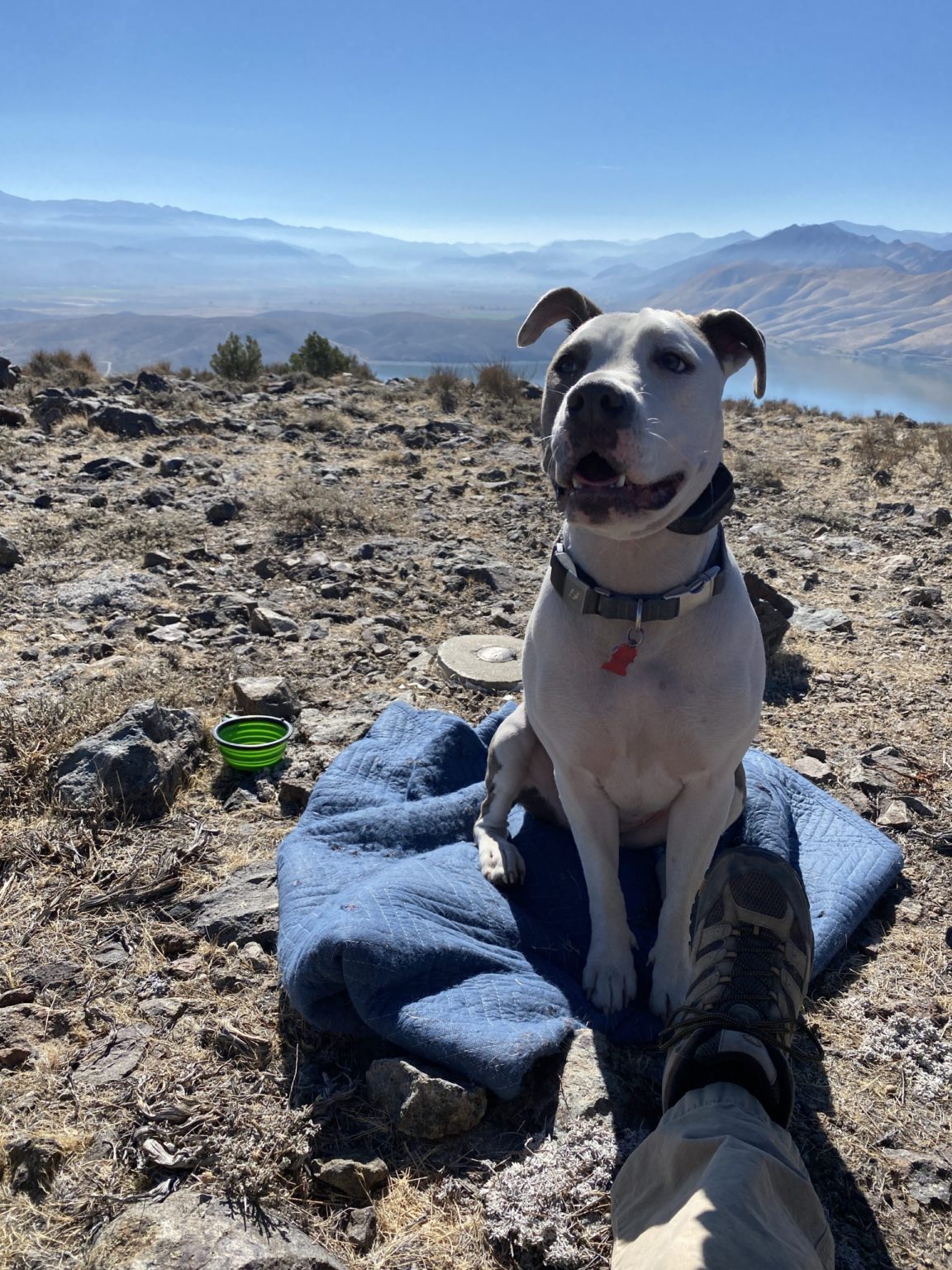
We returned to camp and I moved the folding table to the shade. I got out my old Bose Soundlink speaker, my journal, my log, and my notes and sat down with a bottle of Cab. I threw out an old furniture blanket I keep in the rig for The Girl and she arranged herself so she could keep overwatch and nap.

I listened to music the rest of the afternoon. I spent time reflecting on the weekend, on life as it is, and what I learned from this expedition. Many of those thoughts found their way into my journal and into my notes.

Many memories of Wife came to me that afternoon. I reflected on our life together for all of those years. There is a certain melancholy that accompanies such reflection as we had always thought I would eventually retire and we would spend our remaining time together doing stuff together. That was not to be, though. And, such is the nature of life. It is inherently uncertain, but for certain things. It is changeable. It is fragile.

I made some notes about my experience with this Field Day. I know there are more things I need to learn and to practice. As written many times in this on-line journal and at least as many in my paper book, one reason I am an amateur radio operator is for emergency communications. Although I have interest in serving the community, my primary goal is to be able to contact my family and loved ones if or when commercial communications fail.

So, I still have work to do in this regard.

As the Sun fell toward the horizon, I realized that the mosquitos had gotten to me. That caused a few interesting words. I moved my things into the camper and recovered the folding table.

The Girl and I made another round through the Fletcher Spring area to get some exercise and to make a few more captures while the light was pretty.

Departure: Monday morning I rose, made coffee, and spent a little time waking up. The portable radio I brought along received a Reno station well enough that I got a little news. It is also nice to have a voice in the rig.

After coffee, I decided I did not want food. I just wanted to break camp and motor on home. I figured I might find some food along the way (maybe Smith, Nevada). So, I got The Girl out for her morning constitutional and carried the little Olympus along, just in case I found something interesting.

She checked all her favorite places for something to chase. I swatted a couple of persistent mosquitoes. After making our circuit, I put her in the 4Runner while I did that last of the chores associated with breaking camp.

Then I started the 4Runner. I was greeted with a miss from the engine, the Check Engine light flashed, the Traction Control light was solid, and the 4-Lo light flashed. This was a wrench in the works I did not anticipate.1 I did the standard checks, found nothing obvious, and decided to try to limp home.

After hooking up the camper and making sure the lights and brakes worked, we headed out. It was going to be a long slow haul to the highway anyway. I could tell that the miss was real and that the engine produced less power than normal.

That made me think about those long pulls out of Smith Valley and Holbrook Junction. I shrugged to myself, “There’s no sense borrowing trouble before I need to.”

Sure enough, the pull from Smith Valley was done at 30mph. I did not push the engine hard as I did not want to cause any damage. The pull from Holbrook Junction was not so bad, although a lot of vehicles stacked up behind us and several made very dangerous passes in their impatience2.

I was relieved to get home. I parked the camper and then the 4Runner. It did not take long to unload, so I did. Then I put most of the things away and settled in to recover from the weekend.

My buddy Greg called in the afternoon and I told him the story. “Oh, rodents!” he said. “I’ll bring my OBD scanner over this evening after supper and we can check it.”

“Thank you.”

Sometime around 1900h he arrived. We read the codes from the 4Runner’s computer and confirmed the miss and a couple other problems. On opening the hood, we found a chewed through wire and a nest. I had a jumper wire with alligator clips on the ends and he jumpered the broken wire. The miss went away.

“Why don’t you come over in the morning and we’ll try a repair. Earlier is better before the heat rises.”

“How about 0900h?”

“Yeah.”

“See you then.”

At least I knew that I was probably not faced with a huge problem.

Repairs: I drove over the next morning and it took us a couple of hours to clean out the engine bay, repair the chewed wire, and clean up another wire from which rodents had removed some of the insulation. I made a short test drive and everything seemed normal.

So, I took my buddy to lunch.

When I got home, I ordered my own OBD scanner.

Lessons Learned: Once again, on a significant deployment, I learned some things. Some of my problems were my own fault for rushing the deployment.

  • Follow the plan. I let myself get ahead of myself. I did not write a full punchlist to check off things like food, power adapters, and personal items (like my Kindle). The plan is as important as anything on the punchlist.
  • When in an area where there might be rodents, leave the hood raised at least a few inches. That will discourage them from crawling up in the engine compartment to build a nest (and chew wires).
  • Be sure to check the camper equipment, even it worked correctly during the last deployment. My water heater worked fine when I used the camper for a work project just a few weeks before Field Day. The T-fitting at the water heater broke sometime after that trip.
  • I fumbled my Winlink exercise. There should be a Winlink best practices guide in existence. I need to find it, or make it. Then I need to practice with Winlink in the field. This is important, because being able to send and receive Winlink email messages is part of my preparedness plan.
  • JS8Call is one of my digital radio tools. I use it at home sometimes just so I know how it works. But, there is a lot more to the tool (and an update now) than what I have used it for. So, I need to take it out and run it in the field for practice. If there is a best practices guide, then I need to study and practice.
  • The FLDIGI suite is another set of digital tools for ham radio. I trained on them (KA7FOO did the training, RIP), used them on the ORCANET (back when it was running), but have not used them in a couple of years. There is benefit to having these tools available, particularly when propagation is poor enough that voice communications are not reliable. So noted.
  • Part of this digital experience is to have the equipment and tools prepared before going to the field. I now know that I should have a CAT cable and Digirig (and cables) ready for the Yaesu FT-897D (and the FT-857D that is in my inventory). These old radios are solid, field capable, and I have filters for them. They will remain in my inventory and be used.

I found working on my log was a pain-in-the-ass. I futzed around with N1MM+ and N3FJP’s Field Day log software, trying to find an optimal way through the process. In the end, I used ADIF Master (a freely available program) to do the final editing of my log in preparation for uploading it to ARRL for processing.

Despite the frustration (mostly with myself) and the vehicle issue (damned rats), it was a good Field Day and a good outing. I continue to learn about radio operation and camping.

I also realize I should have girded my loins and ran a frequency instead of hunting and pouncing on other runners. I just did not want to work so hard.

Life is good.


1I did recall thinking on the trip out that I put a lot of trust in a more than ten-year-old vehicle with more than 200,000 miles on it.

2I am increasingly annoyed at the impatience of drivers. Too many times, now, impatient drivers have passed me at locations where it is not safe. Several times, this caused them to cut in on me, dragging a camper, because they did not leave enough room or had the visibility to make the pass. This is a lack of care about their own and other’s safety on the road. Their impatience turns into a problem for me. Fortunately, I generally anticipate the problem and take care to have room to stay safe.
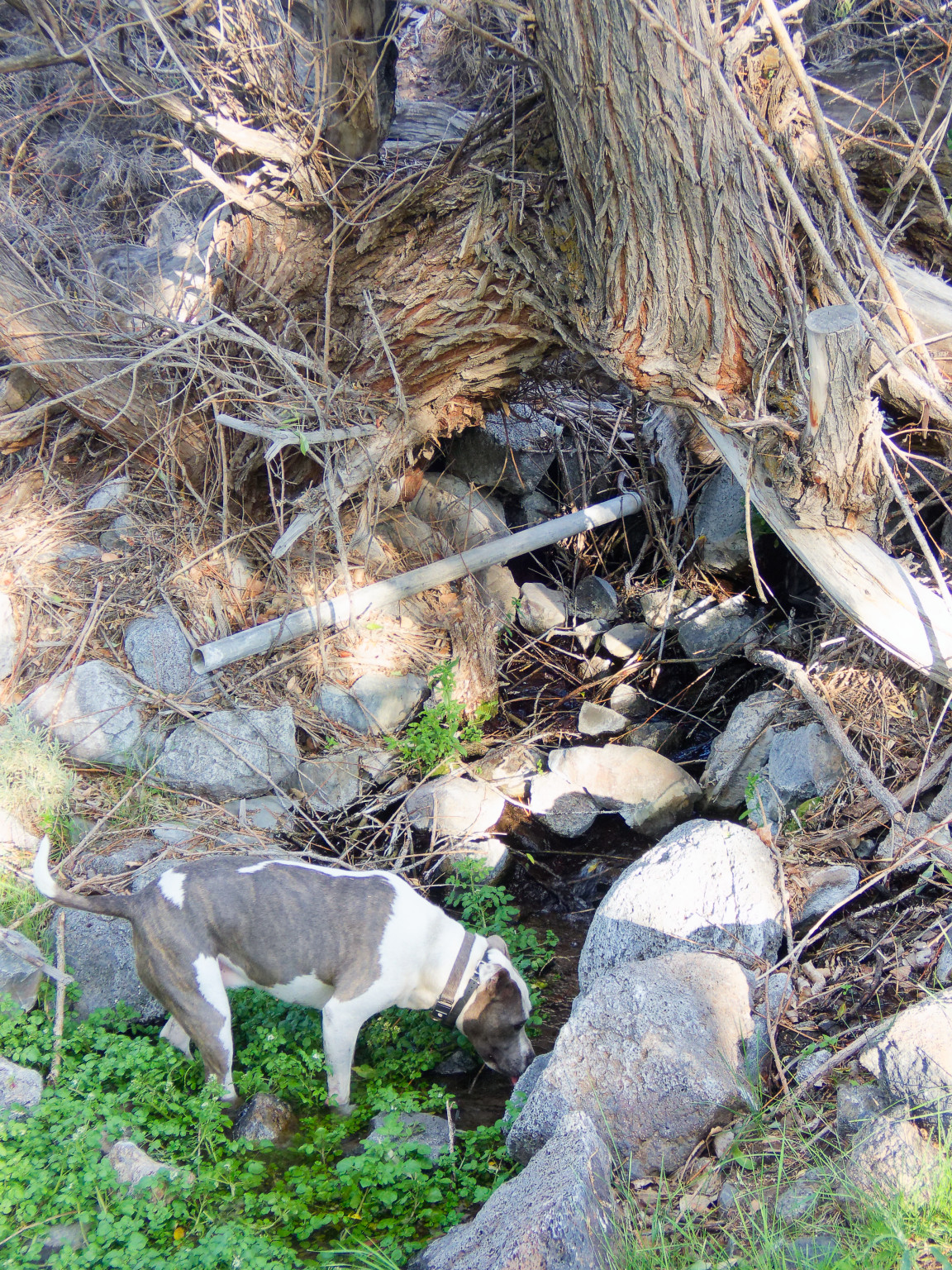
Although I would not drink unfiltered water from Fletcher Spring, The Girl’s immune system is much stronger than mine and she did drink. Captured with TG-7, 2025-06-27 18:08:31, 7.84mm, 1/80sec, f/2.9, ISO-200, SOOC.

Pismo Beach

I had a few hours after the site walk, so I decided to take in Pismo Beach. Captured with X-T5, 2026-04-23 22:37:31, 16mm, 1/900sec, f/8, ISO-1600, light processing with PhotoLab 7.

To the best of my recollection, it has been more than 50 years since I last set foot on Pismo Beach. The time was the mid-1970s and my Dad’s dad had terminal throat cancer. We decided to go see the west coast family and see grandpa off.

It was in late March, so we decided to take the south route. We had friends at Los Alamos, so we spent one night there visiting Frank and Christy. Then we headed on to the LA Basin to visit Pat and Beth, then turn north. We spent a couple of days with them, before turning north to see family for a few more days. There are many stories from our short stay with our old friends, but not for now.

On our way north, we stopped for a few minutes at Pismo Beach. There I made a capture with Dad’s Argus C3 (the brick) on Kodachrome. My composition was so awful because I did not notice the “No Parking” sign right in the middle of the frame. The sunset was gorgeous, but ruined by the sign.

We paused there for a few minutes to listen to the surf, before heading on to our hotel for the night.

Thursday, after completing the day’s work, I found myself with a few hours. I booked two nights at the hotel, expecting that we would not finish early enough to make the trip home. So, after a short nap, The Girl and I headed to the beach to spend a few hours. I wanted to activate the park (ATNO) and had a small camera kit built around the Fujifilm X-T5. I paid the permit fee, asked the young man working the entry about best places, and received direction to find a place clear of people. Heh…

This time I drove on the beach. We motored along the way to the south until I found an area that others decided was unacceptable. I deployed my station and wondered how I would hear over the sound of wind and surf. Fortunately, I found a set of earbuds in the radio kit (sometimes I am actually smart) and stowed the hearing aids.

With the station setup, I started hunting POTA activators on the 20m band. I worked a few of them using both phone and code, then picked a frequency, spotted myself, and started calling to announce my availability to take calls. I worked the radio for about an hour, logging plenty of contacts to make the activation, and then turned off the radio. I just sat there for a few minutes, listening and watching the surf, the birds picking at the sand, and the passersby.

After a few minutes, I recovered the station and got The Girl out of the rig. There was no one close, so we played grab ass off-lead for a while. She did the attack-the-boots thing she sometimes does, and we had a great time. She hunted the piles of seaweed for things to eat while I chased her off of them, not particularly caring for the thought of kisses later.

With her energy burned off, I turned the rig around to face the surf and retrieved my camera bag. There were two lenses to use in that kit — the Fujinon 16-55mm f/2.8 zoom and the 70-300mm slow zoom. But, I also had the Fujinon 1.4TC in the kit, which really extended the reach of the telephoto lens.

So I spent the next couple of hours watching the Sun set, making images of the birds hunting for nibbles in the surf, watching a pair of surf fishers working the waves, and watching others pass through my field of view. I also spent some time remembering the stop there with Wife so many years ago. I think she would love the place again, waiting patiently while I played radio and then photographer while reading her book and enjoying the place.

Yeah, that would be what she did. Then we would have gone into town for some supper and talk. Yes, she is still missed.

Doggo and I recently celebrated our sixth anniversary together. Well, she enjoyed the celebration even if the time does not mean much to her. That means Sera is between seven- and eight-years old. I do mark the time.

As the Sun set, we headed back into town. I drove to The Quarterdeck, a small restaurant near the hotel. It is a little dated, but the food is pretty good. I had blackened halibut and a margarita. I even saved a bit for The Girl, who quickly munched it when I returned to the rig. Then we called it a night.

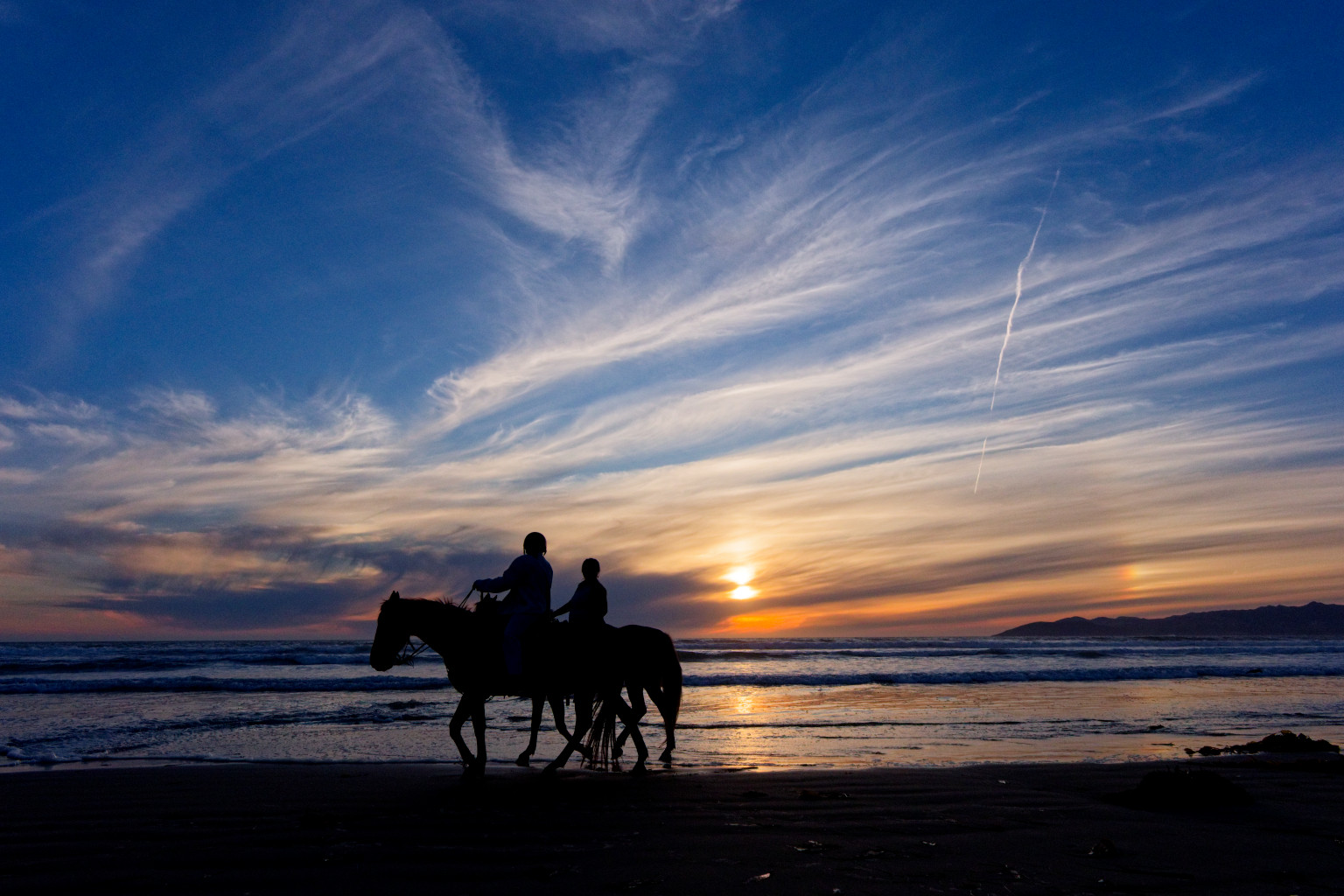
I saw many interesting things during my few hours at Pismo Beach. This pair of equestrians were just one of them. Captured with X-T5, 2026-04-23 22:23:51, 16mm, 1/2700sec, f/8, ISO-1600, light processing with PhotoLab 7.

Digital Station

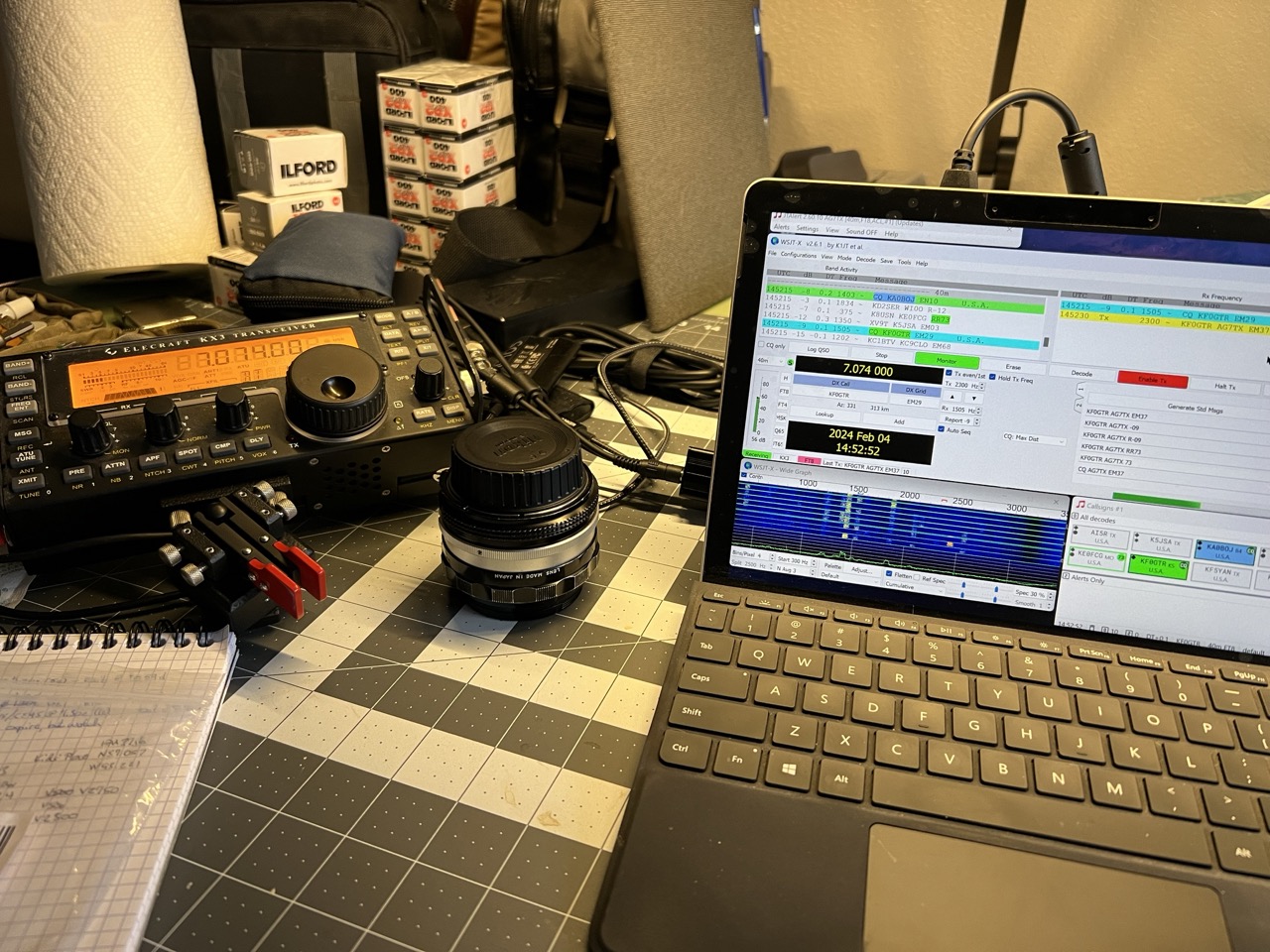
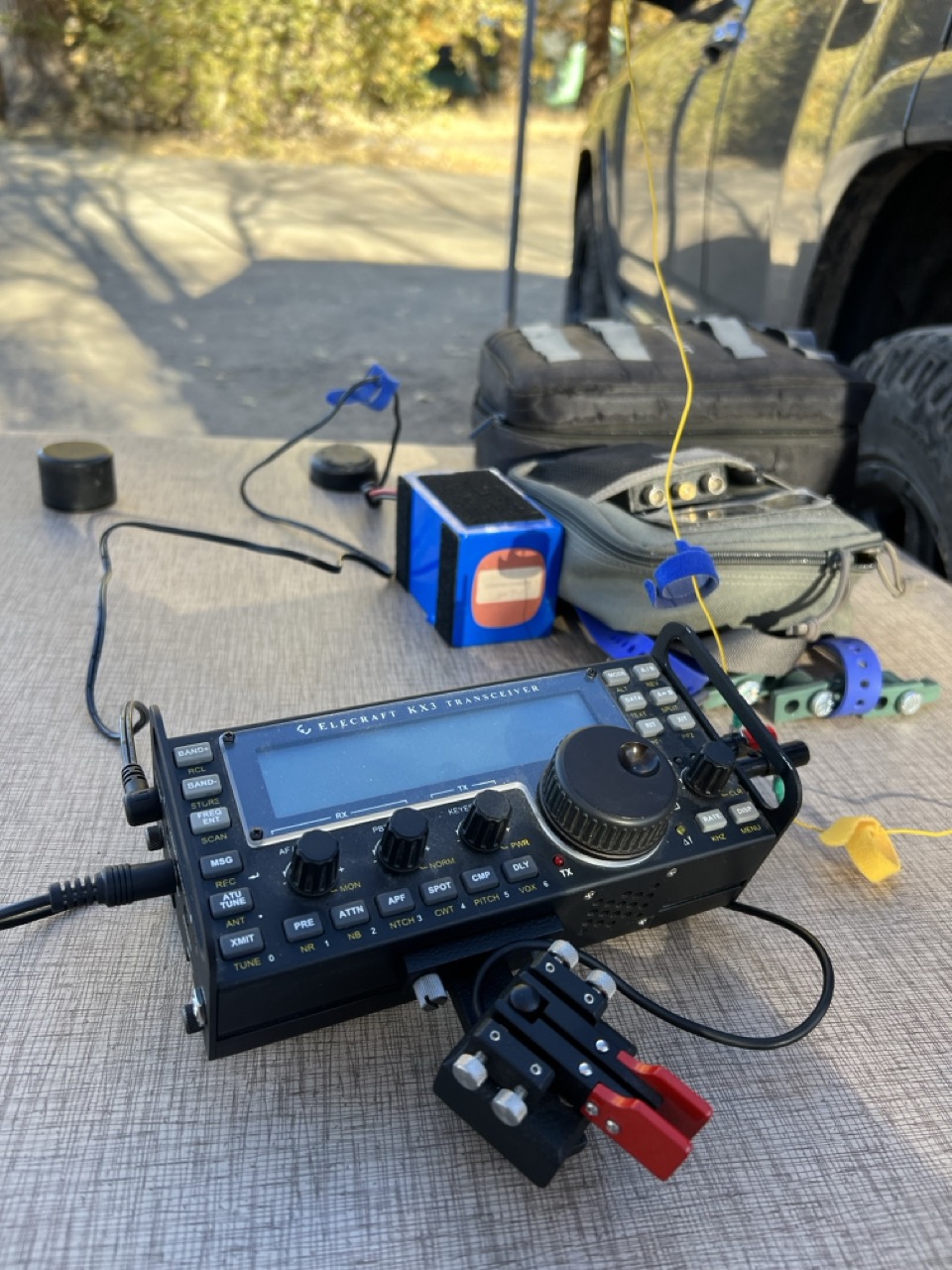
This is my portable digital radio station, as it is as of Sunday morning. I have Winlink Express, WSJTX, and JS8Call all running the KX3. Image captured with iPhone 13 Pro Max.

A week or so ago, I was motivated to get some of the digital modes operational on my portable station. I did not bring the Digirig Mobile that I specifically purchased for the Elecraft KX2/KX3 radios with me this trip. It was one of several things left behind because I simply did not have enough time to prepare for the trip. So, I did what I always do… I bought another module.

It is not actually a waste because I will put one in each of the KX3 and KX2 go-kits. Then there will not be a (significant) risk of leaving the module behind (again).

The WSJTX software gives access to the FT8 and FT4 modes, which are useful for quick exchanges such as those for a POTA or SOTA activation, or for a contest1. I have yet to use these modes for any of those things. But I do use them when home (in the radio noise) so I can play a little radio. I have yet to use FT8 for a park activation, although that is a thing.

JS8Call is a digital mode based on the FT8 engine, but permits more text than the quick exchange of the latter mode. That is, a full conversation contact is possible along with a lot more capability. This is a potential mode for emergency communications when voice operations are not possible or not advisable. I do use this mode to make contacts when at home and the noise is too much for me to hear other stations.

Both FT8 and JS8 are called weak signal modes because the computational engines are capable of extracting usable signals at the noise floor or below. This is amazing!

I spent a good part of Saturday getting everything running and testing the results. The main issue I encountered was a change in Windows 11 that treated the soundcard (the Digirig) as a DVD device with a data rate of 48KHz. I think the software was expecting a datarate of 44.1KHz (the CD rate).

Once I sorted this problem out, all three programs worked fine. I was able to send and receive email (Winlink) via HF radio. I was able to make contacts using both WSJTX and JS8Call modes. And these tasks were accomplished with the KX3 at five watts output into the Elecraft AX1/AXE antenna. The antenna is a tiny thing that I use when there is no room to deploy something larger. It is truly a compromise antenna. Yet I was able to accomplish my goals in a noisy environment using a compromise antenna and five watts.

The next step is to get the FLDIGI suite working on my Surface Go 2 and with the KX2/KX3 radios. This is another digital software package that has a lot of capability for many modes. It will be useful in an emergency setting when other means of communication (Internet, phones) are unavailable. But, for now, I want to spend time working with JS8 so I can learn its capabilities. I also need practice with Winlink so I can get around in it efficiently.

  • Setup of WSJTX and JS8Call are closely related (use the same engine). Once one of them is working, the odds are that the other will work with only some small adjustments.
  • Use the USB mode and not the DATA mode on the KX2/KX3 radios. That is what works best, at least for me.
  • The bitrate of the soundcard is a big deal. It took some hunting to find it and I did not see it documented anywhere else. The search engines failed me in that regard.
  • Getting VARA HF to work with the soundcard can also be a bit fiddly. The sure to pay attention to the ALC function of the radio (set the audio output of the soundcard or audio input the radio carefully). Any audio compression should be turned off. I suspect the same will be true of other modems (ARDOP, Packet, etc), although I have not tried them (yet).
  • If you find you do not have enough headroom with the audio input or the audio output, an adjustment to the soundcard levels is appropriate through the Windows Sound setup page. (Which one will depend on what version of Windows you are running.)
  • I am generally good at remembering how to do these configurations once I sort the approach out. However, it is probably a good idea to get the setup procedure recorded in one’s radio notes in case adjustments need to be made under the pressure of required operations.

That is my report for this little exercise. In total, I probably spent five or six hours fiddling with the equipment and software and another few hours playing with the radio. It was an intellectually challenging exercise because there are so many moving parts. But, it was still a good day.

I also had the chance to visit with my buddy in Montana, who decided to work on some of this as well.

Maybe some of these notes will help someone else over the hump. I know there was a lot of research to solve simple (ha) problems.

Life is good.

1Yes, some contests permit use of the FT8/FT4 digital modes.

Parks on the Air

Shot with the Fujifilm X100V.

A couple of weekends ago I decided it was time to not work all weekend. On Saturday morning, The Girl and I headed out, not knowing where I might end up. We walked for an hour out at Silver Saddle Ranch, then headed east on US 50. I was on the phone with my buddy Dick and indicated that I needed to get out and do something away from the house.

At first, I thought I would drive down to Yerington and activate the wildlife management area north of town. But, as I turned south on US 95, I decided that either Buckland Station or Ft. Churchill were both closer and needed to be activated.

Buckland Station won the coin toss. I parked the rig and looked for a place to deploy a wire. Seeing none, I retrieved the drive-on mast mount and the 10m SOTAbeams mast from the rig and set them up. I also retrieved the Elecraft KX3 and a small battery from the rig.

A little wider shot of the Buckland Station deployment. The KX3 is in the foreground and the SOTAbeams mast, random-wire antenna, and part of the drive-on mast are in the background. Shot with iPhone 13 Pro Max.
I used the Sagebrush Antenna deployed to near vertical with the distal end affixed to the top of the mast. The opposite end went to a cobrahead adapter and direct to the radio. I threw the counterpoise on the ground around the rig.

I sat down at my folding table with my back to the sun (it was chilly), started a log on my iPhone (HAMRS), and listened on 20m near the QRP watering hole of 14.060MHz. With nothing heard, I called QRL? (“Is the frequency in use?”) a couple of times, then hit the message button to transmit “CQ CQ POTA DE AG7TX AG7TX POTA K” a couple of times, then paused to listen for a caller.

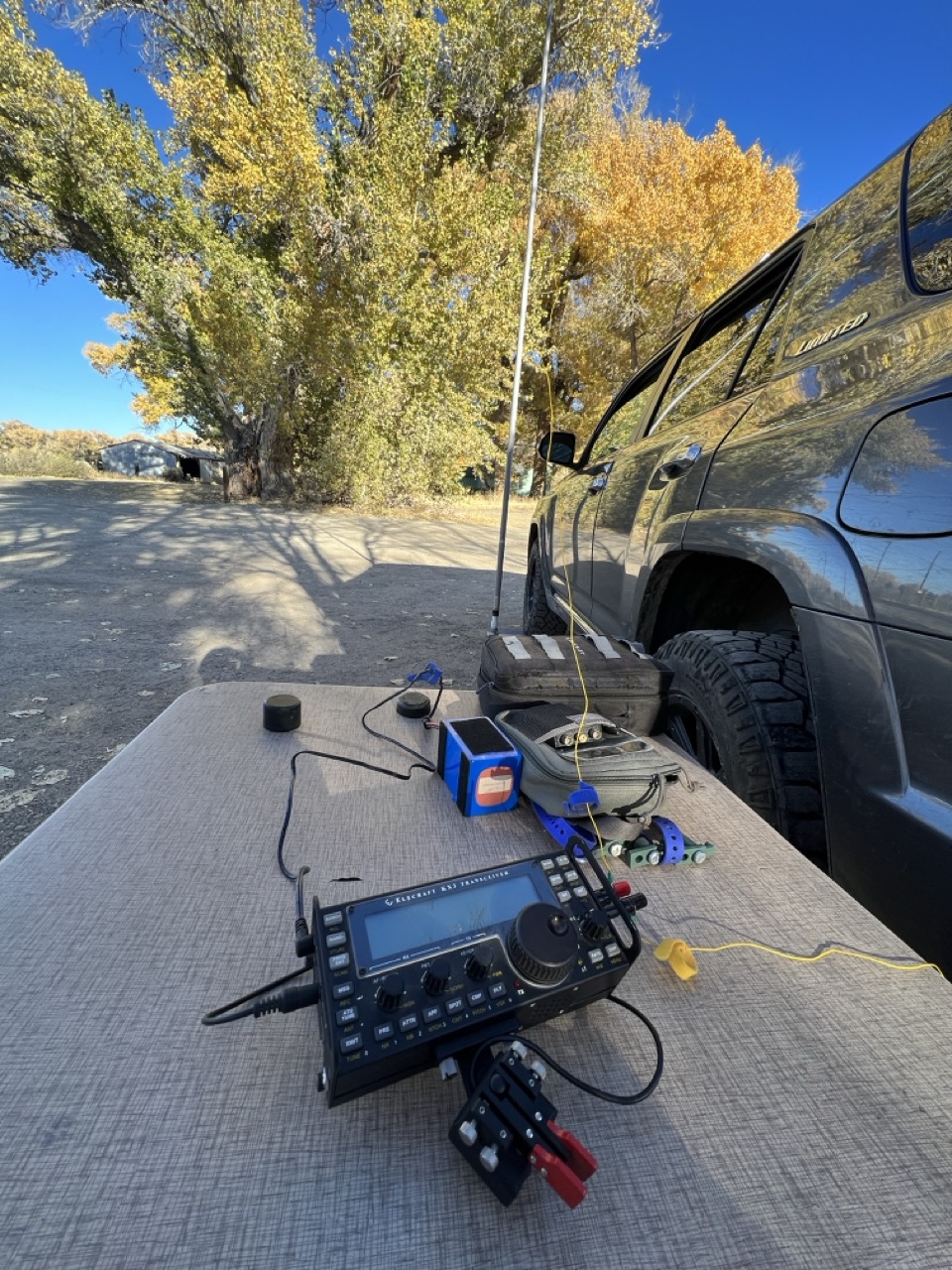
The KX3 station setup at Buckland Station for a POTA activation. Shot with iPhone 13 Pro Max.
While the radio was sending my general call, I spotted myself on the POTA network. After a few minutes, the calls began to come in. I worked each station as I could and even managed a few DX (foreign country) contacts. The most memorable being an OH1 station located in Finland.

I worked the bands for an hour or so and made my quota for an activation. I was cold, so The Girl and I headed home after a brief pit stop.

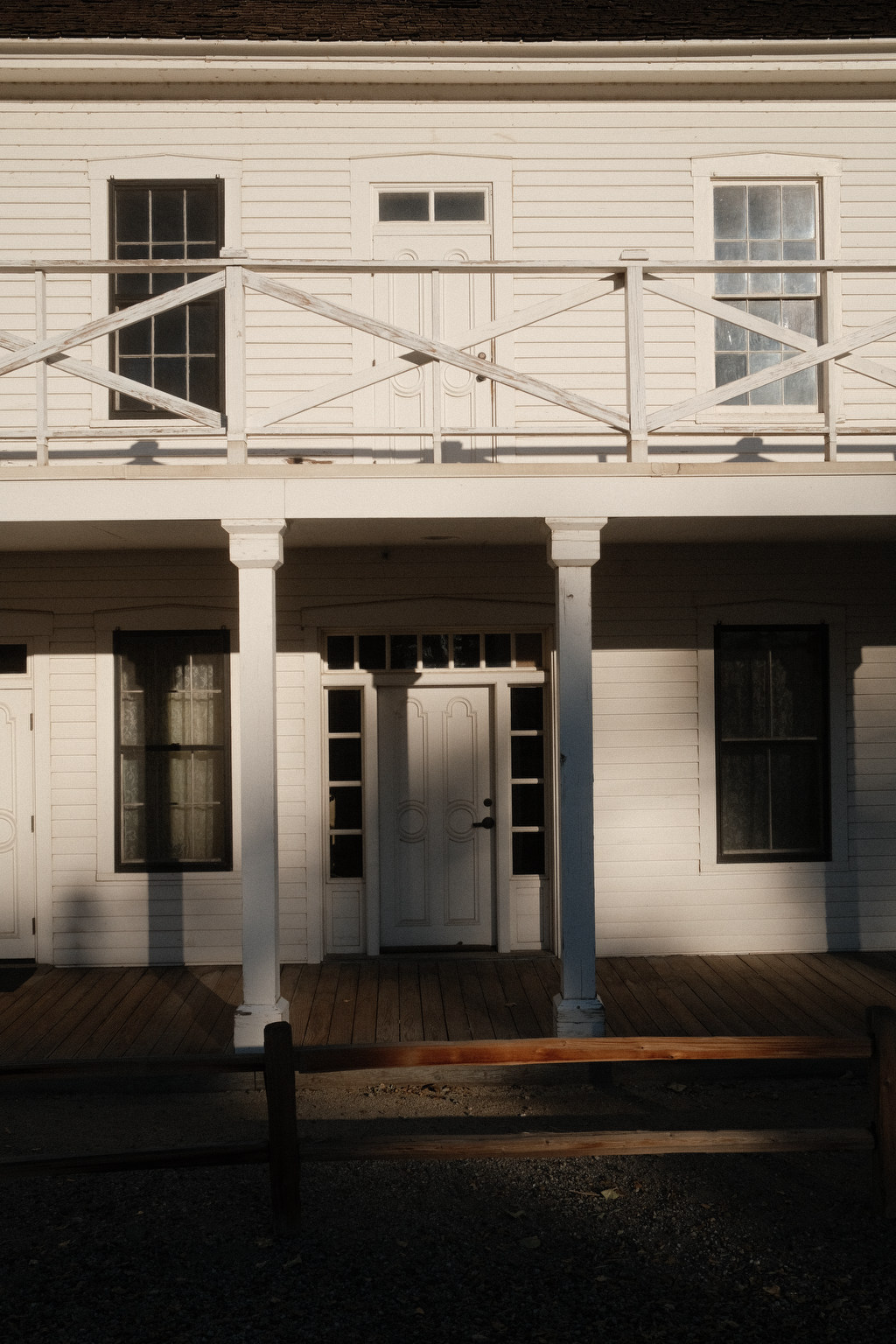
The door of Buckland Station. This is what arriving travelers and Pony Express riders would have seen a hundred years ago. Shot with Fujifilm X100V at f/8 with Reggie’s Portra film simulation.
I woke Sunday morning again not wanting to spend the day working. So I puttered a bit over my morning coffee and then decided to get The Girl out to walk and do another POTA activation.

I grabbed a snack because my blood sugar has been falling unexpectedly, some water, and a battery for the radio. We loaded up into the rig and headed west to Spooner Summit. I pulled off onto the forest road and parked the rig at the staging area where I like to work.

The Girl and I then headed out to walk before I set up a radio. Again, I talked to my buddy in Montana as I walked. But I kept my eyes open for critters as I have seen a big coyote who is not afraid of humans several times.

She was ready to rest when we returned to the rig, so I gave her some water and put her in the 4Runner. She settled right down for a nap in the sun.

I retrieved the new line-throwing kit from the 4Runner, stretched out the line, and affixed the throw weight. After four or five throws, I was unable to hit my target branch. Instead of fumbling more, I retrieved the drive-on mast mount and the 10m mast from the rig and setup a wire antenna. I again used the Elecraft KX3 barefoot (10-15w of power) and set up my table and chair.

A wind had come up, maybe gusting to 10–15mph, but variable direction. It was kinda-sorta from the south, but was curling around to the point I could not get shelter.

So I put on my heavier hoodie, put my back to the wind (and the sun), and worked the radio. The higher bands have been good lately, so I started on 10m and worked my way down.

Again, it took an hour or hour-and-a-half to make my activation quota and work the bands dry. The sun was falling lower in the sky and I was cold, so I quit.

It did not take long to put away the station and get The Girl out for a last bit. She looked for critters and peed until I called her in and we got into the rig.

It was another good day and a good day for me to get outdoors. The Girl loved it, too.

I learned a few more things.

  • I need practice with the throwing kit. I suspect there is something of an art to using a throw weight and line to hit a particular target.
  • I need some kind of shelter for cool-weather activations. I looked at a fishing hut last year, but did not buy one. A small fishing hut that folds up would make a good operating shelter. I could deploy a heater (I have one) and place a mat for The Girl.
  • My principal reservation about a hut is the lack of windows. I like being outside because (in part) I like the sun and the light. I do not want my activation shelter to cut those things off.
  • I need the means to heat water and make coffee, tea, soup, or a hot meal. I have used the Trangia burner in another stove I have in my inventory. But it is not as handy as I want. Hence, I am working on an upgraded kit and some of the results are posted on this weblog.
  • The iPhone works for spotting myself and for logging, But I think a Rite-in-the-Rain notebook and pencil should be in my field kit. I am thinking again of reducing my dependence on technology, although it is good to be able to spot myself for SOTA/POTA activations.
  • HAMRS is well suited to logging POTA activations. It has features that display other activators and make it easy to log their information for park-to-park chasing.
  • I am not sure I ever documented my post-processing of POTA logs. Most of my activations are multiple parks, at least two. I have a couple of favorite places that are three or four park activations. That means the post-processing of my log requires some editing so that chasers get credit of more than one park. I also get credit for activating multiple parks.
  • The new field cooking kit is coming along. I will have the ability to make a hot drink or food in the field. This is a critical safety issue as hypothermia is real and it does not have to be very cold for it to strike. Hot food and drink are part of combating environmental dangers effectively.
  • I am really enjoying Morse Code. I still operate phone part of the time. But the ability to deploy a small radio kit and make contacts thousands of miles away with a few watts means everything is smaller, lighter, and simpler than a more powerful radio kit.

That is all I can think of. It was a good couple of days in the field. Life is good.

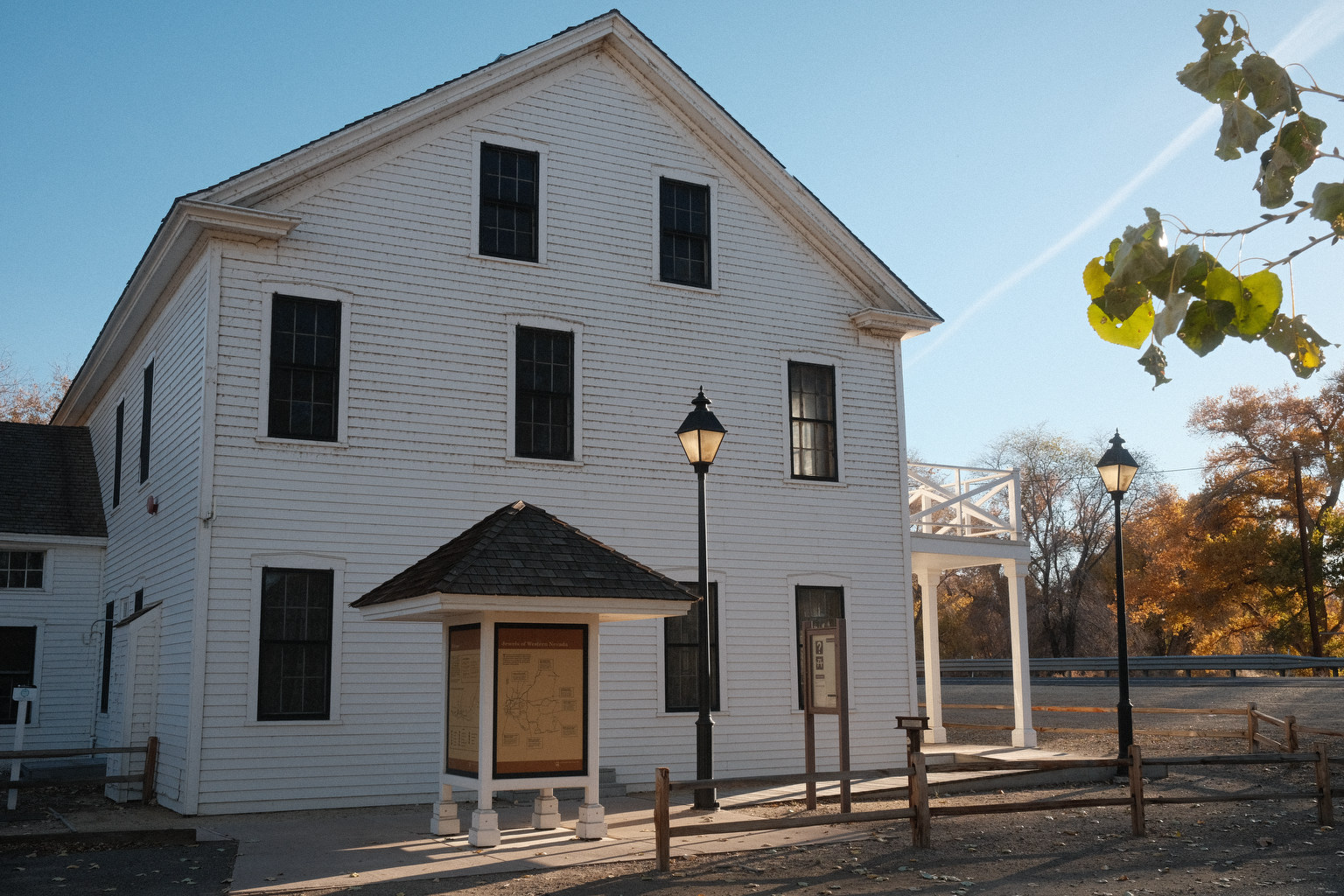
Before I left the park, I walked around Buckland Station for a few captures. This one is of the north-facing side of Buckland Station. Shot with the Fujifilm X100V at f/8 with Reggie’s Portra film simulation.

Wild Oat Mountain, W7N/TR-065 SOTA Activation

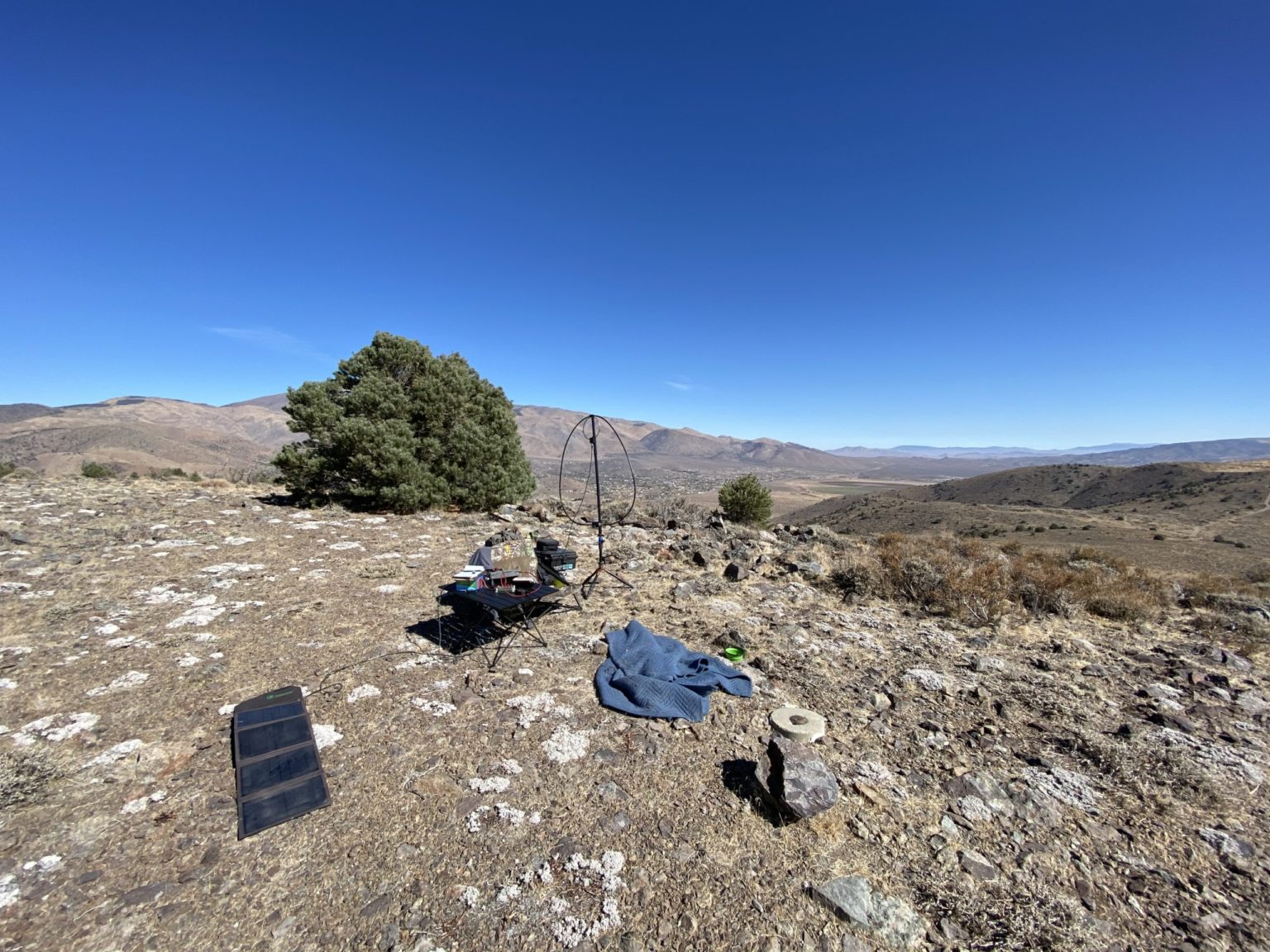
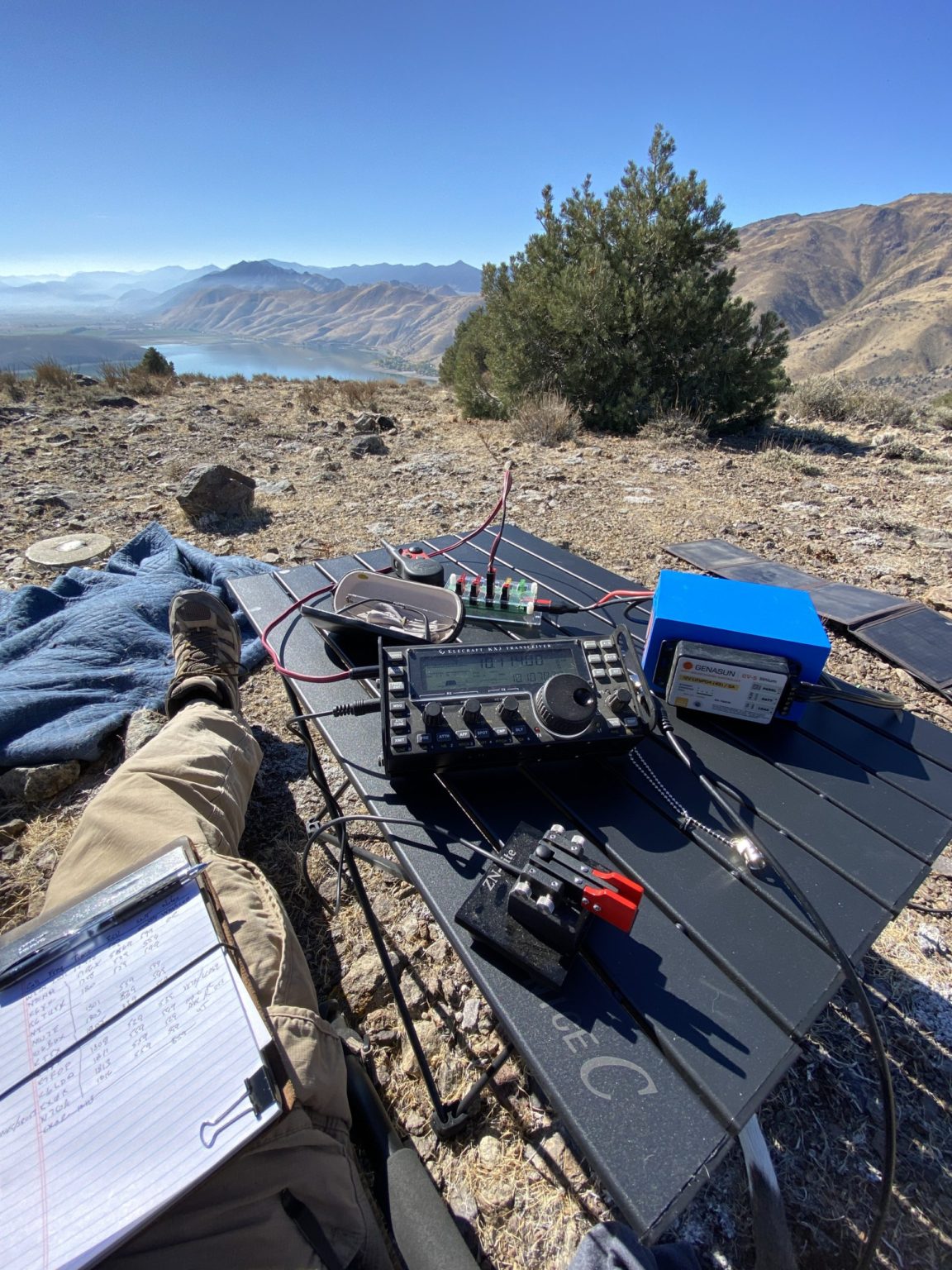
The Wild Oat Mountain operating point and station. The CalTrans benchmark is visible near the station.

A few weeks ago (seems like forever now), after the Nevada QSO Party, I was not ready to settle down for very long. I started working up a new outing almost as soon as I had the camper unpacked and the laundry running. My friends suggested that I was not working hard enough, but I am not quite sure what they meant.

Given that everyone in our little group was tied up or busy doing other things, I planned a little outing to a SOTA summit south of Carson City near Lake Topaz in Douglas County. I posted an alert on SOTAWatch that I would be attempting an activation and emailed a few of my CWOps Academy friends to be on the lookout for me.

Saturday morning arrived and I loaded up the rig, put some dog food in a baggie (The Girl will not eat before an outing), and made sure we had plenty of water. The route was in the GPSr and I had everything needed. So, out the door we went.

I stopped at McDonald’s for a biscuit and a coffee. I ate on the way south, saving a bite of my biscuit for The Girl, who was watching me like Snoopy on his doghouse.

I did not miss the turnoff for the trail and it was a fairly easy trail drive to up near the summit. In the spirit of SOTA, I schlepped my radio equipment to my selected operating point and then paused to give The Girl a short walk around the summit to burn off some energy.

We found a CalTrans benchmark on the summit. I thought that was pretty cool. I never tire of finding the old benchmarks on top of mountains or near highways as I travel around.

The Girl is also a SOTA Dog. She is learning to sit on command and loves to have a mat for said sitting.
The Girl settled down a little, so I put out her mat and assembled the station. I have put together the little Elecraft KX3 station so many times that I think I could do it blindfolded. I tested the setup and everything looked to be operating normally.

I did not connect the microphone to the radio. I determined that I would operate code only and do my best. I found a frequency on the 40m band that was quiet and asked a few times if it was in use. Nothing heard, so I took a deep breath, steeled myself, and posted my spot on SOTAWatch.

Then I began calling CQ (general call) SOTA (identifying myself as a SOTA activator), sent my callsign, and listened. It took only a few calls before a pileup of stations were returning my call. My hands shaking and my breath a little ragged, I responded to the fragments of callsigns I could pick out, sending the fragment plus a question mark indicating that the calling station should send their callsign again so I could copy it.

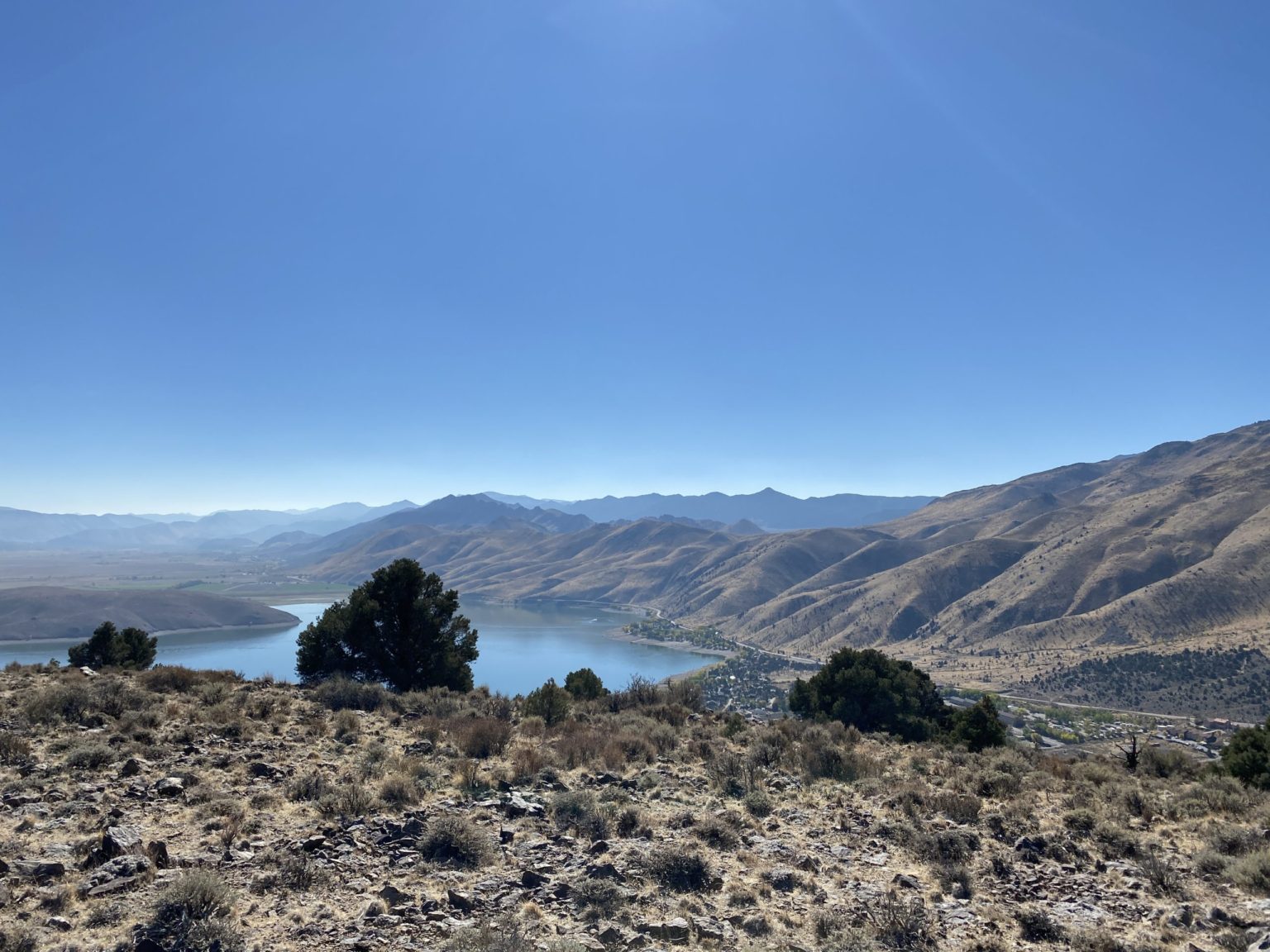
My radio, power supply, key, log, and Topaz Lake from my operating position.
One by one I worked these stations, putting each one in my log (on my knee) with their signal report, my signal report, and the time. I heard a few S2S calls (summit-to-summit, cherished contacts for double points) and worked those stations the best I could. Some were just too weak for me to hear, but I worked everyone I could hear, including one of my CWA instructors.

I made a dozen or so contacts on 40m, more than enough to qualify my activation. As I fished out the hole, I called a couple more times “last call before I change bands” and listened. I cleared the frequency and moved to the 30m band.

Again I called CQ SOTA and listened. Several station returned my call, but not as many as on 40m. Many chasers had their contact for my activation and were looking for other activators. I worked another of my CWA instructors and that was a treat. With that hole fished out, I cleared the frequency and moved to 20m.

I worked a few more chasers on 20m, but I could tell that the herd was thinning. Then I heard a call that sounded like “EA2…” and listened a couple more times. The station was fading in and out of my noise floor and I had trouble getting a full callsign. I returned the call and we worked and worked until I got the callsign. I was reasonably sure I also copied the signal report.

At that point I decided to call it a day. I cleared the frequency, looked over my log, and shut everything down. The Girl was ready for some movement so we walked the area again a couple of times. I took her to the rig and got her some water. She was ready to go home. So I tore down the station, stowed my gear in the rig, and then did one last walk-around to be sure nothing was left behind. I paused one more time to take in the view, even with the smoke. I made sure I had captures of the area.

Then we returned to the rig and headed down the trail. I was tired, hot, and sweaty, but deeply gratified that I had completed my SOTA activation in CW mode only. It was good to be home, get a shower, enjoy a little cooler air in the house, and settle down for the remainder of the day. With a shower and some food, I was nearly done. But I worked on my log a little, played with The Girl a little, and then called it a day. It was a really good day.

I learned a few things as well:

  • I should tie my pen to the kneeboard. I kept dropping my pen in the dirt.
  • I got hot in the sun even if it was a little cool when we got to the OP. I should have setup the station in the shade even if I needed a cover to be warm. It was too much sun that day.
  • Headphones would probably make copying the calling stations a little easier. I do not like to be isolated from my surroundings, so perhaps just one phone or earbud would help without disconnecting me from my environment.
  • I should determine my own pace. Chasers will either wait to work me or they will not. I only need four contacts to make the activation. I can afford to slow down my pace a little so I can breathe and have fun. I had fun anyway, but I let myself get stressed.
  • I had plenty of power with the 15w that the KX3 makes. I might have worked a few more stations with a few more watts, but I made my activation and it was a lot easier without having an amplifier along too.
I stepped away from the station as I started tearing down for this view. It was still a little smokey from the fires and it was fairly hot in the sun. Still, it was a good day.