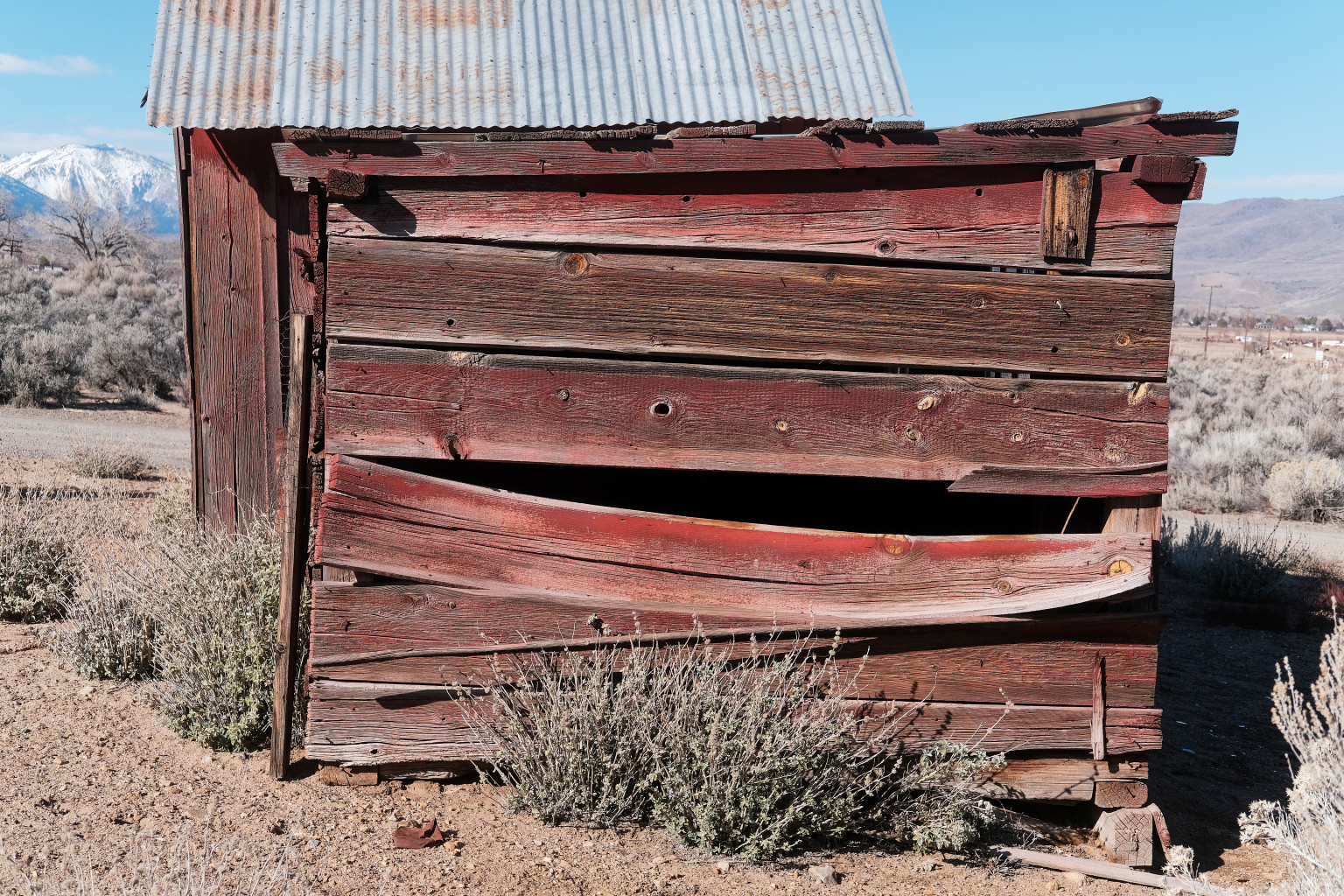
Hmmm… this part of the toolshed could certainly use some love. The desert Sun from the South is hard on whatever it shines on. Captured with X-Pro3, 2026-01-23 13:25:24, 35mm, 1/340sec, f/8, ISO-160, Classic Chrome film simulation (in-camera), SOOC.
It is no secret that The Girl and I hike the Silver Saddle Ranch open space area much of the winter. It is only a few minutes from our home, gives a rural feel without having to drive far, and is often without heavy traffic (foot or vehicular). If I stay in the sageland west from the ranch compound, there is an opportunity to have some relief in my path, which this old body needs to maintain strength.
I recently encountered an old man (well, another old man) hiking the area with his dog. I noticed he was taking some of the intermediate trails between the upper path and the old two-track that leads from the ranch compound to the Mexican Ditch. I like to avoid the ranch compound proper and the cinder trail that is part of the relatively new trail complex in the Carson River corridor. There is more traffic than I prefer and Doggo strains to interact with other dogs1. But, I took his idea and started hiking up and down the hill on the intermediate trails.
We have been taking this approach the last few days. I am noticing that I probably should take her down to the ditch once on our outing so she can cool off a little and get a drink. We are upstream from any of the mercury pollution, so there is little risk of her being poisoned by the water. So, I will amend our trail to get down by the ditch so she can water.
We were out later than usual one afternoon (just before school lets out) and the Sun was at a different angle than usual. I noticed the light on the old shed and the warped, sagging siding. I have been enjoying the Fuji X-Pro3 as a walkabout camera, had the Fujinon 35mm f/2 affixed to the body, and had the output set to the Classic Chrome film simulation. So, I made a few captures. I like this one.
We finished our hike and packed it in. It was a good day. Life is good.
1Although many times those interactions are fine and the dogs just play, if the other dog has any attitude, then a fight generally starts. Sera will be the dominant bitch. I also think she gets something from the kerfuffles besides being the dominant dog. She is scrappy. So, I prefer just to not deal with it.
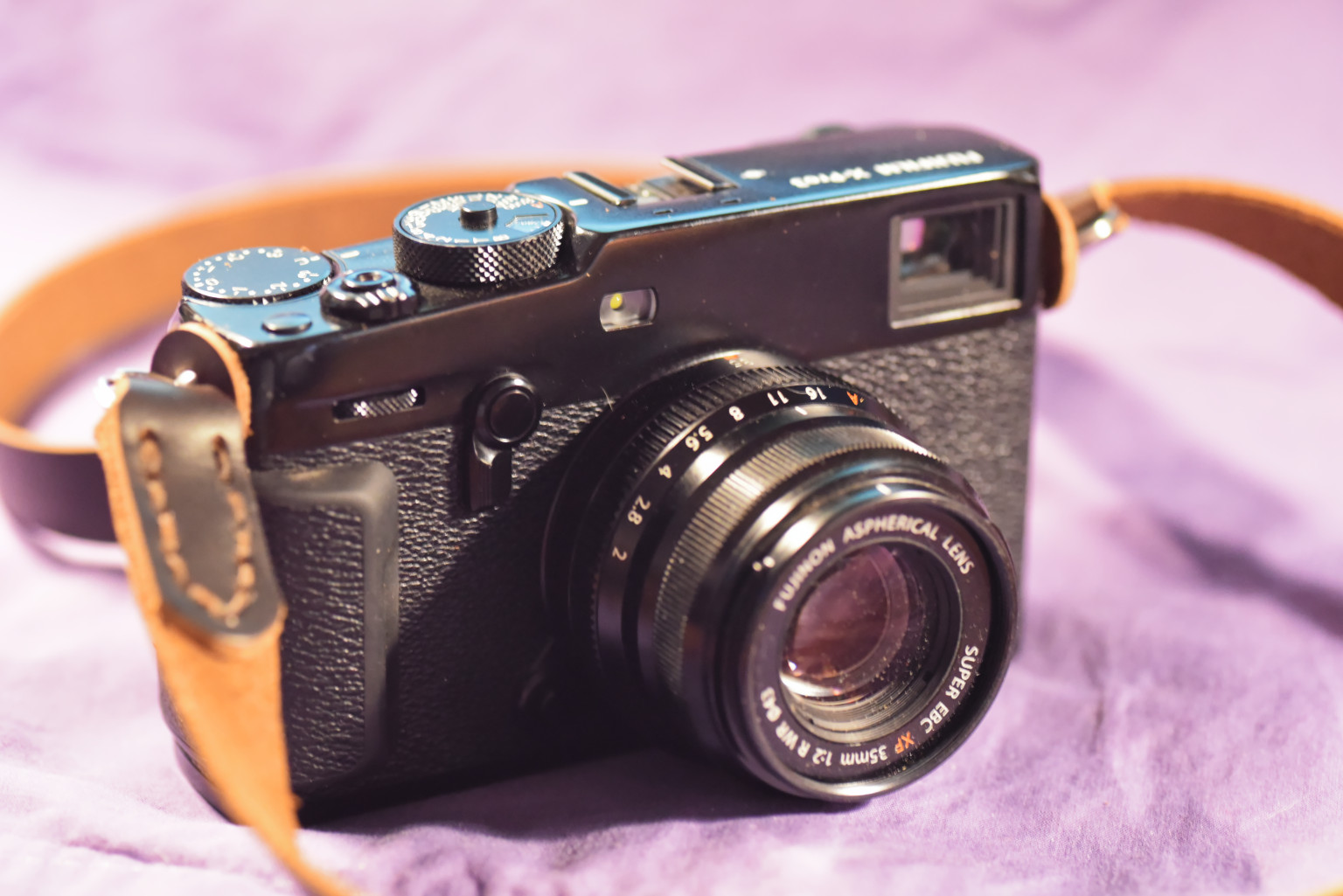
I rented a Fujifilm X-Pro3 to play with. There is quite a lot of hubbub over the X-Pro Fujifilm cameras, mostly because of the hybrid optical viewfinder. So, I decided to find out what it is all about. Captured with NIKON D750, 2026-01-23 16:38:45, Vivitar Series 1 90mm macro, 1/15sec, f/5.6, ISO-6400, SOOC.
A few weeks ago (months?), my buddy was busting my chops a bit about my Fujifilm X100vi. He was giving me a hard time because I usually use an interchangeable lens camera and the X100 series is decidedly a fixed-lens camera. That is, it is not a system camera but “an expensive point-and-shoot.”
My argument is that sometimes I do not want to take a system with me; I want a camera at hand though. I do not want my camera work to be fiddly, though.
By fiddly, I mean that I do not want to have to make decisions about what lens to use in the field. I want to have a purpose-built machine (a camera and lens) that is more than my phone.
Aside: I decided the last couple-three years that I think computational photography is cool, but it has some limits as implemented in current mobile phone technology. Furthermore, I want to use my mobile phone less and I want a simpler (less expensive) mobile phone as well because I do not want to spend all of my time looking at my phone.
His pushback was that I could simply fit a prime lens to my (very nice) Fujifilm X-T5 and carry that. There is truth in that. But, I really like my X100vi. It has an elegance in its simplicity that is different from the other system cameras in Fujifilm’s stable. It has a bit of that classic rangefinder look that all the kids chase (and that made the X100v nearly impossible to buy because they were always out of stock).
The conversation made me think a little about my [ahem] rationalization to justify ownership of a X100vi. On my last roadtrip, I elected to take the X-T5 and a small kit along. I chose the Fujinon 18-55mm, f/2.8-4 kit zoom, the Fujinon 70-300mm zoom (in case I needed a telephoto lens), and the Fujinon 35mm f/1.4 (original standard prime). I found the kit zoom to be the lens I used most on that trip. It gave me a nice range of focal lengths that work in a lot of (most?) circumstances, is relatively small and light, and is optically better than almost all other kit lenses. (The exception likely being the classic nifty-fifties that came on film bodies.)
I was able to get some subject/background separation with the kit zoom, particularly at the long end of the zoom range. I had a fast standard lens in the kit if I wanted more. (I did use it a little, but consciously chose to stick with the zoom most of the time.)
All of this, spare batteries, and spare SD cards all fit into the Fujifilm/Domke collaboration messenger bag that I have in my inventory. There was even a little room for my computer glasses, my Kindle (in the back slash pocket), and a Clif bar (emergency ration). I could swap out the glasses/Kindle for a small water bottle if I wanted.
That made for the lightest, most powerful kit I have constructed to date. In retrospect, I did wish I had the Fujinon 60mm f/2.4 macro with me. There were a few times that the close-focusing capability of that lens and the slightly larger maximum aperture would have been used. But, I learned.
That brings me back to the Fujifilm X-Pro3 that is in a small kit. It is a rental camera. I checked the shutter count and it has 15K actuations according to Exiftool. It was made in 2021, also according to Exiftool. I rented it as an experiment and I really like the camera.
It is similar to the X100vi and probably more similar to the X100v that preceded my X100vi. I think that the underlying sensor technology and processor are the same as the X100v. The viewfinder is slightly different because The X-Pro3 has to accommodate the interchangeable lenses. In the hybrid OVF, the frame lines change with the focal length of the lens. It is usable from pretty wide (18mm is the widest I have used to date) through 50mm. With a press of a small lever, I can switch to the EVF, which uses the sensor instead of the optical viewfinder and use lenses outside the effective range of the OVF for composition.
I also love the sound of the mechanical shutter in the X-Pro3. It has the same solid thunk of my original Fujifilm camera, the X-T1.
Would it replace my X100vi? No, I think not. It is last-generation technology and the primary reason I bought the X100vi is to have a simple, rangefinder-style camera *with* the fifth-generation IBIS. I really do not care about pixel count (there was a significant bump in that specification) as much as the image stabilization.
I could have a similar experience and aesthetic with a silver/chrome X-Pro3 and one of Fujifilm’s small primes (what I call the f/2 line). But again, none of those lenses have OIS. It adds bulk (and cost). However, I would give up the IBIS that I find useful in some of my shooting situations.
There are rumors that Fujifilm is preparing to release an updated X-Pro camera this year. It will have either the fifth generation X-Trans sensor (and IBIS) or there will be a sixth generation system released.
That is my analysis of how an X-Pro Series camera could fit into what I do with photography. One could supplant the X100vi if, and only if, the next generation adds IBIS. That will probably make the X-Pro camera slightly larger (to accommodate the mechanism), which is not a deal killer. I like the hybrid OVF. It works. The X-Pro also has an EVF with the press of a lever for focal lengths that do not work with the OVF. It has that classic rangefinder look that I have come to like.
I will continue to enjoy my X-Pro3 rental. I will have a it a few more days. I remain on the fence about whether or not I will keep it.
The Girl and I will hike with it again today. I am looking forward to that. I remain grateful on a daily basis. Life is good.
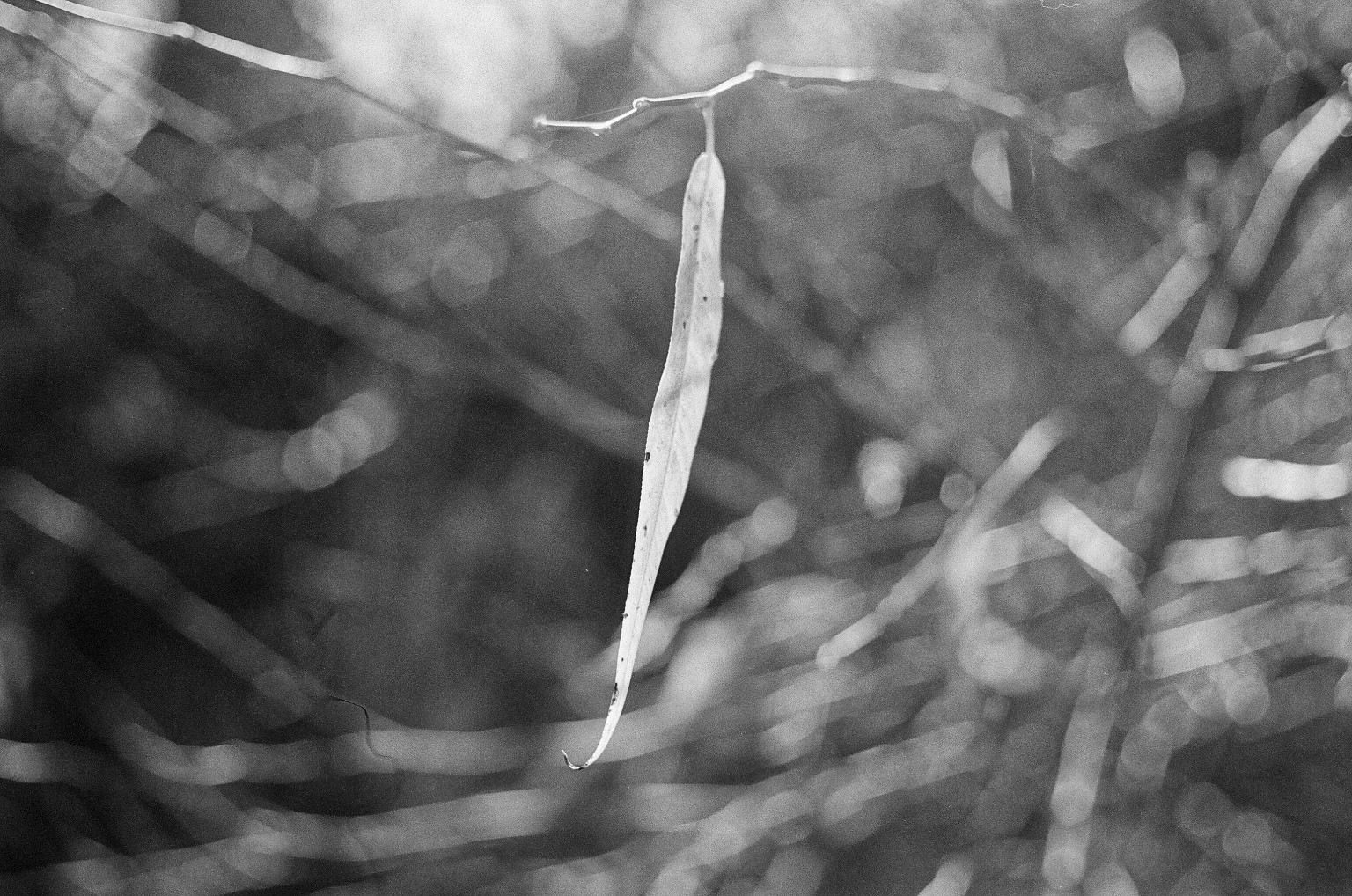
This capture is from a test roll with the Nikon FM2n and a Nikkor 50mm f/1.4 lens, on Ilford XP-2. This is one of the few leaves left on this old willow tree.
A few weeks ago I carried the Nikon FM2n that sat on the shelf for several years. Long ago, my photographer connection, errr buddy, pushed this camera on me from his inventory. He indicated that it was a suitable object of lust for film photographers and I considered it a back up for some of my other film cameras.
Time moves on and I find myself connected to Nikon cameras at this point in my life. Well, connected to Nikon film cameras (and dSLRs). All of these use the ancient Nikon F-mount, so all of my legacy glass is useful.
I have not looked at any of the new Nikon Z cameras. I am so heavily invested in Fujifilm that I am not sure I want to change systems. I certainly do not want to buy a new set of lenses for what I do with my Fujifilm cameras.
But, I digress. While hiking with The Girl one afternoon, we crossed the Mexican Ditch at one of the irrigation structures (where we often cross) and I paused for a moment to see if anything caught my eye. I noticed this solitary willow leaf, clinging to the branches of a winter-sleeping willow. So I paused, checked the framing, adjusted the exposure to suit myself, and made the capture. I also made a few more captures, before we headed off to finish our hike and return home.
The negative scans were uploaded to the processor’s website last weekend. I am still working through them, looking for frames that recreate the emotion I felt when looking at the scene. This one will do for today.
I sure enjoy hiking with The Girl, as challenging as she can be. Sometimes I also find an interesting scene. I am grateful.
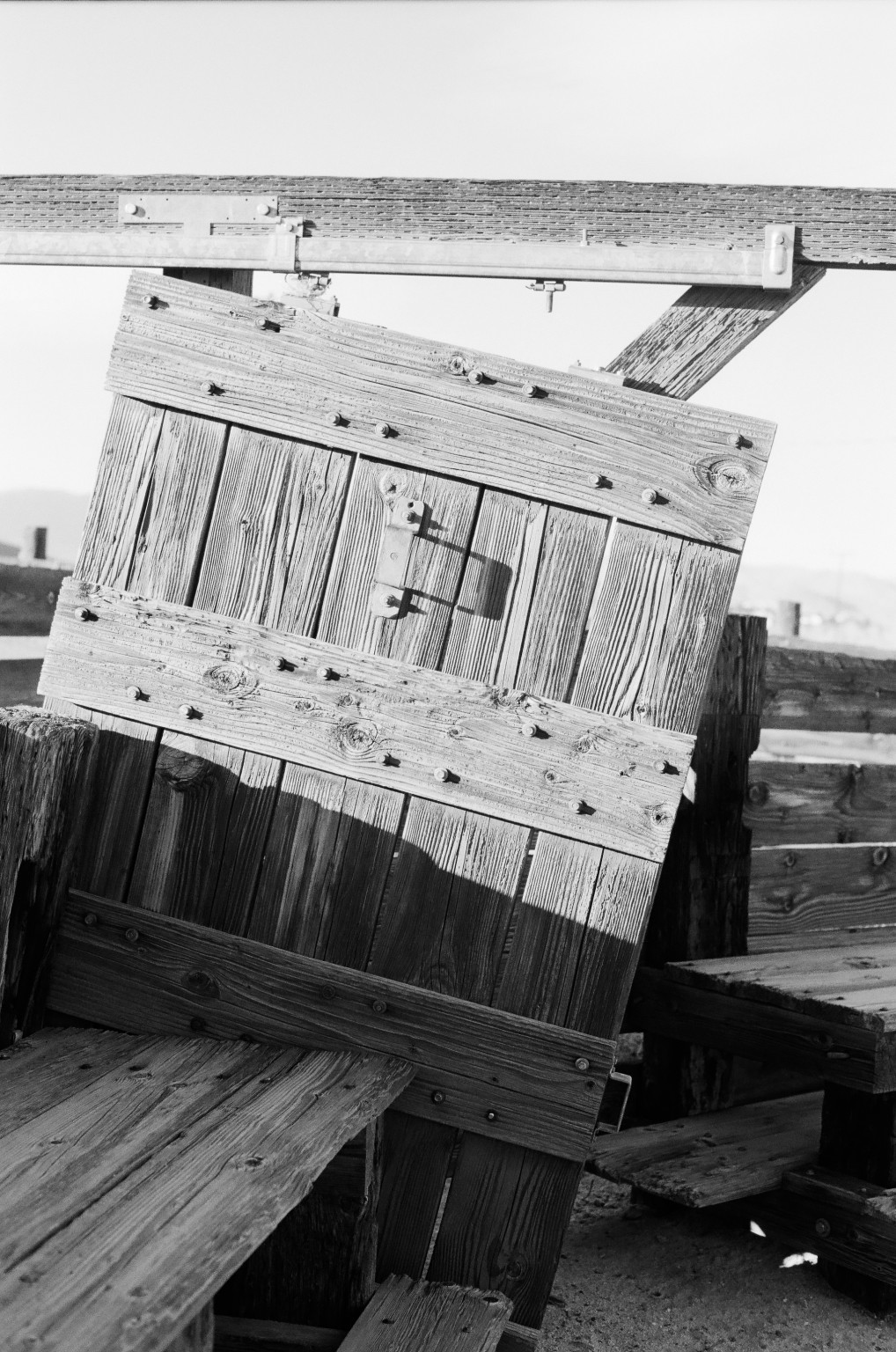
It might not look red in this capture, but the flaking red paint is there. Captured with the Nikon F3hp and a Nikkor 50mm f/1.4 at either f/5.6 or f/8 on Kodak Ektar, then post-processed to black and white in PhotoLab 7.
Right after it arrived, I put a roll of (long expired) Kodak Ektar 100 in the F3 and set the ISO for 50 (one stop over exposed). The rule of thumb is that the colors will be off and the film less sensitive. So, I went with it.
I mounted a Nikkor 50mm f/1.4 AIS to the body, put a strap on it, and The Girl and I headed out for a hike. The hike was good and I made a few captures along the way.
Over the next few days I continued working through that 36-exposure roll. When it was finished, there were a few frames left on the roll in the F2. So It was carried a couple more days.
In the end, I sent three rolls of film to The Darkroom for processing. The scans were posted Saturday, so I downloaded them and began my review. One roll from the Nikon FM2n, one from the F2, and one from the new-to-me F3. There are actually a few frames in the lot that are keepers.
I selected the frame above to illustrate the results. It is a conversion from the Ektar roll that was done in PhotoLab. I continue to learn that tool.
I simply prefer film. Digital is so much more convenient and the technology so much better. But the analog look is what I prefer.
I like my Nikons and the Nikkor glass. I definitely like photography. Right now, as busy with other stuff as I am, it gives me a few minutes of respite from work to do something creative.
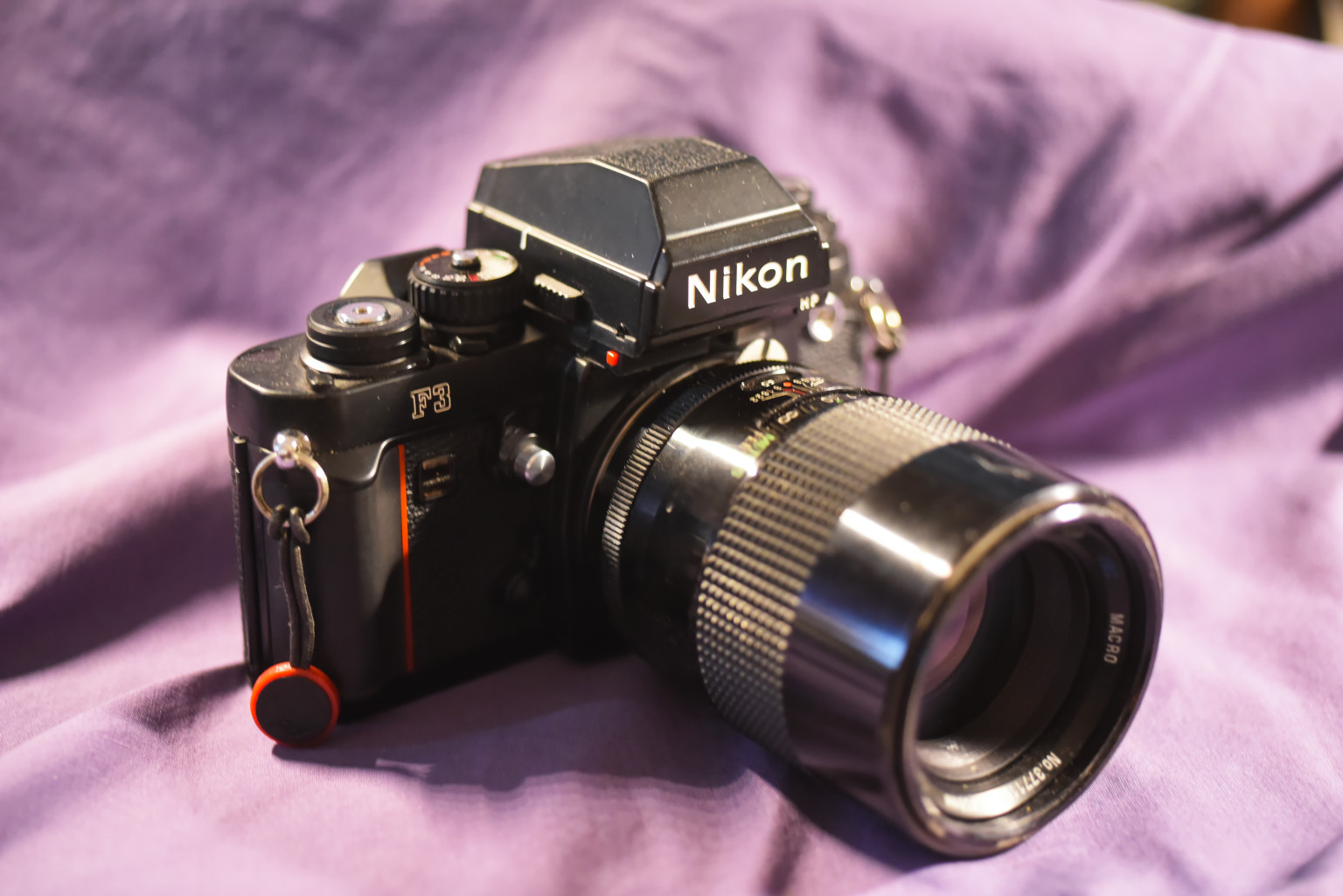
The Nikon F3hp, a professional film camera introduced around 1980. I have not checked the serial number of my unit for date of production (yet).
I was tempted to write it followed me home, can I keep it? I recently read that the DE-3 finder used on the Nikon F3 has a lot more eye relief than the standard viewfinders. Given I wear eyeglasses, this is important to me and one of the things that causes me struggle to use the F2as in my inventory. So, I decided to buy the F3hp and try it.
My unit arrived about two weeks ago. I put an expired roll of Kodak Ektar 100 in it (like 10-years expired) and rated it ISO 50. I then proceeded to carry the camera for a couple of days on walkies with The Girl to test it. I finished the roll and sent it (and a couple more) to The Darkroom for processing. I received the digitized negatives Saturday. I will share some of those frames later.
The camera handles very well. With the electronically controlled shutter, it offers an aperture priority mode. That is my primary mode as it suits my preference for shooting style.
I am able to do well enough with a manual camera, making the shutter speed adjustment with the camera at my eye. This just makes it a lot easier.
This camera is a keeper, despite my love for mechanical cameras.
The little Olympus Tough TG-7 has an internal program to do a macro focus stack. It works. Captured with TG-7, 2025-07-07 10:03:52, 5.4mm, 1/250sec, f/3.2, ISO-100.
The little Olympus Tough TG-7 gave me another surprise a few days ago. I knew about its capability to stack focus frames in-camera for macro photography. What I did not know is that it does it fairly well and takes only a moment.
The Girl and I were on our normal summer trail and I had the TG-7 in my hip pocket. I noticed the sun on the nut of the gate lock that keeps four-wheel traffic from the fire road.
“That might make an interesting image…”
I paused a minute, while The Girl snuffled about, and set the camera to macro focus-stacking. When I pressed the shutter release, I heard the camera take several frames in quick succession. It then flashed an image for a few seconds and returned to ready mode.
The frame is pretty darned good. I am surprised.
I wonder what other things this little camera does this well.
This is a test frame using the new Adobe Labs Indigo camera app. I did some light post-processing in PhotoLab7. Captured with iPhone 13 Pro Max, 2025-06-24 07:17:31, 5.7mm, 1/30sec, f/1.5, ISO-100.
My last iPhone upgrade was from an iPhone 11 Pro Max (I think, and iPhone 11 for sure) to the iPhone 13 Pro Max. I have not upgraded to the latest and greatest, and probably will not. That is a topic for another essay.
I also have tried any number of camera apps in my iPhones over the years. I was just reading through a recent email from DPReview about Adobe Lab’s new camera app, Indigo. I have not wanted to give up completely on the iPhone camera, but the quality of output is generally unsatisfactory. So, I decided to give the new Indigo app a chance.
The result of my first shot is the example above. It is a grab shot of my coffee mug, dust, residue, and all. I did a little post processing in PhotoLab7 to slightly improve the aesthetic.
From what I see, Indigo has promise. I will be doing more testing and grab some of the RAW images that it produces for post processing and review.
I do not care for Adobe’s change to a subscription model. For that reason, I eschew most of the their products. It does not matter to me whether they are the standard or not. I have alternatives that serve my needs. Indigo might be the exception to my rule.
I shot this just after sunset while walking The Girl a couple of nights ago. Captured with TG-7, 2025-06-21 19:42:27, 18mm, 1/50sec, f/4.9, ISO-800, SOOC JPG.
I will have a review of the Olympus Tough TG7 after I have more experience with the little camera. Based on my initial use of it, I have a good impression thus far. But, I need more experience to fully form my opinion of the little camera.
My use case for it is a field camera that I use to document my project work. I could use my iPhone, but better images can be made (I think) with a purpose-built tool. I spent several hours researching weatherproof or weather resistant cameras, particularly those that will fit into a pocket. I ended up with a TG7. It readily fits into the back pocket of my cargo pants.
I made this image Sunday evening while taking The Girl on our evening excursion. I wait until the Sun falls behind the Carson Range, then we head out for a half-mile walk once it cools down a little. Both of us benefit from the outside time.
The light was falling just enough that the sign made an impression. So, I paused, let her sniff at the nearby brush a bit (to leave pee-mail), and made this capture.
I have since learned I should dial down the compression a bit and/or shoot the Olympus raw format and post process the result. I will try both of these approaches for some upcoming test shots.
But, the SOOC images that I am getting from the TG7 are pretty good, in my opinion. Perhaps I do not have the critical eye of other photographers.
After the pause, The Girl and I headed home. She asked for her evening treat. I had mine, too. Then we hit the sack.
This is my new Olympus Tough TG-7. It will be the camera I use specifically for field work. It replaces a Panasonic ZS-40 that is not weather, water, and dust resistant.
This little camera came into my inventory last weekend. It is the replacement for an aging (and not well) Panasonic ZS-40. The latter served as a travel and field work camera for a several years, but was set aside a couple of years ago because of my dissatisfaction with its image quality.
I pulled it from storage a couple of years ago for a big field project. I found it inferior on a job site because it is susceptible to dust and sand. In fact, I thought it was damaged by a few grains of sand in the lens body. However, it seems to be working.
I did an important field walk a couple of weeks ago. I did not make any images or field notes. I should have. I did not want to use my phone as a camera. I should have.
What this told me is that I need a purpose-built tool for making images when I am working in the field. I need to ramp up my field notes as well, and back them up with images. So, that is my self-chastising for this failure.
That set me looking for a suitable replacement for the Panasonic and for my iPhone. Aside: I think the latter might be on its way out as well. More on that another time.
After a bit of research (a couple of hours), I decided that the Olympus Tough TG-7 might be an appropriate candidate. It is waterproof, dust proof, and drop resistant. (Supposedly, it is drop proof to two meters.) I chose red because it is more readily visible than black and less susceptible to solar heating.
After a few test shots, I ordered additional batteries and a lens hood/filter adapter. I will keep a UV filter on the camera despite it having protective glass over the lens.
I am carrying it on daily outings so I can learn to use it. It is quite capable and has a reasonable zoom range (optical). I am taking it to the field next week for its first thorough test as I need to document an extensive field walk on new projects.
My initial impression is that this is a solid compact camera. Despite the small sensor size (1/2.3 inches), the image quality seems much better than it should, based on previous experience. The SOOC JPEGs look good and I have posted several on this weblog already (the Daily Doggo being the most recent).
Not that the camera needs another review, but i will post my thoughts on the camera for my use-case later this summer, once I have more experience with it. There are lots of technical reviews out there, so I will provide a more subjective review based on my experience with the TG-7 in field use.
I think this is a good purchase and well worth the cost. We will see.
Now The Girl is ready for her daily outing. I think I will hit Subway for a breakfast sandwich and we will go up to our Spooner Summit site and get in a good hike. Then I can attend to completing my preparations for several days in the field.
I am working with a new compact camera, an Olympus Tough TG-7. I added a flash diffuser to the to the kit and used it to make this capture. I think I was beyond the working distance. Olympus TG-7 SOOC.
On Saturday, I took delivery of a new camera. It was purchased as my primary work/field camera. It is an Olympus Tough TG-7 compact. I will do a first impressions review of it shortly. But, I think it will be what I need.