A few weeks ago (months?), my buddy was busting my chops a bit about my Fujifilm X100vi. He was giving me a hard time because I usually use an interchangeable lens camera and the X100 series is decidedly a fixed-lens camera. That is, it is not a system camera but “an expensive point-and-shoot.”
My argument is that sometimes I do not want to take a system with me; I want a camera at hand though. I do not want my camera work to be fiddly, though.
By fiddly, I mean that I do not want to have to make decisions about what lens to use in the field. I want to have a purpose-built machine (a camera and lens) that is more than my phone.
Aside: I decided the last couple-three years that I think computational photography is cool, but it has some limits as implemented in current mobile phone technology. Furthermore, I want to use my mobile phone less and I want a simpler (less expensive) mobile phone as well because I do not want to spend all of my time looking at my phone.
His pushback was that I could simply fit a prime lens to my (very nice) Fujifilm X-T5 and carry that. There is truth in that. But, I really like my X100vi. It has an elegance in its simplicity that is different from the other system cameras in Fujifilm’s stable. It has a bit of that classic rangefinder look that all the kids chase (and that made the X100v nearly impossible to buy because they were always out of stock).
The conversation made me think a little about my [ahem] rationalization to justify ownership of a X100vi. On my last roadtrip, I elected to take the X-T5 and a small kit along. I chose the Fujinon 18-55mm, f/2.8-4 kit zoom, the Fujinon 70-300mm zoom (in case I needed a telephoto lens), and the Fujinon 35mm f/1.4 (original standard prime). I found the kit zoom to be the lens I used most on that trip. It gave me a nice range of focal lengths that work in a lot of (most?) circumstances, is relatively small and light, and is optically better than almost all other kit lenses. (The exception likely being the classic nifty-fifties that came on film bodies.)
I was able to get some subject/background separation with the kit zoom, particularly at the long end of the zoom range. I had a fast standard lens in the kit if I wanted more. (I did use it a little, but consciously chose to stick with the zoom most of the time.)
All of this, spare batteries, and spare SD cards all fit into the Fujifilm/Domke collaboration messenger bag that I have in my inventory. There was even a little room for my computer glasses, my Kindle (in the back slash pocket), and a Clif bar (emergency ration). I could swap out the glasses/Kindle for a small water bottle if I wanted.
That made for the lightest, most powerful kit I have constructed to date. In retrospect, I did wish I had the Fujinon 60mm f/2.4 macro with me. There were a few times that the close-focusing capability of that lens and the slightly larger maximum aperture would have been used. But, I learned.
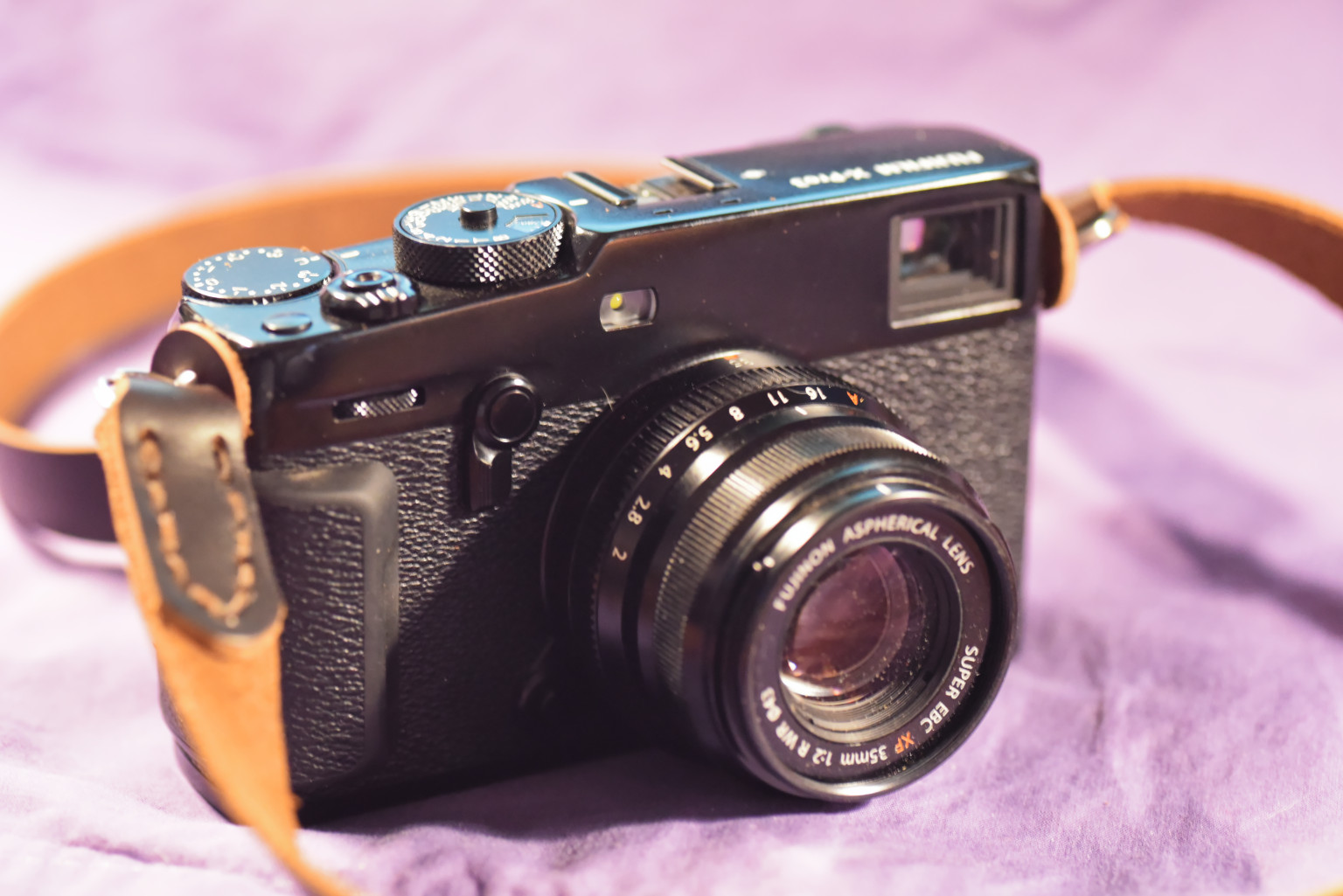
That brings me back to the Fujifilm X-Pro3 that is in a small kit. It is a rental camera. I checked the shutter count and it has 15K actuations according to Exiftool. It was made in 2021, also according to Exiftool. I rented it as an experiment and I really like the camera.
It is similar to the X100vi and probably more similar to the X100v that preceded my X100vi. I think that the underlying sensor technology and processor are the same as the X100v. The viewfinder is slightly different because The X-Pro3 has to accommodate the interchangeable lenses. In the hybrid OVF, the frame lines change with the focal length of the lens. It is usable from pretty wide (18mm is the widest I have used to date) through 50mm. With a press of a small lever, I can switch to the EVF, which uses the sensor instead of the optical viewfinder and use lenses outside the effective range of the OVF for composition.
I also love the sound of the mechanical shutter in the X-Pro3. It has the same solid thunk of my original Fujifilm camera, the X-T1.
Would it replace my X100vi? No, I think not. It is last-generation technology and the primary reason I bought the X100vi is to have a simple, rangefinder-style camera *with* the fifth-generation IBIS. I really do not care about pixel count (there was a significant bump in that specification) as much as the image stabilization.
I could have a similar experience and aesthetic with a silver/chrome X-Pro3 and one of Fujifilm’s small primes (what I call the f/2 line). But again, none of those lenses have OIS. It adds bulk (and cost). However, I would give up the IBIS that I find useful in some of my shooting situations.
There are rumors that Fujifilm is preparing to release an updated X-Pro camera this year. It will have either the fifth generation X-Trans sensor (and IBIS) or there will be a sixth generation system released.
That is my analysis of how an X-Pro Series camera could fit into what I do with photography. One could supplant the X100vi if, and only if, the next generation adds IBIS. That will probably make the X-Pro camera slightly larger (to accommodate the mechanism), which is not a deal killer. I like the hybrid OVF. It works. The X-Pro also has an EVF with the press of a lever for focal lengths that do not work with the OVF. It has that classic rangefinder look that I have come to like.
I will continue to enjoy my X-Pro3 rental. I will have a it a few more days. I remain on the fence about whether or not I will keep it.
The Girl and I will hike with it again today. I am looking forward to that. I remain grateful on a daily basis. Life is good.