Fujifilm X-Pro 3

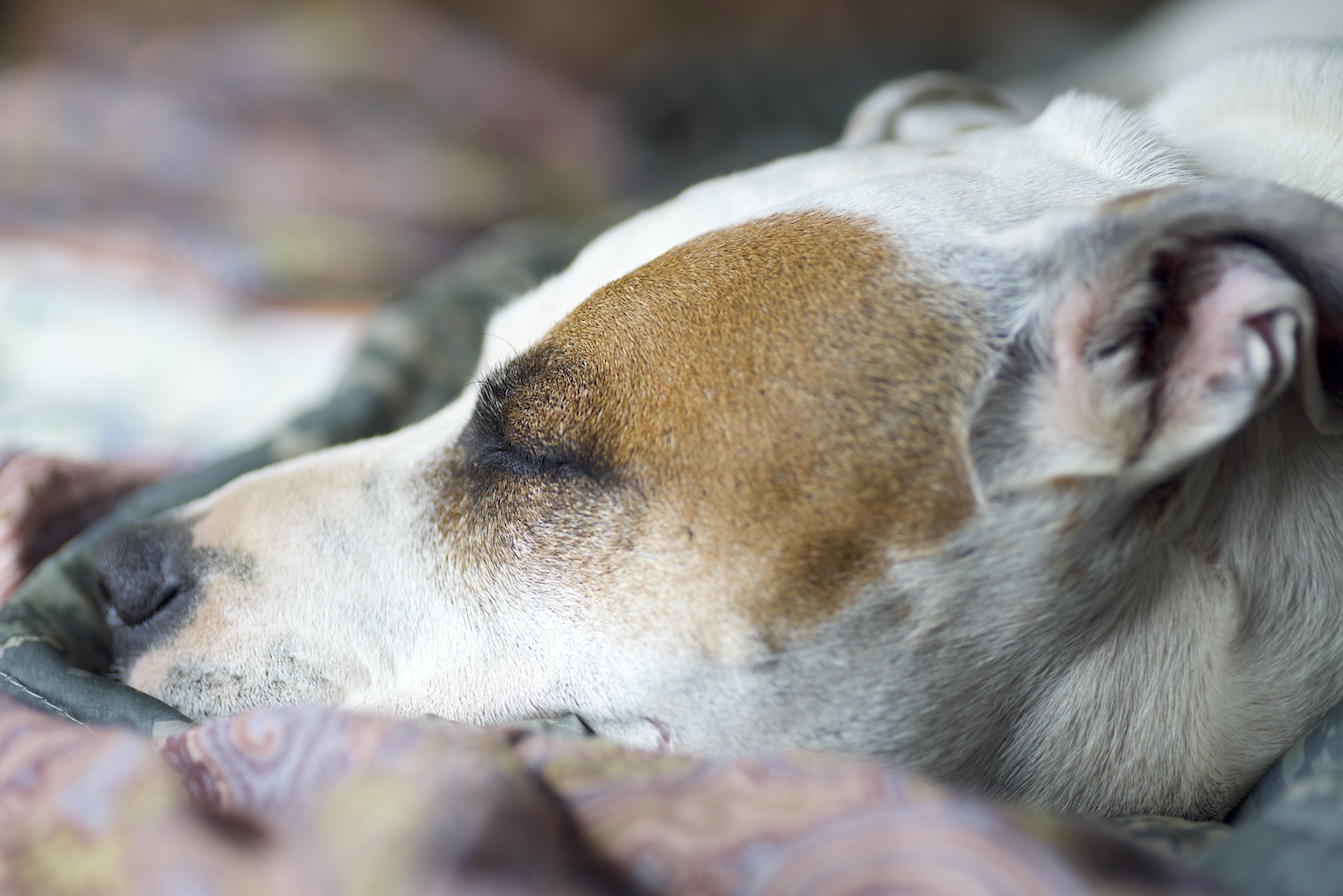
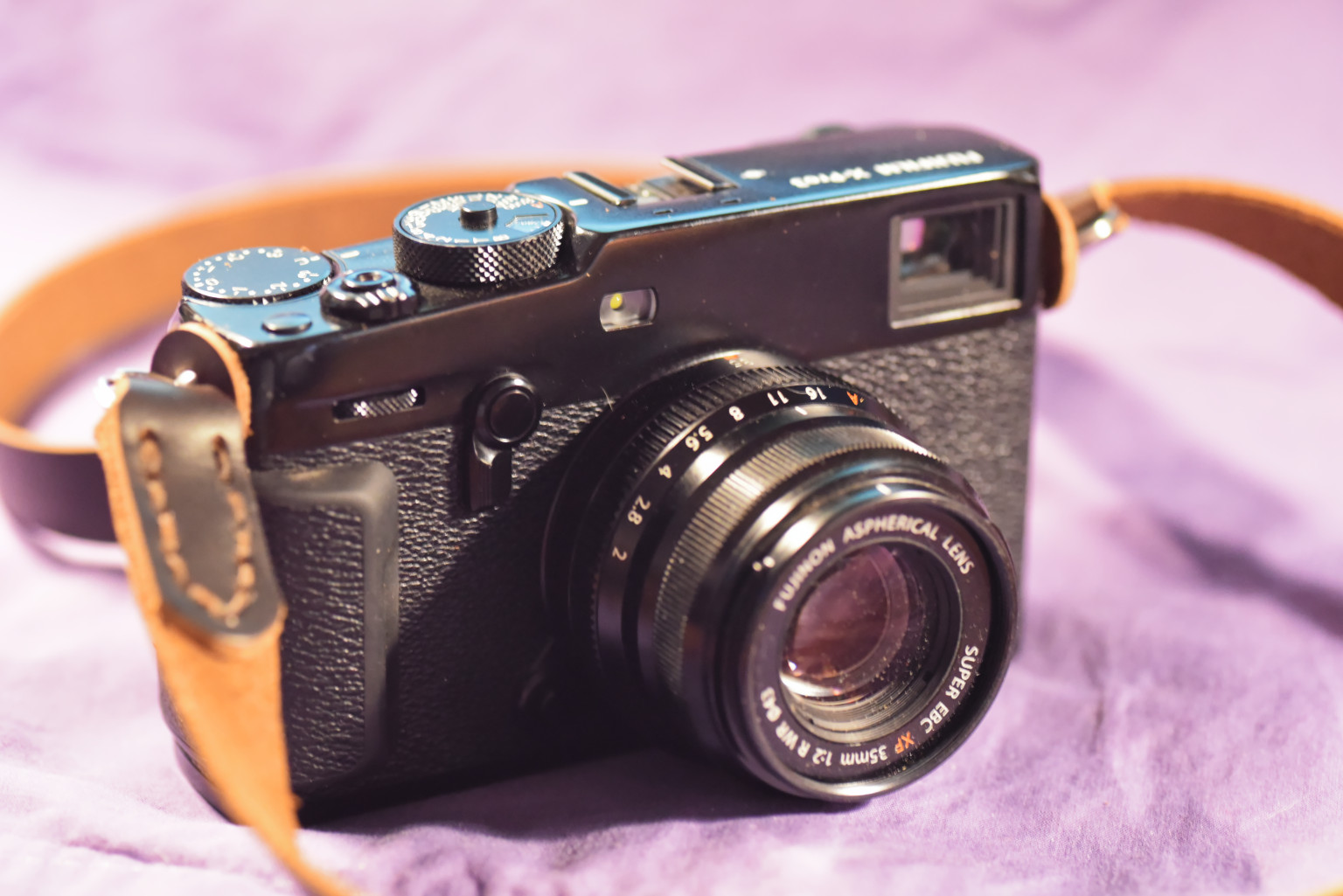
I rented a Fujifilm X-Pro3 to play with. There is quite a lot of hubbub over the X-Pro Fujifilm cameras, mostly because of the hybrid optical viewfinder. So, I decided to find out what it is all about. Captured with NIKON D750, 2026-01-23 16:38:45, Vivitar Series 1 90mm macro, 1/15sec, f/5.6, ISO-6400, SOOC.

A few weeks ago (months?), my buddy was busting my chops a bit about my Fujifilm X100vi. He was giving me a hard time because I usually use an interchangeable lens camera and the X100 series is decidedly a fixed-lens camera. That is, it is not a system camera but “an expensive point-and-shoot.”

My argument is that sometimes I do not want to take a system with me; I want a camera at hand though. I do not want my camera work to be fiddly, though.

By fiddly, I mean that I do not want to have to make decisions about what lens to use in the field. I want to have a purpose-built machine (a camera and lens) that is more than my phone.

Aside: I decided the last couple-three years that I think computational photography is cool, but it has some limits as implemented in current mobile phone technology. Furthermore, I want to use my mobile phone less and I want a simpler (less expensive) mobile phone as well because I do not want to spend all of my time looking at my phone.

His pushback was that I could simply fit a prime lens to my (very nice) Fujifilm X-T5 and carry that. There is truth in that. But, I really like my X100vi. It has an elegance in its simplicity that is different from the other system cameras in Fujifilm’s stable. It has a bit of that classic rangefinder look that all the kids chase (and that made the X100v nearly impossible to buy because they were always out of stock).

The conversation made me think a little about my [ahem] rationalization to justify ownership of a X100vi. On my last roadtrip, I elected to take the X-T5 and a small kit along. I chose the Fujinon 18-55mm, f/2.8-4 kit zoom, the Fujinon 70-300mm zoom (in case I needed a telephoto lens), and the Fujinon 35mm f/1.4 (original standard prime). I found the kit zoom to be the lens I used most on that trip. It gave me a nice range of focal lengths that work in a lot of (most?) circumstances, is relatively small and light, and is optically better than almost all other kit lenses. (The exception likely being the classic nifty-fifties that came on film bodies.)

I was able to get some subject/background separation with the kit zoom, particularly at the long end of the zoom range. I had a fast standard lens in the kit if I wanted more. (I did use it a little, but consciously chose to stick with the zoom most of the time.)

All of this, spare batteries, and spare SD cards all fit into the Fujifilm/Domke collaboration messenger bag that I have in my inventory. There was even a little room for my computer glasses, my Kindle (in the back slash pocket), and a Clif bar (emergency ration). I could swap out the glasses/Kindle for a small water bottle if I wanted.

That made for the lightest, most powerful kit I have constructed to date. In retrospect, I did wish I had the Fujinon 60mm f/2.4 macro with me. There were a few times that the close-focusing capability of that lens and the slightly larger maximum aperture would have been used. But, I learned.

That brings me back to the Fujifilm X-Pro3 that is in a small kit. It is a rental camera. I checked the shutter count and it has 15K actuations according to Exiftool. It was made in 2021, also according to Exiftool. I rented it as an experiment and I really like the camera.

It is similar to the X100vi and probably more similar to the X100v that preceded my X100vi. I think that the underlying sensor technology and processor are the same as the X100v. The viewfinder is slightly different because The X-Pro3 has to accommodate the interchangeable lenses. In the hybrid OVF, the frame lines change with the focal length of the lens. It is usable from pretty wide (18mm is the widest I have used to date) through 50mm. With a press of a small lever, I can switch to the EVF, which uses the sensor instead of the optical viewfinder and use lenses outside the effective range of the OVF for composition.

I also love the sound of the mechanical shutter in the X-Pro3. It has the same solid thunk of my original Fujifilm camera, the X-T1.

Would it replace my X100vi? No, I think not. It is last-generation technology and the primary reason I bought the X100vi is to have a simple, rangefinder-style camera *with* the fifth-generation IBIS. I really do not care about pixel count (there was a significant bump in that specification) as much as the image stabilization.

I could have a similar experience and aesthetic with a silver/chrome X-Pro3 and one of Fujifilm’s small primes (what I call the f/2 line). But again, none of those lenses have OIS. It adds bulk (and cost). However, I would give up the IBIS that I find useful in some of my shooting situations.

There are rumors that Fujifilm is preparing to release an updated X-Pro camera this year. It will have either the fifth generation X-Trans sensor (and IBIS) or there will be a sixth generation system released.

That is my analysis of how an X-Pro Series camera could fit into what I do with photography. One could supplant the X100vi if, and only if, the next generation adds IBIS. That will probably make the X-Pro camera slightly larger (to accommodate the mechanism), which is not a deal killer. I like the hybrid OVF. It works. The X-Pro also has an EVF with the press of a lever for focal lengths that do not work with the OVF. It has that classic rangefinder look that I have come to like.

I will continue to enjoy my X-Pro3 rental. I will have a it a few more days. I remain on the fence about whether or not I will keep it.

The Girl and I will hike with it again today. I am looking forward to that. I remain grateful on a daily basis. Life is good.

Remainders: 07 December 2024

The Mexican Ditch and Trail, shot with the Sony A7iii and the Vivitar Series 1 90mm f/2.5 macro, at f/8. Post processing with PhotoLab to clean up the image.

It is the first day of the week, Sunday 24 November 2024 and I am beginning this week’s (ha!) list of remainders.

  • MrLeica is a YT content creator and blogger who treats Leica cameras and glass, among other things.
  • Andrews Leatherworks makes some fine looking holsters.
  • After a couple of decades of being afraid to eat ham and bean soup (DiL… “Oooh, that’s bad, Dad!”), I found this recipe. I am going to try the the trick of using canned navy beans and washing them before making my soup to see if I can avoid a disaster (so to speak).
  • As part of their holiday sales event, Simpleshot (makers/purveyors of slingshots) did something I really do not care for — they shared my contact information with other small business in the outdoors market. I forgive them; it is easy enough to unsubscribe. One of the new vendors is Wazoo Gear. It made me chuckle when I free-associated “out the wazoo!”. Their offerings look OK to me. Simpleshot is recommended too.
  • Apple Music and its predecessor, iTunes, continues to lose the album art for my music collection. I have thought for a while now that I might want to disengage from the music connection to Apple. This list of music players might be an option.
  • Here is another set of iTunes alternatives. I think there might be a full entry on my love/hate relationship with iTunes and Apple Music.

Test Shot Vivitar Series 1 90mm f/2.5 Macro

The Silver Saddle Ranch compound, viewed from the south of the horse-working paddock. Shot with Sony A7iii and a Vivitar Series 1 90mm f/2.5 macro lens at f/8. Post processed with PhotoLab for black and white conversion and some cleanup.

The Girl and I got out Sunday for our daily walk. With the change in weather, we are walking Silver Saddle Ranch once again. The risk of snakes is abated but there remains a risk of other critters. I sometimes see a large coyote and there was a report of a mountain lion working a sheep ranch nearby.

I am reminded that life is inherently risky. The risk can be mitigated to some extent, but none of us get out alive. There is no such thing as safe. But, I digress.

I found a Vivitar Series 1 90mm f/2.5 macro lens in my inventory. (I actually found a second sample and I have no idea how I got two. They were purchased long ago.) I carried it mounted to the Sony A7iii Saturday and Sunday and came away with a couple frames that are OK, by my estimation.

We had a great walk, except that Goofus, AKA The Girl, had too much energy and ran too hard. She limped around the house Sunday evening and Monday morning. So, I am going to have to mitigate that to some extent. With the coyote I saw yesterday and the mountain lion report, I need to keep her closer in anyway. She can still range out a bit, just not more than a few tens of feet.

The lens is quite good, especially given its age. It is plenty sharp, focuses quite close (and I have the extension that will let it focus to 1:1) without the extension, and the rendering is good. It was built by Tokina. Those lenses built by the Komine and Tokina companies were generally of higher quality than the run of the mill Vivitar glass.

The reputation of the Vivitar is that it produces a very nice background blur (bokeh) and renders an image well. It is useful for general photography when the focal length is appropriate.

So I made a few images as we walked. It is my way of rebuilding after focusing on problem solving. I give my mind a break from the analytical work and feed my soul.

When we came around to the northbound part of our trail, I noticed the scene of the ranch compound. The wave cloud over Mt. McLellan added to the scene. It also begged to be in black and white, at least to me. I made the capture, while The Girl waited impatiently for me.

Because of the traffic, I put her on lead until we passed the compound. When I saw the way was clear, I released her from the lead but kept her close anyway.

As we approached the rig and the end of our outing, the Sun popped out from behind the clouds. I paused to make an image of the entry sign. I am working on a Silver Saddle Ranch gallery and the sign will make a nice theme photo.

When I reviewed the image, I noticed some chromatic aberration along the hard lines of the top of the stone. It is not prominent, but it is there. This is not unusual for vintage glass and is easy to correct in post processing. It also diminishes with an increase in f-number.

It was a good walk. Even with the overcast and cooler weather, I returned home refreshed. The Girl came home tired, and a tired dog is a happy dog.

Life is good. I am grateful.

Silver Saddle Ranch

I love walking the Silver Saddle Ranch open space area. It’s jointly managed by Carson City and BLM.

Since nearly being carried away by mosquitoes at the Riverview Park, The Girl and I have spent our morning walks to the south, along the Carson River on the Silver Saddle Ranch open space area. The ranch is still a working ranch with cattle and hay fields. I often meet the ranch manager while walking as he tends the irrigation system.

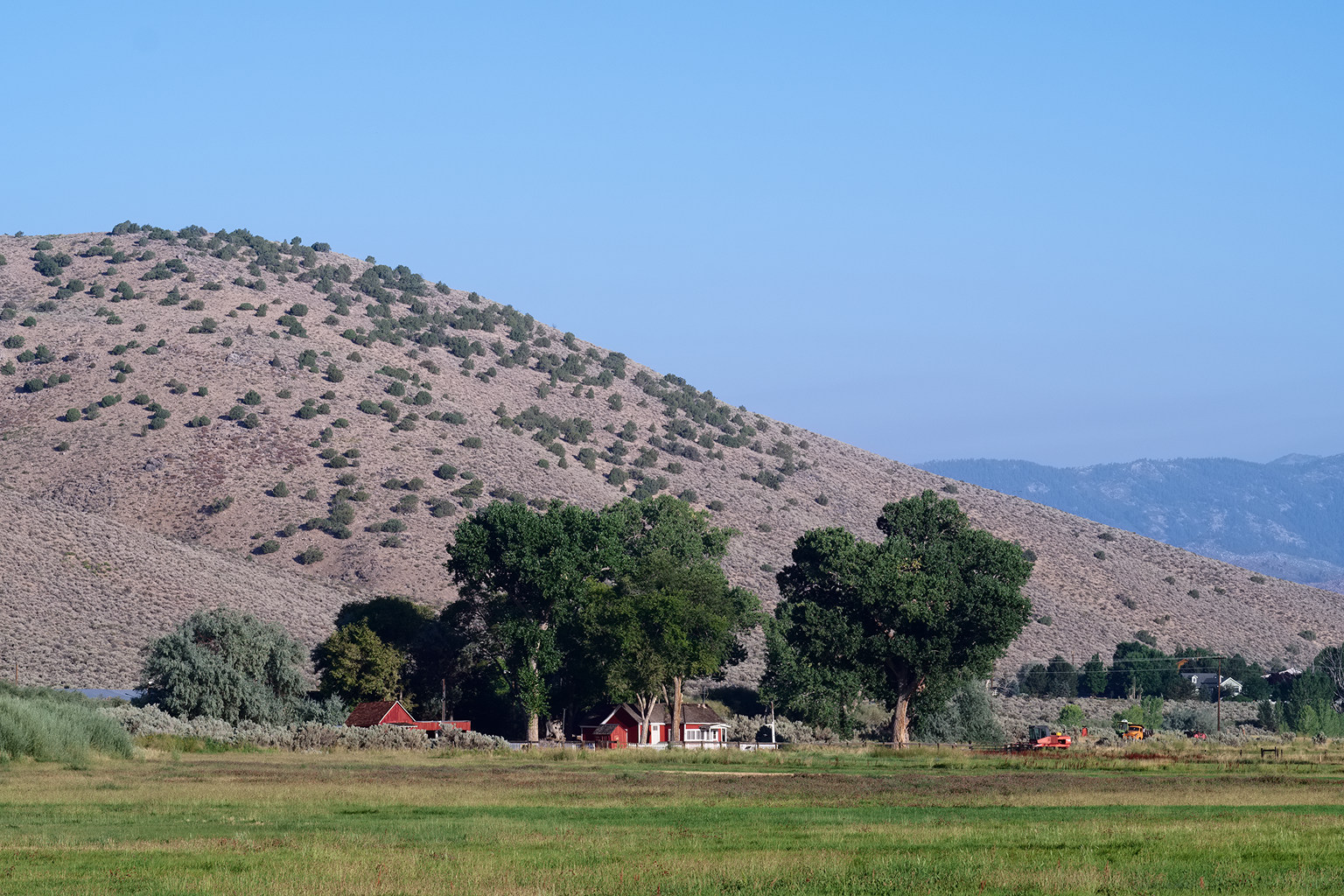
The capture is my morning view of the ranch compound. At one time this was a bustling ranch with a number of ranch hands all working from this area. It is nothing of what it once was, but remains a reminder of Nevada heritage. I am thankful that it is maintained as a place where I can spend time outdoors with The Girl.

It is also a place where I see many wild animals. There are mostly birds (and I do enjoy the raptors), but we see other species as well.

I shot this image with the Fujifilm X-H1 and the marvelous Vivitar Series 1 90mm f/2.5 macro lens that was built by Tokina, otherwise knows as the “Bokina.”

Vivitar Series 1 90mm f/2.5 Macro

The Girl is often my model, being the girl I have handy and being good-looking.

After months of hunting and waiting on the-bay, I finally bought a Vivitar Series 1 90mm f/2.5 macro lens — the Tokina build. This lens is called the “Bokina” for obvious reasons. Something spectacular happened in the optical design that resulted in very smooth out of focus backgrounds. Hence derives its nickname.

I bought mine in Nikon mount, which means it will work on all of my Nikons, be it a film or digital camera. I am going to enjoy working with this lens. It is a classic by numerous standards.